
- Quick Answer
- What Happens If Police Find a Weapon During a Traffic Stop?
- What Happens After Police Find a Weapon During a Traffic Stop?
- Traffic Stop Weapon Risk Factors in Illinois
- Different Weapons Create Different Legal Issues in Illinois
- What Not To Say If Police Find a Weapon During a Traffic Stop
- Can Police Search Your Car After Finding a Weapon?
- What If the Weapon Was Not Yours?
- Why a Legal Weapon Can Still Create Problems During a Traffic Stop
- If the Weapon Is Legal and Permitted
- Duty to Inform During a Traffic Stop
- Securing the Weapon
- Return of Firearm
- If the Weapon Is Unlawful or Improperly Transported
- No Valid FOID or CCL
- Aggravating Factors
- Weapon Seizure
- Common Defenses and Legal Nuances
- Unlawful Search and Seizure
- Constructive Possession
- Procedural Protections
- What To Do After Police Find a Weapon During a Traffic Stop
- Final Thoughts
- Protect Yourself After a Traffic Stop Weapons Charge
- Related Articles
- Common Questions About Weapons Found During Illinois Traffic Stops
- Can police take a weapon during a traffic stop in Illinois?
- Can I be charged if the weapon in the car was not mine?
- Can police search my car just because they stopped me?
- Should I tell police the weapon is for self-defense?
- Can a legal weapon still lead to charges in Illinois?
- Can I be charged if the weapon was found in a borrowed car?
- Does police finding a weapon automatically mean I committed a crime?
- Can police charge me if a weapon is found in a shared vehicle?
- What happens if police find a weapon after an illegal search?
- Does having a FOID card prevent weapon charges?
- Can police search my car after finding a weapon?
- Can a weapons charge be dismissed after an illegal search?
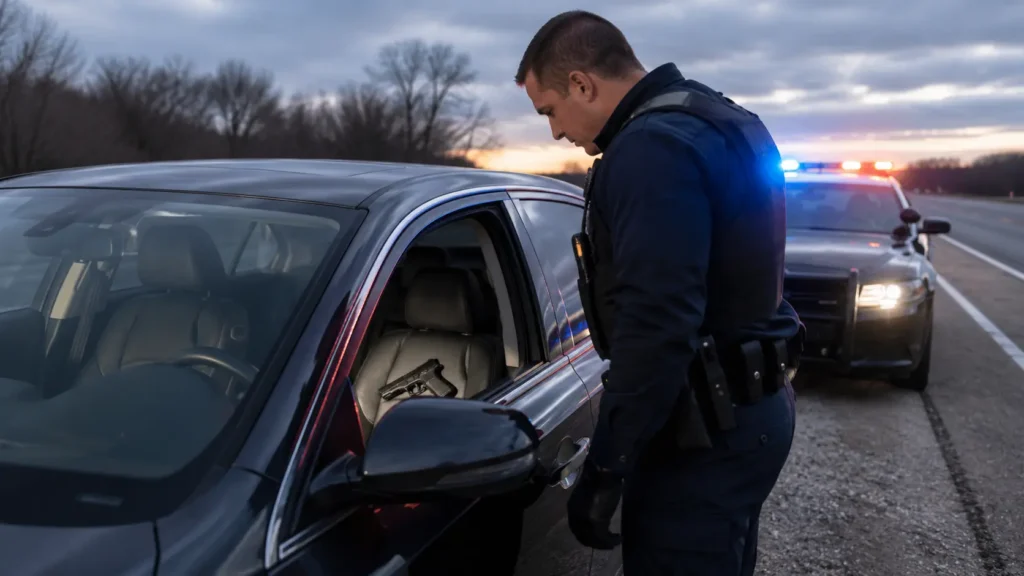
A weapon found during a traffic stop in Illinois can quickly turn a routine stop into a criminal investigation. Police may secure the weapon, question the driver or passengers, review FOID or concealed carry status, and decide whether the item was lawfully possessed, transported, or accessible.
The outcome depends on the weapon type, where it was found, whether the search was lawful, whether the person had required legal authority, and whether police believe the weapon was connected to another offense. Before explaining ownership, intent, or self-defense, speak with a criminal defense attorney.
Quick Answer
If police find a weapon during an Illinois traffic stop, they may secure the weapon, investigate possession, check FOID or concealed carry status, and determine whether charges are appropriate. A weapon discovery does not automatically prove a crime. The outcome depends on where the weapon was found, who controlled the area, whether the search was lawful, and whether possession was legal.
What Happens If Police Find a Weapon During a Traffic Stop?
If police find a weapon during a traffic stop, the officer may first secure the weapon for safety. That does not always mean the driver or passenger will be arrested, but it usually leads to more questions about ownership, license status, location, access, and how the weapon was stored. A criminal defense attorney can review the traffic stop, search, police report, body camera footage, and possession evidence before you make statements about the weapon.
Police may check whether the person has a valid FOID card or concealed carry license, whether the weapon was loaded or accessible, whether the item is prohibited, and whether the stop or vehicle search was lawful. If police believe the weapon was unlawfully possessed or transported, the stop may lead to weapons charges. For a broader overview of restricted items, review this guide to Illinois weapons charges and what you cannot carry or possess.
The defense may focus on whether the traffic stop was valid, whether the vehicle search was legal, whether the person knew the weapon was there, and whether prosecutors can prove actual or constructive possession.
What Happens After Police Find a Weapon During a Traffic Stop?
| Step | What Happens |
|---|---|
| Weapon Discovery | Police secure the weapon and determine whether additional investigation is needed. |
| Possession Review | Officers examine ownership, location, accessibility, and control. |
| License Check | Police may review FOID, concealed carry status, and legal requirements. |
| Evidence Review | The defense may examine the stop, search, reports, and video evidence. |
| Case Decision | The matter may result in release, seizure, charges, or further investigation. |
Traffic Stop Weapon Risk Factors in Illinois
When police find a weapon during a traffic stop, the outcome depends on more than the weapon itself. Police and prosecutors may review where the item was found, whether it was accessible, whether the person had required legal authority, and whether the search was lawful.
| Risk Factor | Why It Matters | Possible Defense Issue |
|---|---|---|
| Type of weapon | Different weapons are treated differently under Illinois law. | The defense may challenge whether the item was actually prohibited. |
| Where the weapon was found | Location affects knowledge, access, and possession arguments. | The defense may argue lack of control or knowledge. |
| Accessibility | Accessible weapons may receive additional scrutiny. | The defense may challenge actual possession. |
| FOID or concealed carry status | Licensing requirements may affect legality. | The defense may review whether legal requirements applied. |
| Search legality | Police need lawful authority to search. | Evidence may be challenged if the search was unlawful. |
If the weapon was a Taser or stun gun, this guide explains what happens when a Taser or stun gun is found during an Illinois traffic stop.
Different Weapons Create Different Legal Issues in Illinois
| Weapon Type | Main Legal Concern |
|---|---|
| Firearm | FOID status, concealed carry license, transportation, and accessibility. |
| Taser or stun gun | Possession rules, licensing issues, and where the device was found. |
| Knife | Blade type, location, intent, and prohibited areas. |
| Brass knuckles or prohibited weapons | Whether the item is restricted under Illinois weapons laws. |
What Not To Say If Police Find a Weapon During a Traffic Stop
Do not guess, explain, or make detailed statements about the weapon without legal advice. Comments about ownership, self-defense, protection, where the item came from, or why it was in the vehicle may appear in the police report and later be used in court.
Stay respectful, keep your hands visible, avoid arguing on the roadside, and do not physically resist. If officers ask about the weapon or the search, you can ask to speak with an attorney before answering detailed questions.
Can Police Search Your Car After Finding a Weapon?
Police cannot search every vehicle just because they made a traffic stop. A traffic violation may justify the stop, but officers usually need a separate legal reason to search the car, such as probable cause, consent, evidence in plain view, a lawful arrest, or an inventory search after towing.
If police found a weapon after searching your vehicle, the legality of the search may become one of the most important defense issues. A criminal defense attorney can review what the officer saw, what was said, whether consent was given, and whether the search followed Illinois and constitutional rules. If the item was a knife, the legal issue may depend on the blade type, intent, and location, so review this guide to Illinois knife laws.
For more detail on vehicle searches, read this guide on when police can search your car during a traffic stop in Illinois.
What If the Weapon Was Not Yours?
A weapon found in a car does not automatically prove that every person in the vehicle knowingly possessed it. Police and prosecutors may look at who owned the vehicle, where the weapon was located, who had access to it, whether anyone made statements, and whether there is evidence connecting the weapon to a specific person.
This issue matters in borrowed cars, shared vehicles, rides with passengers, family vehicles, and cases where the weapon was found in a bag, console, glove box, or under a seat. The defense may focus on lack of knowledge, lack of control, or an unlawful search.
If the item involved brass knuckles, read more about what happens when brass knuckles are found in a car in Illinois.
Why a Legal Weapon Can Still Create Problems During a Traffic Stop
Even if a weapon is legal to own, the way it is carried, stored, transported, or accessed during a traffic stop can still create legal issues. Location, concealment, licensing, prohibited places, prior record, and statements to police may all affect the case.
This is why drivers should not assume that legal ownership ends the issue. A defense attorney can review whether the item was lawful, whether it was transported correctly, and whether police had a valid basis to seize it or make an arrest.
For a broader overview of restricted items, review this guide to Illinois weapons charges and what you cannot carry or possess.
When multiple people have access to a vehicle, possession becomes an important issue. Understanding constructive possession can help explain why ownership alone does not always determine a weapons charge.
For legal help after a weapons charge, visit the criminal defense attorney in Springfield, IL page.
If the Weapon Is Legal and Permitted
Not every weapon found during a traffic stop leads to a criminal charge. Illinois allows lawful firearm possession and transportation when the person follows the rules.
For Illinois residents, firearm possession generally requires a valid Firearm Owner’s Identification card or an Illinois Concealed Carry License. A FOID card allows possession, but it is not the same as a concealed carry license. Illinois State Police guidance also states that a firearm transported in a vehicle must be broken down, not immediately accessible, unloaded and enclosed in a case, or carried under the Illinois Concealed Carry Act by someone with a valid Illinois Concealed Carry License.
If the person is properly licensed and the firearm is handled legally, police may still ask questions and secure the firearm during the stop.
Duty to Inform During a Traffic Stop
Illinois has a duty to inform rule when an officer asks.
If an officer initiates an investigative stop, including a traffic stop, and asks whether the person has a concealed firearm, the person must disclose possession or present the concealed carry license upon request. The person must also identify the location of the firearm and allow the officer to safely secure it during the stop if requested. Passengers with a concealed firearm must follow the same requirement.
This means a lawful gun owner should stay calm, keep hands visible, avoid reaching for the weapon, and follow clear instructions.
Securing the Weapon
Police may secure a firearm during a traffic stop if they believe it is necessary for safety. This does not always mean the person is being arrested.
An officer may temporarily take control of the firearm, move it away from the driver or passengers, or direct the person to keep it secured while the stop continues. The purpose is officer safety and scene control.
The key point is this: do not reach for the weapon unless the officer clearly instructs you to do so. A normal traffic stop gets chaotic fast when hands move toward a gun. That is the legal version of touching a hot stove.
Return of Firearm
If the person is legally allowed to possess the firearm, is not a threat, and is physically and mentally capable of possessing it, Illinois law says the firearm should be returned before the officer releases the person from the scene and ends contact.
The firearm may not be returned if police believe it is evidence, the weapon is illegal, the person is prohibited from possessing it, or the stop leads to an arrest.
If the Weapon Is Unlawful or Improperly Transported
The situation changes if the firearm is not lawfully possessed or transported.
Police may arrest someone if they believe the person has:
- No valid FOID card or Illinois Concealed Carry License
- A loaded and accessible firearm without proper authority
- A firearm stored in a way that violates Illinois transport rules
- A stolen firearm
- A defaced firearm
- A prohibited weapon
- A firearm connected to another crime
- A weapon in a prohibited location
Improper transport is a common issue. A person may believe they are “bringing the gun from one place to another,” but Illinois law focuses on how the firearm is stored, whether it is accessible, whether it is loaded, and whether the person has the proper license.
Weapon cases can involve different charges depending on possession, transportation, licensing, and the type of weapon involved. Review more about Illinois weapons charges and prohibited weapons .
No Valid FOID or CCL
A missing FOID card or concealed carry license can turn the stop into a weapons case.
For Illinois residents, possession of firearms or ammunition usually requires a FOID card or Illinois Concealed Carry License. A FOID card alone does not authorize concealed carry. A concealed carry license is required to carry a concealed firearm in Illinois.
If the firearm is loaded, accessible, or concealed without the proper license, prosecutors may look at charges such as unlawful use of a weapon or aggravated unlawful use of a weapon.
Aggravating Factors
A weapon found during a traffic stop becomes more serious when aggravating factors are present.
Common aggravating factors include:
- The weapon was loaded
- The weapon was within reach
- The person had no FOID or CCL
- The person had a prior felony conviction
- The weapon was stolen
- The serial number was removed or altered
- Drugs were also found
- The stop involved suspected DUI
- The weapon was connected to a threat, assault, or domestic violence allegation
- The weapon was found near a school, courthouse, or other sensitive location
These facts affect charging decisions, bond or pretrial release arguments, plea negotiations, and sentencing exposure.
Weapon Seizure
Police may seize the weapon if they believe it is illegal, improperly possessed, evidence of a crime, or needed for safety reasons.
A seizure does not automatically mean the case is strong. The defense may challenge how police found the weapon, whether the search was lawful, whether the person knew about the weapon, and whether the person had actual control over it.
This matters because many traffic stop weapon cases are built on fast decisions made on the roadside.
Common Defenses and Legal Nuances
A weapons charge after a traffic stop does not always mean the prosecution has a clean case.
The facts matter. The body camera footage matters. The reason for the stop matters. The search matters. Who owned the vehicle matters. Where the weapon was found matters.
A criminal defense attorney in Springfield can review whether police followed proper procedures and whether the evidence can be challenged.
Unlawful Search and Seizure
Police need a lawful basis to stop a vehicle. They also need a lawful reason to search it.
A defense attorney may review whether:
- The original traffic stop was valid
- Police extended the stop without legal justification
- The officer had probable cause to search the vehicle
- The driver gave valid consent
- The search went beyond the legal scope
- Police relied on an unlawful detention
- The weapon was found after a rights violation
If the search was unlawful, the defense may ask the court to suppress the weapon. If the weapon gets suppressed, the prosecution may lose the core evidence in the case.
Constructive Possession
Constructive possession is one of the biggest issues in vehicle weapon cases.
Police may find a weapon in a glove box, under a seat, in the center console, in a bag, or in the back seat. That does not automatically prove every person in the car possessed it.
To prove possession, prosecutors usually need evidence that the person knew the weapon was there and had control over it. This becomes more complicated when:
- Multiple people were in the vehicle
- The car belonged to someone else
- The weapon was hidden
- The weapon was found near a passenger
- No fingerprints or DNA connect the person to the weapon
- The person made no admission
- The weapon was inside another person’s bag or container
Constructive possession cases often turn on small facts. One detail may shift the case from serious risk to defensible.
Procedural Protections
Anyone facing a weapons charge after a traffic stop has legal protections.
These include the right to remain silent, the right to an attorney, the right to challenge the stop, the right to challenge the search, the right to review police reports and body camera footage, and the right to hold the State to its burden of proof.
Do not try to explain your way out of a weapons charge on the side of the road. Statements made during a traffic stop may become evidence later. Stay respectful, provide required identification and license information, and ask for a lawyer before answering detailed questions about ownership, possession, or intent.
What To Do After Police Find a Weapon During a Traffic Stop
If police found a weapon during your traffic stop in Illinois, take the case seriously right away.
You should:
- Write down what happened before your memory fades
- Note why police said they stopped the vehicle
- Save any ticket, citation, receipt, or property inventory
- Identify who was in the vehicle
- Avoid discussing the case by text or social media
- Contact a criminal defense attorney before court
Early review matters because traffic stop cases often depend on video footage, officer conduct, search authority, and whether the State can prove possession.
If the traffic stop resulted in an arrest, understanding your next steps is important. Learn more about what happens after a first arrest in Illinois .
Final Thoughts
A weapon found during a traffic stop in Illinois does not always lead to a conviction. If the weapon is legal, properly transported, and the person has the right FOID or CCL status, the stop may end without charges.
But if police believe the weapon was unlawful, improperly transported, or connected to another offense, the case can move fast. This is when speaking with a criminal defense attorney becomes important.
The strongest defense starts with the details: why the stop happened, how the search happened, where the weapon was found, who had access to it, and whether police followed the law.
A criminal defense attorney can review the traffic stop, challenge unlawful search and seizure issues, examine constructive possession claims, and protect your rights in court. The bottom line is that a weapon found during a traffic stop can create serious legal risk, especially when police also allege other offenses such as drug possession or unlawful possession of contraband.
CDL helps people facing Illinois weapons charges work with an experienced criminal defense attorney, understand their rights, challenge weak evidence, and protect their future after a traffic stop turns into a criminal case.
Protect Yourself After a Traffic Stop Weapons Charge
A weapon found during a traffic stop does not automatically prove unlawful possession. Search legality, ownership, accessibility, licensing, and statements made during the stop can affect your case.
Andrew Affrunti can review the traffic stop, evidence, and possible defenses available in Springfield and Sangamon County.
Contact the OfficeRelated Articles
- Are Tasers and Stun Guns Legal in Illinois?
- Are Brass Knuckles Illegal in Illinois?
- Can Police Search Your Phone Without a Warrant in Illinois?
- Can Police Search Your Car During a Traffic Stop in Illinois?
Common Questions About Weapons Found During Illinois Traffic Stops
Can police take a weapon during a traffic stop in Illinois?
Police may temporarily secure a weapon during a traffic stop for safety. Whether the weapon is returned, seized, or used as evidence depends on the facts, the type of weapon, and whether possession was lawful.
Can I be charged if the weapon in the car was not mine?
Possibly, but the State must usually prove knowledge and control. A weapon found in a shared or borrowed vehicle does not automatically prove that every person in the car knowingly possessed it.
Can police search my car just because they stopped me?
No. A traffic stop alone does not automatically allow a full vehicle search. Police generally need a separate legal reason, such as probable cause, consent, evidence in plain view, a lawful arrest, or an inventory search.
Should I tell police the weapon is for self-defense?
You should avoid making detailed statements without legal advice. Saying the weapon was for self-defense may still be used as evidence that you knowingly possessed or intended to carry it.
Can a legal weapon still lead to charges in Illinois?
Yes. A weapon that is legal to own can still create problems if it is carried, stored, transported, concealed, or possessed in a way that violates Illinois law.
Can I be charged if the weapon was found in a borrowed car?
Possibly. Vehicle ownership alone does not determine possession. Prosecutors may look at who knew about the weapon, who controlled the area where it was found, and whether evidence connects the person to the item.
Does police finding a weapon automatically mean I committed a crime?
No. Finding a weapon does not automatically prove unlawful possession. The State must still prove the required legal elements, including possession, knowledge, and any licensing or transportation violations.
Can police charge me if a weapon is found in a shared vehicle?
Possibly. Prosecutors generally must connect the person to possession, knowledge, or control of the weapon. The location of the weapon and access to the area may affect the case.
What happens if police find a weapon after an illegal search?
If police obtained the weapon through an unlawful search, the defense may challenge whether the evidence should be used in court.
Does having a FOID card prevent weapon charges?
Not always. FOID status is only one factor. The weapon type, transportation method, location, and circumstances may still create legal issues.
Can police search my car after finding a weapon?
Finding a weapon does not automatically allow police to search the entire vehicle. Officers generally need a separate legal basis, such as consent, probable cause, plain view, or another recognized exception.
Can a weapons charge be dismissed after an illegal search?
If police obtained the weapon through an unlawful search, the defense may challenge whether the evidence should be used in court.