
- Quick Answer
- Are Brass Knuckles Illegal in Illinois?
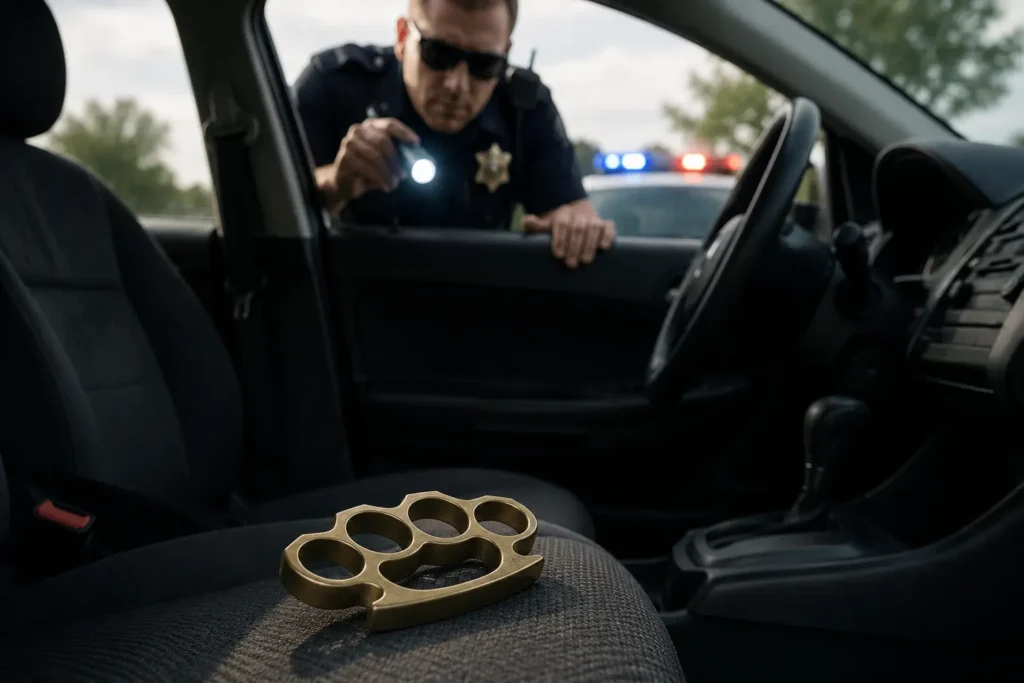
- What Happens If Police Find Brass Knuckles in Your Car?
- Where Brass Knuckles Were Found in the Car Matters
- What Is Constructive Possession in a Brass Knuckles Car Case?
- Who Can Be Charged When Brass Knuckles Are Found in a Vehicle?
- Can Police Search Your Car for Brass Knuckles During a Traffic Stop?
- Can a Brass Knuckles Charge Become More Serious?
- Possible Defense Options in a Brass Knuckles Case
- What Should You Do After Brass Knuckles Are Found in Your Car?
- Brass Knuckles Penalties in Illinois
- What Police Look For When Brass Knuckles Are Found
- Were Brass Knuckles Found in Your Car?
- Related Weapons and Traffic Stop Resources
- Frequently Asked Questions
- Are brass knuckles illegal to possess in Illinois?
- What happens if police find brass knuckles in my car?
- Is basic brass-knuckles possession a felony in Illinois?
- What if the brass knuckles belonged to my passenger?
- What if I did not know brass knuckles were inside the car?
- Can police search my entire car after seeing brass knuckles?
- Can brass knuckles be suppressed if police searched my car illegally?
- Can I be charged with brass knuckles possession if the vehicle is not mine?
- Can a brass knuckles charge affect my criminal record?
- Can a lawyer challenge evidence found during a brass knuckles search?
Quick Answer
If police find brass knuckles in your car in Illinois, the case may depend on whether prosecutors can prove you knowingly possessed or controlled the weapon. The legality of the traffic stop and vehicle search, where the item was found, and who had access to the vehicle may affect the outcome.
Are Brass Knuckles Illegal in Illinois?
Yes. Illinois law prohibits a person from knowingly selling, manufacturing, purchasing, possessing, or carrying metal knuckles or another knuckle weapon regardless of what material the weapon is made from.
That means prosecutors do not necessarily need to prove that the knuckles were used in a fight. The central issue in a possession case may instead be whether the accused knowingly possessed or controlled the prohibited weapon.
When brass knuckles are discovered inside a vehicle, additional questions arise about who knew they were there, who controlled the area where they were found, and whether police lawfully discovered them.
Brass knuckles are only one type of prohibited weapon under Illinois law. Learn more about Illinois weapons charges and prohibited weapons .
What Happens If Police Find Brass Knuckles in Your Car?
Police may investigate who possessed the weapon, where it was located, whether the driver or a passenger knew about it, and why officers searched the vehicle.
Important issues may include:
- Who owned or regularly used the vehicle
- Where the brass knuckles were located
- Whether the item was visible or hidden
- Who had access to the area
- Whether anyone admitted ownership or knowledge
- Whether passengers were present
- Whether police had a lawful basis for the stop and search
Finding a prohibited weapon inside a vehicle does not answer every possession question by itself. The State still must prove the elements of the charge against the particular defendant. For the broader statewide rules, review whether brass knuckles are illegal in Illinois and how the weapons statute applies.
Where Brass Knuckles Were Found in the Car Matters
| Where Found | Why It May Matter | Defense Question |
|---|---|---|
| On the driver’s person | May support an allegation of direct possession. | Was the stop, frisk, or search lawful? |
| Driver’s door or seat area | May appear closely connected to the driver. | Who used the vehicle and who knew the item was there? |
| Center console | Several occupants may have access. | Does access alone establish knowing possession? |
| Glove box | Ownership and control of the vehicle may become important. | Who had access to the compartment? |
| Passenger’s bag or belongings | May point toward another occupant rather than the driver. | What evidence connects the driver to that property? |
| Trunk or hidden compartment | Immediate accessibility may be lower. | Can prosecutors prove knowledge of the item? |
| Borrowed or shared vehicle | Several people may have recently possessed or used the car. | Who placed the item there and when? |
What Is Constructive Possession in a Brass Knuckles Car Case?
When brass knuckles are not physically on a person’s body, prosecutors may rely on a constructive-possession theory.
The dispute may focus on whether the accused knew the weapon was present and exercised control over the place where it was found.
Important evidence may include:
- Vehicle ownership
- Who regularly drove the vehicle
- Passenger access
- Location of the weapon
- Whether it was visible or hidden
- Bags or property belonging to another occupant
- Statements made during the traffic stop
- Video evidence
- Fingerprint or other physical evidence when available
A driver is not automatically responsible for everything inside a borrowed or shared vehicle. Likewise, saying that the brass knuckles belonged to a passenger does not automatically end the case.
The evidence must be evaluated to determine whether prosecutors can connect the particular defendant to knowing possession of the prohibited weapon.
Who Can Be Charged When Brass Knuckles Are Found in a Vehicle?
| Situation | Possible Legal Issue |
|---|---|
| Brass knuckles found on the driver | Police may argue direct possession. |
| Brass knuckles found near the driver | Prosecutors may argue control or knowledge. |
| Brass knuckles found in passenger belongings | The State must connect the driver to knowing possession. |
| Brass knuckles found in shared areas | Access alone may not establish possession. |
| Brass knuckles found in a borrowed vehicle | Ownership and knowledge become important issues. |
Can Police Search Your Car for Brass Knuckles During a Traffic Stop?
A traffic stop does not automatically authorize police to search the entire vehicle.
Whether a vehicle search is lawful may depend on circumstances such as:
- Consent
- Probable cause
- A valid search warrant
- Evidence lawfully observed from a place officers are entitled to be
- A legally permissible arrest-related search
- A lawful inventory search after impoundment
- Another recognized search exception
If brass knuckles were discovered during a vehicle search, the defense should review why police entered the vehicle, which areas they searched, whether any consent was voluntary, how long the traffic stop lasted, and whether body-camera footage matches the written police report.
When a search violates constitutional requirements, a defendant may ask the court to suppress evidence obtained through the unlawful search. Suppression is not automatic and depends on the facts and applicable exception. For a detailed search analysis, review when police can search your car during an Illinois traffic stop.
Weapon-related traffic stops often involve questions about searches, evidence, and possession. Learn more about what happens when police find a weapon during an Illinois traffic stop .
Can a Brass Knuckles Charge Become More Serious?
Yes, but the legal basis for a more serious charge should be identified precisely.
Basic knowing possession of a prohibited knuckle weapon under 720 ILCS 5/24-1(a)(1) is generally a Class A misdemeanor.
Different or additional felony exposure may arise when another statute or aggravating circumstance applies. Examples can include possession by a person with a qualifying prior felony conviction, possession in certain statutorily protected locations, or conduct connected to a separate criminal offense.
Do not assume that the presence of drugs, another weapon, probation status, or another allegation automatically changes a brass-knuckles charge into a particular felony. The charging documents should identify the statute prosecutors are relying on.
Possible Defense Options in a Brass Knuckles Case
Possible defense options depend on the facts. A defense attorney may review whether the search was legal, whether police had probable cause, whether the item was actually a prohibited knuckle weapon, whether the state can prove knowing possession, and whether any statements were taken improperly.
Understanding your options after a weapons charge may be easier with guidance from a criminal defense attorney in Springfield who can review the evidence and possible defenses in your case.
In some cases, the strongest issue is not the object itself. The strongest issue may be how police found it, who had access to it, and whether prosecutors can prove the required elements of the charge.
| Defense Issue | What Should Be Reviewed |
|---|---|
| Lack of knowledge | Whether the accused actually knew the knuckle weapon was inside the vehicle. |
| Lack of possession or control | Whether another occupant owned or controlled the weapon or the area where it was discovered. |
| Unlawful traffic stop | Whether police had legal justification to stop or continue detaining the vehicle. |
| Unlawful vehicle search | Consent, probable cause, warrant scope, inventory procedures, and other claimed search authority. |
| Disputed statements | Body-camera footage, Miranda issues where applicable, and what the accused actually said. |
| Weapon classification | Whether the seized object actually falls within the statute’s prohibition on metal knuckles or another knuckle weapon. |
Search, possession, statements, and police evidence should be evaluated together when building a criminal defense strategy.
What Should You Do After Brass Knuckles Are Found in Your Car?
After the traffic stop:
- Keep the citation, release papers, tow paperwork, property inventory, and court notices.
- Write down why police said they stopped the vehicle.
- Record whether officers asked for consent to search.
- Note exactly where the brass knuckles were found.
- List every person who was inside or recently used the vehicle.
- Preserve dashboard-camera, phone, GPS, surveillance, and other relevant records.
- Do not guess about who owned the item or how it got there.
- Do not pressure a passenger or witness to change or provide a statement.
- Avoid discussing the case on social media.
- Review the charge and vehicle search before entering a plea.
You may state that you do not want to answer investigative questions without legal advice. Do not physically interfere with police or violate a court order.
If you are facing a weapons-related charge, a criminal defense attorney in Springfield can review the evidence, search issues, and possible defense strategies available in your case.
Brass Knuckles Penalties in Illinois
| Situation | Possible Classification | Important Point |
|---|---|---|
| Basic knowing possession under 24-1(a)(1) | Class A misdemeanor | The prosecution must prove the statutory possession offense. |
| Possession in certain locations covered by 24-1(c)(2) | Class 4 felony | The precise location and statutory requirements must be established. |
| Possession by a person with a prior felony conviction | Separate felony statute may apply | 720 ILCS 5/24-1.1 should be reviewed rather than assuming the ordinary misdemeanor simply becomes a felony. |
| Additional alleged criminal conduct | Separate charges may apply | Each alleged offense should be analyzed independently. |
What Police Look For When Brass Knuckles Are Found
Officers investigating a weapon found inside a vehicle may document:
- Where the item was found
- Its distance from the driver or passenger
- Whether it was visible or hidden
- Who owned or controlled the vehicle
- Which occupants had access to the area
- Whether anyone made statements about ownership or knowledge
- Why officers searched the vehicle
- Whether other evidence was discovered
- What dashboard or body-camera footage shows
These same facts may later become important when evaluating possession and the legality of the search. If officers discovered more than one type of weapon, review what happens when police find a weapon during an Illinois traffic stop.
Were Brass Knuckles Found in Your Car?
A brass-knuckles charge may depend on where the weapon was found, who had access to the vehicle, whether you knowingly possessed it, and whether police lawfully conducted the stop and search.
Andrew Affrunti can review the possession evidence, police reports, body-camera footage, and possible defense issues in Springfield and Sangamon County.
Schedule a Confidential ConsultationRelated Weapons and Traffic Stop Resources
- Are Brass Knuckles Illegal in Illinois?
- What Happens If Police Find a Weapon During a Traffic Stop in Illinois?
- Can Police Search Your Car During a Traffic Stop in Illinois?
- Criminal Defense Attorney in Springfield, IL
Frequently Asked Questions
Are brass knuckles illegal to possess in Illinois?
Yes. Illinois law prohibits knowingly possessing or carrying metal knuckles or another knuckle weapon regardless of its composition.
What happens if police find brass knuckles in my car?
Police may investigate whether you knowingly possessed the weapon. Important issues include where it was found, who controlled that area, who else used the vehicle, what statements were made, and whether the search was lawful.
Is basic brass-knuckles possession a felony in Illinois?
Basic possession under 720 ILCS 5/24-1(a)(1) is generally a Class A misdemeanor. Different statutes or circumstances, such as qualifying prior felony status or certain protected locations, may create felony exposure.
What if the brass knuckles belonged to my passenger?
Passenger ownership may be important, but it does not automatically resolve the case. Prosecutors must still establish the required connection between the accused and knowing possession of the weapon.
What if I did not know brass knuckles were inside the car?
Knowledge is an important part of the offense. A borrowed car, hidden item, shared vehicle, passenger belongings, or lack of statements connecting you to the weapon may be relevant to the possession analysis.
Can police search my entire car after seeing brass knuckles?
Not automatically. The permissible scope of a vehicle search depends on the legal basis officers rely on, such as probable cause, consent, a warrant, or another recognized exception.
Can brass knuckles be suppressed if police searched my car illegally?
A defense attorney may ask the court to suppress evidence obtained through an unlawful search. Whether the evidence is excluded depends on the facts and whether another lawful basis justified the search or seizure.
Can I be charged with brass knuckles possession if the vehicle is not mine?
Possibly. Vehicle ownership alone does not determine possession. Prosecutors must still prove that the accused knowingly possessed or controlled the prohibited weapon.
Can a brass knuckles charge affect my criminal record?
Yes. A conviction can create a criminal record and may affect employment, housing, professional opportunities, and future legal matters.
Can a lawyer challenge evidence found during a brass knuckles search?
Yes. A defense attorney may review whether police had legal justification to search the vehicle, whether consent was valid, and whether evidence was obtained in violation of constitutional protections.