
- Common Weapons That Can Lead to Charges in Illinois
- Illinois Weapons Restrictions at a Glance
- Common Mistakes That Can Lead to Illinois Weapons Charges
- Can You Face Weapons Charges Without Using the Weapon?
- Weapon Possession vs. Unlawful Use of a Weapon in Illinois
- Places Where Weapons Are Restricted in Illinois
- What Prosecutors Review in Illinois Weapons Cases
- Illinois FOID and Concealed Carry Requirements
- Transporting Weapons in Illinois
- Illinois Assault Weapon Restrictions and Criminal Risk
- Who Is Barred From Possessing Weapons in Illinois?
- Common Weapons Charges Filed in Illinois
- Penalties for Illinois Weapons Charges
- Defense Strategies for Illinois Weapons Charges
- When to Call a Criminal Defense Attorney After a Weapons Charge
- Charged With a Weapons Offense in Illinois?
- Related Articles
- Frequently Asked Questions About Illinois Weapons Charges
- What weapons are illegal to possess in Illinois?
- Can I face an Illinois weapons charge if I never used the weapon?
- Are brass knuckles illegal in Illinois?
- Do I need a FOID card for every weapon in Illinois?
- Can a weapon found in my car lead to charges?
- Does saying I carried the weapon for self-defense make it legal?
- Can weapon evidence be suppressed after an illegal search?
- Bottom Line: Illinois Weapons Charges Depend on the Details
Quick Answer
Illinois weapons charges depend on the specific item, how and where it was carried, whether a FOID card or concealed carry license was required, whether the person was legally allowed to possess the weapon, and which statute prosecutors rely on. Some items, such as metal knuckles and ballistic knives, are specifically prohibited. Other weapons may be lawful in some circumstances but create charges because of unlawful intent, licensing, transportation, location, or prohibited-person restrictions.
Last updated: August 2026. Illinois weapons charges can depend on the item, location, license status, prior record, and search details.
Illinois weapons laws are strict. A person might face criminal charges for carrying the wrong weapon, possessing a firearm without the proper license, bringing a weapon into a prohibited location, or having a weapon while legally barred from possession.
Some cases involve guns. Others involve knives, brass knuckles, stun guns, or other weapons police believe were carried unlawfully.
The key issue is not always whether the person owned the weapon. Prosecutors often look at where the weapon was found, how it was carried, whether the person had a valid FOID Card or concealed carry license, and whether the person was allowed to possess it under Illinois law. If you are facing a weapons charge, a criminal defense attorney can review the search, possession evidence, license issues, and possible defenses.
If your weapons charge started during a stop, arrest, or search, related defense issues may also matter. Learn more about criminal defense in Springfield, IL, what happens when police find a weapon during a traffic stop, mistakes to avoid after being arrested, and what happens if you have an unknown warrant in Illinois.
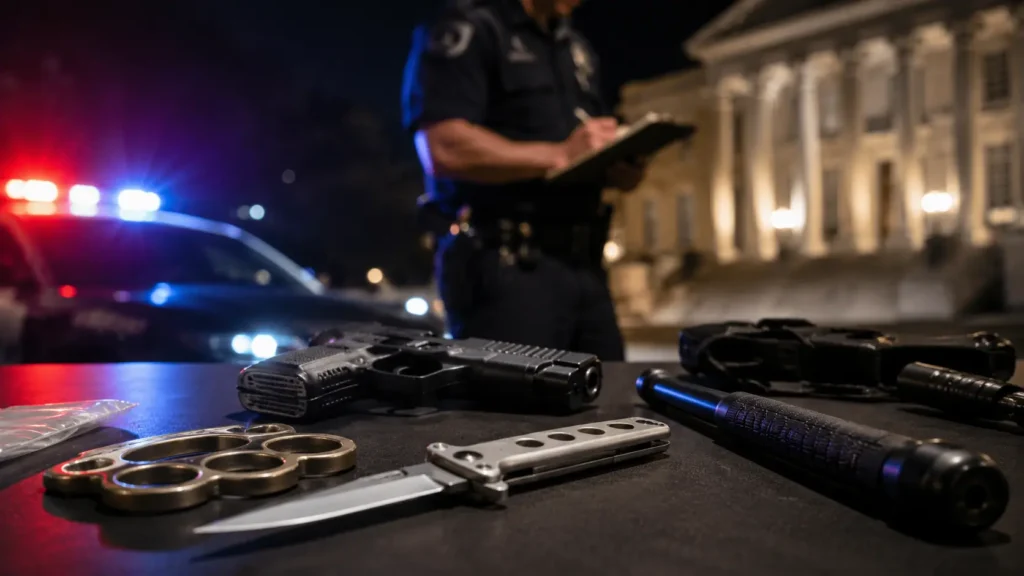
Common Weapons That Can Lead to Charges in Illinois
Illinois weapons charges are not limited to firearms. Police may also investigate knives, brass knuckles, tasers, stun guns, clubs, firearm accessories, ammunition, and items carried in restricted locations. Knife cases can be fact-specific, especially when the issue involves blade type, intent, or location, so review this guide to Illinois knife laws.
The legal risk depends on the item, where it was found, whether it was accessible, whether the person had required legal authority, and whether the person was prohibited from possessing weapons. A weapon found in a vehicle, backpack, pocket, purse, or restricted location can quickly become a criminal case. If police found a weapon in your vehicle, read what happens when a weapon is found during a traffic stop in Illinois.
If the weapon was discovered during a traffic stop, arrest, search, or police investigation, the details matter. A defense attorney may review whether the search was lawful, whether prosecutors can prove knowing possession, and whether the item was actually illegal under Illinois law. For knife-specific rules, review what knives are legal to carry in Illinois.
Illinois Weapons Restrictions at a Glance
| Weapon or Issue | General Illinois Rule | Key Question |
|---|---|---|
| Firearm | Subject to FOID, concealed carry, transportation, prohibited-location, and prohibited-person rules. | Was possession and carry authorized under the applicable firearm statute? |
| Metal knuckles | Specifically prohibited under Section 24-1(a)(1). | Did the accused knowingly possess or carry the prohibited item? |
| Switchblade | Regulated under Section 24-1(a)(1), subject to a statutory FOID exception. | Does the FOID exception apply? |
| Ballistic knife | Specifically prohibited under Section 24-1(a)(1). | Does the seized item meet the statutory definition? |
| Taser or stun gun | FOID and weapons provisions may apply depending on possession, carry, intent, and location. | Was possession authorized and what subsection is charged? |
| Restricted-location weapon | Different statutes impose restrictions depending on weapon and location. | Does the specific location provision actually apply to this item? |
Common Mistakes That Can Lead to Illinois Weapons Charges
Common problems include:
- Carrying an item without understanding whether it is specifically prohibited
- Assuming a FOID card authorizes every form of carry
- Assuming a concealed carry license applies to every weapon
- Transporting a firearm or regulated weapon incorrectly
- Bringing a weapon into a restricted location
- Carrying a weapon while subject to a disqualifying court order or status
- Making statements that establish ownership, knowledge, or unlawful intent
The legality of the item should be separated from how it was carried, where it was found, and whether the person was legally authorized to possess it.
Can You Face Weapons Charges Without Using the Weapon?
Yes. Many Illinois weapons offenses are based on possession, carry, purchase, manufacture, sale, transportation, licensing, location, or prohibited status rather than actual use.
For example, Section 24-1(a)(1) prohibits knowing possession of certain listed weapons even when they were never displayed or used.
Other weapon provisions may require proof of unlawful intent or additional circumstances, so the State must prove the elements of the particular charge.
Weapon Possession vs. Unlawful Use of a Weapon in Illinois
“Weapons charge” is a broad description, not one single Illinois offense.
Depending on the statute, prosecutors may need to prove:
- Knowing possession
- Knowing carry
- A prohibited type of weapon
- Intent to use an item unlawfully against another
- Lack of required legal authority
- Possession in a restricted place
- Prohibited-person status
For example, Section 24-1(a)(1) prohibits possession of certain listed weapons, while subsection (a)(2) covers specified dangerous weapons when carried or possessed with intent to use them unlawfully against another.
Places Where Weapons Are Restricted in Illinois
Location restrictions are weapon-specific. Illinois law does not apply one identical rule to firearms, knives, Tasers, knuckle weapons, and every other item.
Depending on the statute, special restrictions may apply to locations such as:
- Schools
- Courthouses
- Government buildings
- Public transportation property
- Certain public gatherings
- Other locations specifically identified by Illinois law
Firearms are also subject to separate prohibited-location rules under the Firearm Concealed Carry Act.
Always identify both the weapon and the location statute before describing the conduct as unlawful.
What Prosecutors Review in Illinois Weapons Cases
Important evidence may include:
- The exact item seized
- Where it was found
- Who owned or controlled the location
- Whether the accused knew the item was present
- FOID or concealed carry status when relevant
- Statements about ownership or intent
- Vehicle or home ownership
- Other people with access
- Search-warrant, consent, or probable-cause evidence
- Body-camera or surveillance footage
- Whether a statutory exception applies
The defense should evaluate the same evidence independently rather than relying only on how police classified the item.
Illinois FOID and Concealed Carry Requirements
A FOID card and a concealed carry license serve different purposes.
A valid FOID card generally relates to eligibility to acquire or possess firearms and certain other regulated weapons under Illinois law.
A concealed carry license addresses authority to carry a concealed firearm under the Firearm Concealed Carry Act and remains subject to statutory restrictions and prohibited locations.
Having one does not automatically substitute for the other or make every weapon lawful to carry.
FOID status can also matter for specific non-firearm items, including the statutory switchblade exception. If the item was a Taser or stun gun, review Illinois Taser and stun gun laws.
Transporting Weapons in Illinois
Transportation rules depend on the weapon involved.
For firearms, legal issues may include:
- FOID status
- Whether the firearm is unloaded
- Whether it is enclosed as required
- Whether concealed carry authority applies
- Where the firearm is located
- Whether the person is prohibited from possession
Other weapons may have separate transportation or carry rules.
Do not assume that a weapon is lawful simply because it is inside a vehicle.
Illinois Assault Weapon Restrictions and Criminal Risk
Illinois separately regulates assault weapons, .50 caliber rifles, .50 caliber cartridges, and large-capacity ammunition feeding devices under Sections 24-1.9 and 24-1.10.
Because those statutes contain detailed definitions and exemptions, the specific firearm, magazine, registration history, and statutory exception should be reviewed rather than relying on a general label such as “assault weapon.”
Who Is Barred From Possessing Weapons in Illinois?
Weapon-possession restrictions may arise from:
- Certain criminal convictions
- FOID disqualification or revocation
- Certain protective orders
- Court-imposed release conditions
- Other statutory prohibitions
The applicable restriction depends on the person’s status and the type of weapon involved.
Do not assume that every past criminal case creates a lifetime prohibition.
Common Weapons Charges Filed in Illinois
Illinois does not treat every weapon the same way.
Common weapon-related allegations may involve:
- Firearms
- Metal knuckles or other knuckle weapons
- Switchblades
- Ballistic knives
- Tasers or stun guns
- Billy clubs or similar impact weapons
- Prohibited firearm accessories
- Weapons carried in restricted locations
- Weapons possessed by someone legally prohibited from possession
Some items are specifically prohibited. Others become unlawful only when additional facts exist, such as unlawful intent, lack of required licensing, prohibited location, or prohibited-person status.
The exact charging statute should be identified before describing an item as categorically illegal.
Penalties for Illinois Weapons Charges
Illinois weapons penalties vary significantly by the statute, weapon, location, prior record, licensing status, and aggravating circumstances.
For example:
- Some Section 24-1(a)(1) violations are generally Class A misdemeanors.
- Location-based versions of certain offenses may carry felony classifications.
- Firearm offenses can fall under separate statutes with different penalties.
- Assault-weapon and large-capacity-magazine allegations are governed by their own provisions.
The safest way to describe the possible penalty is to identify the exact statute and subsection listed on the charging document. If the allegation involves metal knuckles, review Illinois brass knuckles laws and penalties.
Defense Strategies for Illinois Weapons Charges
Potential defense issues may include:
- The item was not actually prohibited
- A statutory exemption applied
- The accused did not knowingly possess the weapon
- Another person owned or controlled the item
- Prosecutors cannot prove unlawful intent when intent is required
- A FOID or licensing allegation is factually incorrect
- Police conducted an unlawful stop, search, or seizure
- The search exceeded consent or warrant authority
- The weapon was incorrectly classified
- The State cannot prove a restricted-location element
Whether any issue changes the case depends on the remaining evidence and the elements of the charged offense. If police found the item during a vehicle stop, review when police can search your car during an Illinois traffic stop.
When to Call a Criminal Defense Attorney After a Weapons Charge
Contact a criminal defense attorney as soon as possible after a weapons arrest, traffic stop, search, or police investigation.
Do not try to explain ownership, intent, or licensing status without legal advice. Statements made early in the case may hurt the defense later.
A criminal defense attorney may help by:
• Reviewing the stop and search
• Checking whether police violated your rights
• Reviewing FOID and concealed carry issues
• Challenging possession evidence
• Negotiating with prosecutors
• Seeking reduced charges or dismissal where possible
• Protecting your record and future firearm rights
Charged With a Weapons Offense in Illinois?
Illinois weapons cases can depend on the specific item, FOID or concealed carry status, location, alleged intent, possession evidence, and how police discovered the weapon. Andrew Affrunti can review weapons charges, searches, licensing issues, and possible defenses in Springfield and Sangamon County.
Schedule a Confidential ConsultationCall 217-528-2183
Related Articles
- What Happens If Police Find a Weapon During a Traffic Stop in Illinois?
- Illinois Knife Laws: What You Can and Cannot Carry
- Are Brass Knuckles Illegal in Illinois?
- Are Tasers and Stun Guns Legal in Illinois?
Frequently Asked Questions About Illinois Weapons Charges
What weapons are illegal to possess in Illinois?
Illinois specifically prohibits certain weapons, including metal knuckles, other knuckle weapons, throwing stars, ballistic knives, and other items listed in Section 24-1. Other weapons may become unlawful because of intent, licensing, location, or prohibited-person status.
Can I face an Illinois weapons charge if I never used the weapon?
Yes. Many weapons offenses are based on possession, carry, purchase, transportation, location, or licensing rather than actual use of the weapon.
Are brass knuckles illegal in Illinois?
Yes. Illinois specifically prohibits knowingly possessing, purchasing, selling, manufacturing, or carrying metal knuckles or another knuckle weapon regardless of composition.
Do I need a FOID card for every weapon in Illinois?
No. FOID requirements do not apply identically to every weapon. They primarily relate to firearms and certain other regulated items. The exact weapon and statute determine whether FOID status matters.
Can a weapon found in my car lead to charges?
Potentially. A vehicle weapons case may depend on the type of item, who knew it was present, who controlled the vehicle or area, licensing status, transportation rules, and whether police conducted a lawful search.
Does saying I carried the weapon for self-defense make it legal?
Not automatically. A self-defense purpose does not override a statute that prohibits possession or requires specific licensing. Self-defense may be relevant to use-of-force allegations, but possession and carry rules must be analyzed separately.
Can weapon evidence be suppressed after an illegal search?
A defendant may ask the court to suppress evidence obtained through an unlawful search or seizure. Whether the evidence is excluded depends on the facts and the court’s ruling.
Bottom Line: Illinois Weapons Charges Depend on the Details
Illinois weapons charges depend on several details, including the type of weapon, where it was found, whether proper licenses were required, and whether you were legally allowed to possess it.
A weapon discovered during a traffic stop, inside a vehicle, in a home, or in a restricted location can quickly lead to criminal charges. The case may become more serious when it also involves drug possession, theft, DUI, or another alleged offense.
An Illinois criminal defense attorney can review the evidence, examine whether police followed proper search procedures, challenge weak claims, and address every charge involved in the case.
CDL helps people facing weapons charges and related criminal allegations understand their rights and protect their record and future..