
- Quick Answer
- What Is Criminal Trespass in Illinois?
- What Are the Charges and Penalties for Criminal Trespass in Illinois?
- What Are the Common Examples of Criminal Trespass in Illinois?
- What Happens After You Are Charged with Criminal Trespass in Illinois?
- Can You Be Arrested for Criminal Trespass in Illinois?
- What Happens at an Arraignment for Criminal Trespass?
- What Evidence is Reviewed in an Illinois Criminal Trespass Case?
- What Sentencing Alternatives Are Available for Criminal Trespass in Illinois?
- What Are Common Defenses to Criminal Trespass in Illinois?
- Can Lack of Notice Be a Defense to Criminal Trespass?
- Can Consent or Permission be a Defense to Criminal Trespass?
- Can Necessity be a Defense to Criminal Trespass in Illinois?
- What Other Charges can Accompany Criminal Trespass in Illinois?
- What are the Long-Term Consequences of a Criminal Trespass Conviction?
- What Should You Do After a Criminal Trespass Charge in Illinois?
- How Can a Defense Attorney Fight a Criminal Trespass Charge?
- Speak With a Springfield Trespass Defense Attorney
- Key Takeaways About Criminal Trespass Charges in Illinois
- Frequently Asked Questions
- Is criminal trespass a misdemeanor or felony in Illinois?
- Can you go to jail for criminal trespass in Illinois?
- Can you be arrested for criminal trespass in Illinois?
- Can I be charged with trespassing if I did not know I was on private property?
- What if I had permission to be on the property?
- What evidence is used in a criminal trespass case?
- What are common defenses to criminal trespass in Illinois?
- Can criminal trespass charges be dismissed?
- What should I do after being charged with criminal trespass?
- Can criminal trespass affect my criminal record?
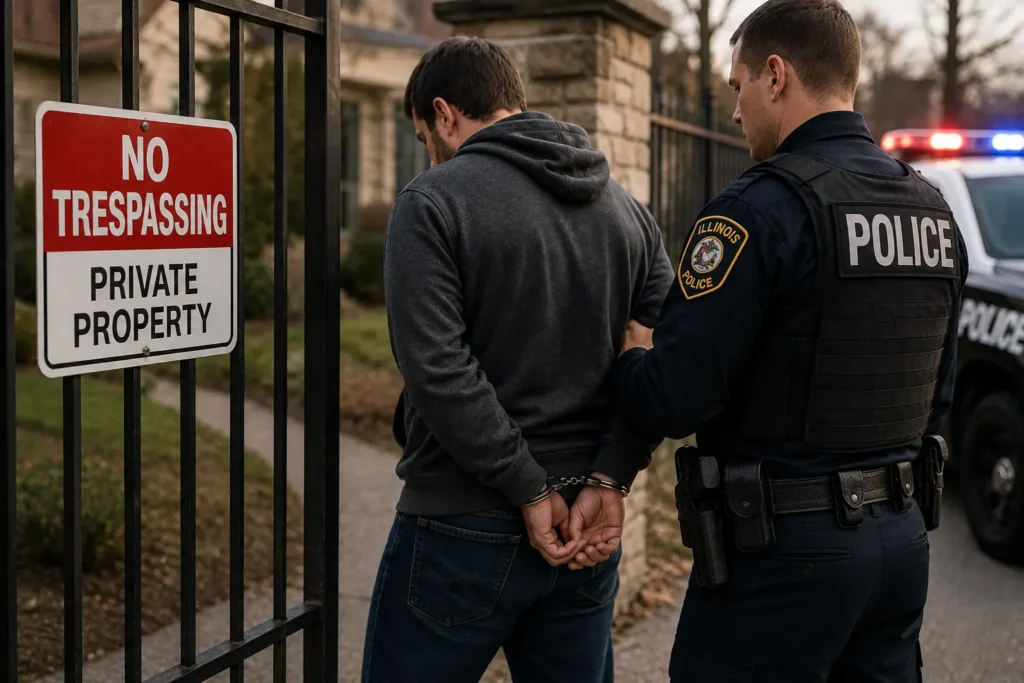
Criminal trespass in Illinois can sound minor at first, but it is still a criminal charge. A person may be accused of trespass after entering private property, refusing to leave when asked, returning after being banned, entering a restricted area, or going onto property without lawful authority.
Trespass charges can happen at homes, stores, apartment buildings, farms, schools, parking lots, businesses, construction sites, public buildings, and private land. Some cases begin as misunderstandings. Others happen after a dispute, theft accusation, domestic conflict, DUI investigation, drug possession arrest, or police call.
If you were charged with criminal trespass in Springfield, Sangamon County, or anywhere in Illinois, you need to understand the classification, possible penalties, court process, and common legal defenses.
Quick Answer
Criminal trespass in Illinois usually means knowingly entering or remaining on property without lawful authority, after notice that entry is forbidden, or after being told to leave. Criminal trespass to real property is generally a Class B misdemeanor, but other trespass-related charges may be more serious depending on the property, location, prior history, and facts. After being charged, the case may involve an arrest or citation, arraignment, discovery, plea negotiations, trial, or sentencing alternatives.
What Is Criminal Trespass in Illinois?
Criminal trespass generally involves being on property without permission or refusing to leave after being told to go. The State usually must prove that the person acted knowingly and lacked lawful authority.
Trespass may involve:
- Entering private property after notice that entry is forbidden
- Remaining on property after being told to leave
- Returning to a store after being banned
- Entering a restricted area
- Going onto residential property without authority
- Entering farmland, construction sites, or business property
- Refusing to leave during a dispute
- Being on property connected to another case, such as theft, DUI, or drug possession
Not every accidental entry is criminal trespass. The details matter, especially notice, permission, intent, and whether the person had a lawful reason to be there.
What Are the Charges and Penalties for Criminal Trespass in Illinois?
Illinois Trespass Classification and Penalties depend on the type of property and the exact charge filed.
Criminal trespass to real property is generally a Class B misdemeanor. A Class B misdemeanor can carry jail exposure, fines, court costs, probation, conditional discharge, and a criminal record if convicted.
Possible penalties may include:
- Jail time
- Fines and court costs
- Probation
- Conditional discharge
- Community service
- Stay-away orders
- No-contact orders
- Restitution if damage occurred
- Criminal record if convicted
- Immigration concerns for non-citizens
- Employment and housing consequences
Some trespass-related offenses can be more serious. For example, criminal trespass to a residence is separate from trespass to real property and may carry harsher penalties depending on the facts. A trespass case may also become more serious if it involves protected property, public infrastructure, government land, a school, a residence, or another criminal allegation.
What Are the Common Examples of Criminal Trespass in Illinois?
Criminal trespass cases can arise from many everyday situations.
Common examples include:
- Refusing to leave a store after being asked
- Returning to a business after receiving a trespass notice
- Entering an apartment building without permission
- Going onto someone’s porch, yard, or driveway without authority
- Entering a construction site
- Cutting across private land after signs are posted
- Remaining at a bar or restaurant after being told to leave
- Entering a restricted section of a public venue
- Going to a home after being warned not to return
- Staying on property after a landlord, owner, or manager demands that you leave
Some trespass cases are connected to other accusations, such as retail theft, disorderly conduct, battery, DUI, drug possession, or violation of an order of protection.
What Happens After You Are Charged with Criminal Trespass in Illinois?
What Happens After You Are Charged depends on whether police issue a citation or make an arrest, whether the property owner wants prosecution, and whether other charges are involved.
The process may include:
- Police contact
- Arrest or citation
- Booking in some cases
- Court date
- Arraignment
- Discovery phase
- Pretrial conferences
- Negotiation
- Trial
- Sentencing alternatives if there is a plea or finding of guilt
Do not ignore a trespass charge just because it seems low-level. Missing court can lead to a warrant, additional penalties, or driver’s license issues in certain traffic-related cases.
Can You Be Arrested for Criminal Trespass in Illinois?
Arrest or Citation is usually the first major step. In some cases, police may issue a citation and release the person. In other cases, police may arrest the person, especially if the situation involves refusal to leave, a residence, threats, property damage, intoxication, drugs, theft, or an outstanding warrant.
A trespass case may start when:
- A property owner calls police
- Store security detains someone
- A landlord reports unauthorized entry
- A homeowner reports someone on the property
- Police respond to a disturbance
- Officers investigate another offense
- A person returns after being banned
If police question you, avoid arguing or trying to talk your way out of the case. A rushed explanation can become evidence later. Courtroom plot twists are expensive, and not in a fun way.
What Happens at an Arraignment for Criminal Trespass?
Arraignment is an early court date where the charge is formally addressed. The judge may advise you of the charge, discuss rights, and ask for a plea.
At arraignment, the court may also address:
- Attorney representation
- Release conditions
- Stay-away orders
- No-contact orders
- Future court dates
- Discovery deadlines
- Related charges
If the trespass charge is tied to theft, DUI, drug possession, domestic conflict, or a protective order, the judge may impose stricter conditions. These conditions should be followed carefully because violating them can create new problems.
What Evidence is Reviewed in an Illinois Criminal Trespass Case?
The Discovery Phase is when the defense receives and reviews evidence from the prosecution. This step is important because trespass cases often depend on notice, permission, identity, and what actually happened at the property.
Discovery may include:
- Police reports
- Body camera footage
- Dash camera footage
- Store security footage
- Trespass notices
- Property owner statements
- Witness statements
- Photos
- 911 call records
- Signs or posted notice evidence
- Lease or property documents
- Messages between the parties
The defense may look for weaknesses, such as unclear notice, conflicting statements, lack of signage, consent, mistaken identity, or proof that the person had a lawful reason to be there.
What Sentencing Alternatives Are Available for Criminal Trespass in Illinois?
Sentencing Alternatives may be available depending on the charge, record, county, facts, and judge.
Possible alternatives may include:
- Court supervision
- Conditional discharge
- Probation
- Community service
- Restitution
- Stay-away agreement
- No-contact order
- Dismissal after compliance in some negotiated outcomes
- Counseling or treatment if related to alcohol, drugs, or conflict
- Fine-only resolution in some cases
The best outcome depends on the evidence and the person’s goals. For many defendants, avoiding a conviction is a major priority because a criminal record can affect jobs, housing, school, and licensing.
What Are Common Defenses to Criminal Trespass in Illinois?
Common Legal Defenses in criminal trespass cases often focus on whether the person knowingly entered or remained without lawful authority.
Possible defenses may include:
- Lack of notice
- Consent or permission
- Necessity
- Mistaken identity
- Lack of intent
- Property boundary confusion
- No clear order to leave
- Invalid or unclear trespass notice
- Public access area
- Emergency circumstances
- Insufficient evidence
- Constitutional issues with the stop, detention, or arrest
A trespass defense should be based on the facts, not assumptions. The details can be surprisingly granular.
Can Lack of Notice Be a Defense to Criminal Trespass?
Lack Of Notice is one of the most common defenses. In many trespass cases, the State must prove that the person had noticed that entry was forbidden or that they were told to leave and refused.
Notice may come from:
- Posted signs
- A property owner’s verbal warning
- A written trespass notice
- A prior ban from the property
- Fencing or locked gates
- Security staff instructions
- Police instruction to leave
If there was no sign, no warning, no clear boundary, and no prior ban, the defense may argue that the person did not knowingly trespass.
Can Consent or Permission be a Defense to Criminal Trespass?
Consent or Permission can also be a defense. If the property owner, tenant, resident, employee, or authorized person gave permission to enter or remain, the trespass allegation may be weaker.
Consent issues may arise when:
- A friend invited someone over
- A tenant allowed entry
- A business was open to the public
- A worker had permission to be on site
- A delivery driver entered for work
- A customer believed they could enter
- Permission was later disputed
The defense may review messages, witness statements, leases, business hours, access rules, and prior interactions to show the person had lawful authority.
Can Necessity be a Defense to Criminal Trespass in Illinois?
Necessity may apply when someone entered or remained on property because of an emergency or urgent situation.
Examples may include:
- Seeking help during a medical emergency
- Escaping danger
- Avoiding immediate harm
- Reporting an emergency
- Helping someone in distress
- Getting out of severe weather
- Responding to an accident
Necessity is not a free pass for ordinary convenience. The defense must connect the entry to a real and immediate need.
What Other Charges can Accompany Criminal Trespass in Illinois?
Criminal trespass may appear by itself or with other charges.
Related charges may include:
- Theft
- Retail theft
- DUI
- Drug possession
- Disorderly conduct
- Battery
- Criminal damage to property
- Violation of an order of protection
- Resisting or obstructing
- Weapons charges
- Probation violation
For example, a person accused of theft may also be charged with trespass if they returned to a store after being banned. A DUI investigation may lead to trespass if someone enters private property after a crash. A drug possession case may include trespass if police claim the person was unlawfully on private land.
When charges overlap, the defense strategy must address the whole case.
What are the Long-Term Consequences of a Criminal Trespass Conviction?
A trespass conviction can create problems outside court.
Collateral consequences may include:
- Employment background check issues
- Housing application problems
- Professional licensing concerns
- School discipline
- Immigration concerns for non-citizens
- Probation violation
- Loss of access to certain locations
- No-contact or stay-away restrictions
- Family law complications in some cases
Even a misdemeanor conviction can follow someone longer than expected. That is why resolving the case carefully matters.
What Should You Do After a Criminal Trespass Charge in Illinois?
If you are charged with criminal trespass in Illinois, take these steps:
- Save all paperwork
- Do not miss court
- Write down what happened privately
- Save texts, emails, or messages showing permission
- Identify witnesses
- Take photos of signs, doors, gates, or property boundaries if safe and lawful
- Preserve receipts, work orders, delivery records, or lease documents
- Avoid returning to the property
- Follow all stay-away or no-contact orders
- Do not post about the case online
- Speak with a criminal defense attorney
Do not go back to the property to “clear things up.” That can lead to a new trespass allegation.
How Can a Defense Attorney Fight a Criminal Trespass Charge?
A Springfield criminal defense attorney can review the charge, evidence, and possible defenses.
An attorney may help by:
- Reviewing police reports
- Checking body camera footage
- Reviewing trespass notices
- Examining signage and property boundaries
- Gathering proof of permission
- Interviewing witnesses
- Challenging lack of notice
- Presenting necessity arguments
- Negotiating sentencing alternatives
- Seeking dismissal or reduction
- Protecting your record
The goal is to limit the damage and pursue the best available outcome.
Speak With a Springfield Trespass Defense Attorney
If you were charged with criminal trespass in Springfield, Sangamon County, or Central Illinois, do not assume it is just a minor property dispute. A trespass conviction can create a criminal record and other long-term consequences.
Whether the case involves a business, residence, school, private land, theft allegation, DUI incident, drug possession issue, or another criminal charge, early legal help can make a difference.
A Springfield criminal defense attorney can explain the charge, review the evidence, identify defenses, and help protect your record.
Key Takeaways About Criminal Trespass Charges in Illinois
Criminal trespass in Illinois can lead to arrest, citation, arraignment, discovery, sentencing alternatives, and a criminal record if convicted. The classification and penalties depend on the type of property, the facts of the case, and whether other charges are involved.
Common defenses include lack of notice, consent or permission, necessity, mistaken identity, and insufficient evidence. These defenses often depend on small details, such as signs, warnings, property boundaries, messages, and witness statements.
If you were charged with criminal trespass in Springfield or Sangamon County, speak with a criminal defense attorney as soon as possible. Early defense work can help challenge the evidence, protect your rights, and pursue the best possible outcome.
Frequently Asked Questions
Is criminal trespass a misdemeanor or felony in Illinois?
Criminal trespass to real property is generally a Class B misdemeanor in Illinois. However, other trespass-related offenses can carry more serious consequences depending on the type of property, location, prior history, and circumstances. The exact charge should be reviewed carefully before determining the potential penalties.
Can you go to jail for criminal trespass in Illinois?
Yes, a criminal trespass conviction can potentially result in jail time. Other consequences may include fines, court costs, probation, conditional discharge, community service, or stay-away orders. The actual sentence depends on the charge, criminal history, facts of the case, and available sentencing alternatives.
Can you be arrested for criminal trespass in Illinois?
Yes, police may arrest someone accused of criminal trespass, although some cases may begin with a citation instead. An arrest may be more likely when the incident involves refusal to leave, threats, property damage, another alleged offense, or an outstanding warrant. What happens depends heavily on the circumstances surrounding the incident.
Can I be charged with trespassing if I did not know I was on private property?
Knowledge and notice can be important issues in a criminal trespass case. If there was no posted sign, warning, clear boundary, or prior notice that entry was prohibited, the defense may challenge whether the person knowingly trespassed. Evidence showing what the person reasonably understood at the time can therefore be important.
What if I had permission to be on the property?
Consent or permission may be a defense to criminal trespass. Evidence such as text messages, witness statements, leases, work records, or previous interactions may help establish that you reasonably believed you had authority to enter or remain. The circumstances surrounding when and how permission was given should be carefully reviewed.
What evidence is used in a criminal trespass case?
Evidence may include police reports, body camera footage, surveillance video, trespass notices, witness statements, photographs, posted signs, property documents, and messages between the parties. Prosecutors may use this evidence to establish notice, identity, and lack of permission. The defense can review the same evidence for inconsistencies or facts supporting a defense.
What are common defenses to criminal trespass in Illinois?
Potential defenses include lack of notice, consent or permission, necessity, mistaken identity, unclear property boundaries, and insufficient evidence. Constitutional issues involving the stop, detention, or arrest may also be relevant in some cases. The appropriate defense depends on the specific facts and evidence.
Can criminal trespass charges be dismissed?
Dismissal may be possible depending on the evidence and circumstances of the case. Problems proving notice, permission, identity, or other required elements may weaken the prosecution’s case. A defense attorney can review the evidence and determine whether dismissal, reduction, or another resolution may be available.
What should I do after being charged with criminal trespass?
Save your court paperwork and any evidence showing permission, notice, property boundaries, or what happened during the incident. Follow all stay-away or no-contact orders and avoid returning to the property to discuss the situation. You should also consider speaking with a criminal defense attorney before making statements about the case.
Can criminal trespass affect my criminal record?
Yes, a criminal trespass conviction can create a criminal record and may have consequences beyond the immediate sentence. It may affect employment, housing, professional licensing, school matters, or access to certain locations. This makes it important to understand your legal options before resolving the charge.