
- Citation vs. Custody
- Arrestable Offenses
- The Booking Process
- Pretrial Release After a Traffic Stop Arrest
- Traffic Court Appearances
- Arraignment
- Potential Consequences
- What You Should Do Now
- How a Defense Attorney Can Help
- Charged After a Traffic Stop in Springfield?
- Common Questions After an Illinois Traffic Stop Charge
- Does a traffic ticket in Illinois mean I was arrested?
- Do I have to appear in court for every Illinois traffic ticket?
- Does paying an Illinois traffic ticket mean I am pleading guilty?
- What happens if a traffic stop leads to an arrest?
- Can police search my car during an Illinois traffic stop?
- Can a traffic stop affect my Illinois driver's license?
- Can evidence from an illegal traffic stop be challenged?
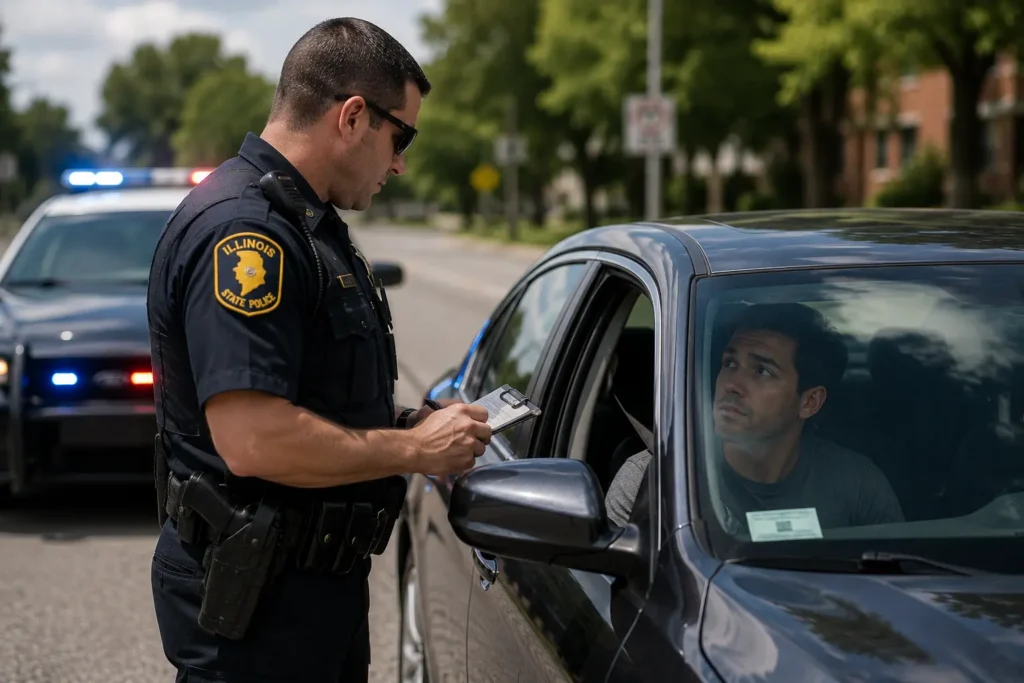
A traffic stop in Illinois can end in more than a warning or a basic ticket. In some cases, the officer issues a citation and lets the driver leave. In other cases, the stop can lead to arrest, custody, booking, court appearances, license problems, fines, or jail exposure.
Many people are surprised when a traffic stop turns into a criminal case. A DUI, theft allegation, drug possession charge, suspended license offense, weapon issue, or outstanding warrant can quickly change the situation. What starts as flashing lights in the rearview mirror can become a serious legal problem.
If you were charged after a traffic stop in Springfield, Sangamon County, or anywhere in Illinois, you need to understand what happens next. The steps after the stop can affect your driver’s license, criminal record, employment, insurance, and freedom.
Quick Answer
What happens after an Illinois traffic stop depends on whether you received a traffic citation, were charged with a criminal offense, or were taken into custody. A ticket may require payment or a court appearance, while charges such as DUI, aggravated speeding, driving while suspended, drug possession, or a weapons offense can create a criminal case. If you were arrested, booking and pretrial release issues may also follow. Check the exact charge, court date, release paperwork, and driver’s license consequences before entering a plea or paying the ticket.
Citation vs. Custody
The first major difference after a traffic stop is whether you receive a citation or are taken into custody.
A citation usually means the officer gives you a ticket or court notice and releases you from the scene. Custody means you are arrested and taken to a police station, jail, or processing facility.
This difference matters because custody usually means the case is more serious, the court process may move faster, and you may face additional release conditions.
| What Happened | Possible Next Step | What to Check |
|---|---|---|
| Traffic citation only | Payment, contesting the ticket, supervision when available, or court appearance. | Whether court is required and what disposition the ticket would create. |
| Criminal charge without continued custody | Criminal court proceedings and future hearing dates. | Charge classification, court date, release conditions, and possible license consequences. |
| Arrest and booking | Booking, release processing, or court proceedings addressing pretrial release. | Custody status, release order, detention request, and next court date. |
| Evidence found during the stop | Additional investigation or charges may follow. | Reason for the stop, search authority, possession evidence, and statements. |
Arrestable Offenses
A traffic stop may become a criminal case when officers develop probable cause for an offense or discover an existing legal basis for arrest.
Examples of charges that may arise from traffic stops include:
- DUI
- Aggravated speeding
- Reckless driving
- Driving while license suspended or revoked
- Drug possession
- Weapons offenses
- Resisting or obstructing
- Leaving the scene of an accident
- Other criminal allegations discovered during the stop
An outstanding warrant may also change the encounter even when the original traffic violation was relatively minor.
Whether custody actually occurs depends on the offense, warrant status, circumstances, and applicable Illinois procedure.
The Booking Process
If the traffic stop results in an arrest, booking may include:
- Recording identifying information
- Fingerprinting and photographs
- Inventorying personal property
- Completing arrest records
- Checking outstanding warrants
- Providing custody, release, or court information
Booking does not determine guilt. It is an administrative stage following an arrest.
Do not use the booking process as an opportunity to explain the allegations or persuade officers that the charge is incorrect. If the stop resulted in an arrest, review what happens after an arrest in Sangamon County.
Pretrial Release After a Traffic Stop Arrest
If the traffic stop results in an arrest, pretrial release may become an immediate issue.
Illinois no longer uses money as the condition determining whether a defendant obtains pretrial release. Depending on the case, the person may be released with legally authorized conditions or the State may seek detention when Section 110-6.1 allows it.
Detention is not automatic simply because the traffic stop produced a criminal charge.
Conditions can vary by case and court order. The release paperwork should be reviewed carefully before leaving custody. If custody or detention is an issue, review how Illinois pretrial release and detention rules work.
Traffic Court Appearances
Some traffic tickets can be handled without a traditional court appearance, while others require the driver to appear.
Check the citation carefully for:
- The charged statute
- Court date
- Whether appearance is required
- Payment instructions
- Whether supervision or another disposition may be available
- Whether the offense can affect your driving record
Paying an eligible ticket electronically generally involves entering a guilty plea, so payment should not be treated as merely an administrative fee. Illinois Courts’ e-Guilty system expressly advises that the driver is entering a guilty plea and giving up the right to trial.
Arraignment
When the traffic stop results in a criminal case, an arraignment or other early criminal-court proceeding may follow depending on the charge and procedure.
At arraignment, the defendant is formally informed of the charge and called upon to plead.
Later proceedings may involve discovery, motions, negotiations, or trial preparation, but those stages go beyond the immediate post-traffic-stop process. For the full criminal case sequence, review how Sangamon County criminal cases move through court.
Potential Consequences
The consequences after a traffic stop depend on the charge, your record, the evidence, and the court outcome.
Potential consequences may include:
- Fines
- Court costs
- Driver’s license suspension
- Jail time
- Probation
- Court supervision
- Community service
- Drug or alcohol evaluation
- Treatment classes
- Increased insurance rates
- Criminal record
- Employment problems
- CDL consequences
- Immigration concerns for non-citizens
Some consequences happen through the court. Others happen through the Illinois Secretary of State, insurance companies, employers, or background checks.
What You Should Do Now
- Save every document. Keep the ticket, release order, tow paperwork, property receipt, and court notices.
- Confirm the exact charge. Do not rely only on what the officer said roadside.
- Confirm your court date. Missing a required appearance may create additional problems.
- Write down what happened. Record the stop location, reason given, questions, searches, tests, witnesses, and arrest sequence.
- Preserve evidence. Save dashcam footage, photographs, messages, receipts, GPS information, and other relevant material.
- Do not discuss the case online. Remove the current “Screenshots have no chill” wording and keep the article professional.
- Follow every release condition. If you were arrested, review the written order.
- Do not rush into payment or a plea. First understand what disposition it creates.
- Have the stop and evidence reviewed when the charge is criminal or otherwise serious.
If police searched your vehicle or found additional evidence, review when police can search your car during an Illinois traffic stop.
How a Defense Attorney Can Help
Depending on the allegation, defense review may include:
- Whether police had a lawful basis for the initial stop
- Whether the detention was unlawfully prolonged
- Whether a vehicle or person was lawfully searched
- Whether an arrest was supported by probable cause
- Whether statements were obtained lawfully
- Whether chemical testing or other evidence can be challenged
- Whether the State can prove possession, operation, or another required element
- Whether supervision or another disposition is legally available
- Whether pretrial motions should be filed
None of these issues guarantees dismissal or reduction. The strategy depends on the specific charge and evidence.
Charged After a Traffic Stop in Springfield?
A traffic stop can become a criminal case when it involves DUI, aggravated speeding, a suspended license, drugs, weapons, resisting, or another criminal allegation. Andrew Affrunti can review the stop, search, arrest, release paperwork, license issues, and evidence for cases in Springfield and Sangamon County.
Schedule a Confidential ConsultationCall 217-528-2183
Common Questions After an Illinois Traffic Stop Charge
Does a traffic ticket in Illinois mean I was arrested?
No. A driver may receive a citation and be released without being taken into custody. Other traffic stops may result in an arrest and booking depending on the alleged offense and circumstances.
Do I have to appear in court for every Illinois traffic ticket?
No. Some eligible traffic offenses can be resolved without an in-person court appearance, while other tickets and criminal traffic charges require court. Check the citation and court instructions carefully.
Does paying an Illinois traffic ticket mean I am pleading guilty?
For eligible tickets handled through Illinois’s electronic plead-and-pay system, payment is connected to a guilty plea. Drivers should understand the disposition and possible driving-record consequences before paying.
What happens if a traffic stop leads to an arrest?
An arrest may be followed by booking, release processing, pretrial release conditions, and criminal court proceedings. The next step depends on the charge, custody status, and court orders.
Can police search my car during an Illinois traffic stop?
Not automatically. A vehicle search requires a lawful basis, such as valid consent, probable cause, a warrant, or another recognized exception to the warrant requirement.
Can a traffic stop affect my Illinois driver’s license?
Yes. Some traffic offenses and DUI-related events can affect driving privileges, but the consequences depend on the exact offense, court disposition, driving history, and applicable Secretary of State rules.
Can evidence from an illegal traffic stop be challenged?
Potentially. A defendant may challenge evidence obtained through an unlawful stop, detention, search, seizure, or arrest. Whether evidence is suppressed depends on the facts and the court’s ruling.