
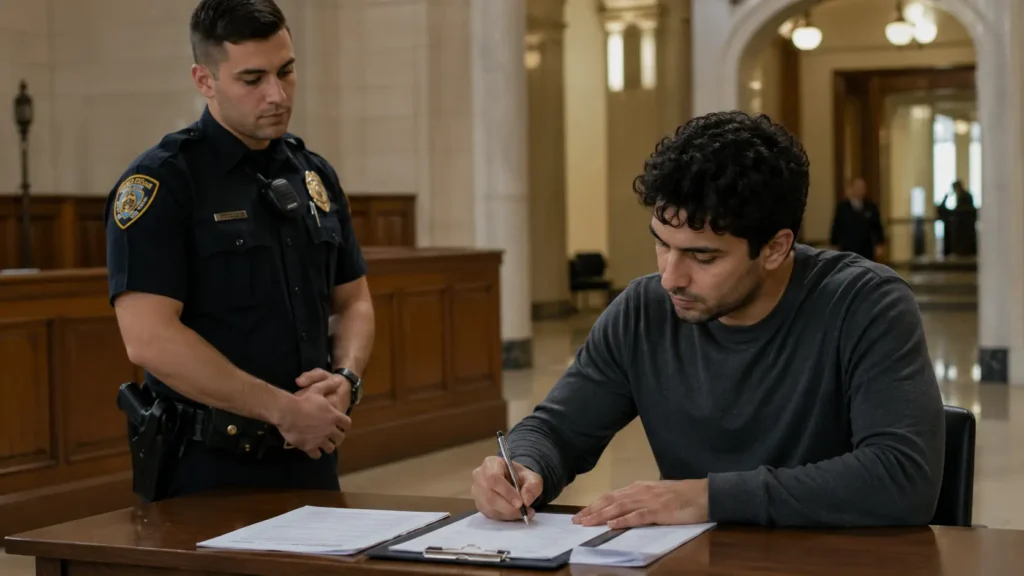
- What happens after an arrest in Sangamon County, Illinois?
- How Sangamon County Circuit Court Fits Into the Arrest Process
- What Happens During Booking After an Arrest in Sangamon County?
- What to Do After Release From Custody
- Why Speedy Trial Deadlines Matter After an Arrest
- What to Expect at Your First Court Appearance After an Arrest
- How Prosecutors Review and Evaluate Criminal Charges
- How to Protect Yourself While Your Criminal Case Is Pending
- Facing a Criminal Case After an Arrest in Sangamon County?
- Common Questions About Arrests in Sangamon County
- What happens immediately after an arrest in Sangamon County?
- Does Illinois still require cash bail after an arrest?
- Can everyone arrested in Sangamon County be detained before trial?
- What happens at the first court appearance after an arrest?
- What should I do after being released from custody?
- How long can someone remain in custody before trial in Illinois?
- Does an arrest mean I will be convicted?
An arrest can feel confusing and overwhelming, especially if you have never been through the criminal justice system before. In Sangamon County, Illinois, the process that follows an arrest is structured and moves quickly. Understanding what typically happens next can help reduce uncertainty and prevent mistakes that might affect your case.
Knowing the steps in the process allows you to focus on protecting your rights and making informed decisions. If you were just arrested and need immediate next steps, review this guide on what to do in the first 24 hours after an arrest. For case-specific help, speak with a criminal defense attorney in Springfield, Illinois.
If you are trying to understand the Sangamon County arrest process, it helps to know what happens from booking to release review, first court appearance, and the next court date.
Quick Answer
What happens after an arrest in Sangamon County, Illinois?
After an arrest in Sangamon County, a person may go through booking, charging review, a first court appearance, and pretrial-release proceedings before the case moves into discovery, motions, negotiations, or trial. Illinois generally presumes defendants are eligible for pretrial release, while detention is available only through the statutory process in qualifying cases. The exact next steps depend on the charge, custody status, release conditions, and how prosecutors proceed.
| Stage | What usually happens |
|---|---|
| Arrest | Police take the person into custody based on alleged criminal conduct |
| Booking | Personal information, fingerprints, photos, and charge details may be recorded |
| Pretrial release review | The court addresses release, applicable conditions, and any properly filed request for detention |
| First court appearance | The judge addresses charges, rights, release conditions, and next court dates |
| Prosecutor review | The State’s Attorney decides what charges to file or pursue |
| Discovery | The defense requests police reports, videos, witness statements, and evidence |
| Pretrial hearings | The court handles motions, negotiations, and case management |
| Trial or resolution | The case may end through dismissal, plea agreement, bench trial, or jury trial |
The Sangamon County Circuit Clerk keeps the official record for proceedings that come before the Sangamon County Courts, and Sangamon County is part of Illinois’ 7th Judicial Circuit.
How Sangamon County Circuit Court Fits Into the Arrest Process
After an arrest in Springfield or elsewhere in Sangamon County, the criminal case may proceed through Sangamon County Circuit Court.
Early court proceedings may address:
- The filed charge
- The defendant’s custody status
- Pretrial release conditions
- A State petition seeking detention, when authorized
- Future court dates
- Representation by counsel
These early hearings do not determine guilt or innocence. They establish how the case will proceed while the allegations remain pending.
What Happens During Booking After an Arrest in Sangamon County?
During booking, law enforcement may:
- Record identifying information
- Take fingerprints and photographs
- Document the alleged offense
- Inventory personal belongings
- Complete arrest and custody records
Booking is an administrative stage following an arrest. It does not establish guilt.
Depending on the charge and custody circumstances, the next step may involve release processing or court proceedings addressing pretrial release. If this is your first arrest, review what happens after a first arrest in Springfield, Illinois.
What to Do After Release From Custody
After release:
- Read every page of your release paperwork.
- Confirm the next court date and courtroom information.
- Follow all no-contact, travel, weapon, monitoring, or other court conditions.
- Keep the citation, complaint, release order, property receipt, and other paperwork.
- Write down what happened while the arrest is still fresh.
- Preserve messages, photographs, videos, receipts, and other potentially relevant evidence.
- Do not discuss the allegations on social media.
- Do not contact an alleged victim or witness in violation of a court order.
- Have the arrest and charge reviewed before making decisions about a plea.
Why Speedy Trial Deadlines Matter After an Arrest
Illinois speedy-trial law uses different rules depending on whether the defendant remains in custody or is on pretrial release.
A person continuously held in custody for the alleged offense generally must be tried within 120 days, subject to delays and exclusions recognized by the statute.
A person on pretrial release generally must be tried within 160 days from a proper demand for trial. For a defendant who is not in custody, the demand must be made in writing.
Defendant-caused delays and certain other statutory events can suspend or extend these periods, so the calendar cannot be calculated simply by counting days from the arrest.
What to Expect at Your First Court Appearance After an Arrest
At an initial court appearance, the court may address the filed charge, counsel, pretrial-release issues, court conditions, and scheduling depending on the procedural posture of the case.
Depending on the case, the State may also seek detention under Illinois pretrial-release law.
This is not the criminal trial. The prosecution has not proven guilt merely because a charge has been filed or a defendant has appeared before a judge.
How Prosecutors Review and Evaluate Criminal Charges
Prosecutors review police reports, witness information, video, physical evidence, and other available material when deciding what charges to file or continue pursuing.
A charge may remain unchanged, be amended, additional charges may be filed, or a charge may later be dismissed depending on the evidence, applicable law, and procedural developments.
The defense separately reviews the prosecution’s evidence for factual disputes, legal issues, evidentiary questions, and possible defenses.
How to Protect Yourself While Your Criminal Case Is Pending
While a criminal case is pending:
- Follow every court-ordered release condition
- Attend every scheduled court date
- Avoid discussing the allegations publicly or on social media
- Avoid contacting protected persons or witnesses when prohibited
- Preserve messages, photos, videos, receipts, and other potentially relevant evidence
- Keep court paperwork and release documents together
- Notify counsel promptly about new police contact or changes in release conditions
Avoid deleting messages, editing files, or posting about the case. Statements and digital records can later become relevant evidence.
Facing a Criminal Case After an Arrest in Sangamon County?
An arrest can involve immediate questions about release conditions, detention, court dates, evidence, police statements, searches, and speedy-trial deadlines. Reviewing the charging paperwork, release order, and current stage of the case can help clarify what needs attention before the next hearing.
Schedule a Confidential ConsultationCommon Questions About Arrests in Sangamon County
What happens immediately after an arrest in Sangamon County?
After an arrest, law enforcement may complete booking, record identifying information, take fingerprints and photographs, inventory property, and complete custody records. Depending on the case, release processing or court proceedings addressing pretrial release may follow.
Does Illinois still require cash bail after an arrest?
No. Illinois no longer uses cash bail as the condition for obtaining pretrial release. Courts apply statutory rules governing release conditions and, in qualifying cases, pretrial detention.
Can everyone arrested in Sangamon County be detained before trial?
No. Pretrial detention is not automatic after an arrest. Illinois law limits when detention may be requested and ordered, and the required statutory procedures and findings must be satisfied.
What happens at the first court appearance after an arrest?
Early court proceedings may address the charge, representation, custody status, release conditions, a detention request when applicable, and future court dates. The first appearance is not the criminal trial.
What should I do after being released from custody?
Read your release order, confirm the next court date, follow every condition, preserve your paperwork and evidence, avoid discussing the allegations publicly, and do not contact anyone contrary to a court order.
How long can someone remain in custody before trial in Illinois?
Illinois speedy-trial law generally requires a person continuously held in custody for an alleged offense to be tried within 120 days, subject to statutory exclusions and delays. Other timing provisions may also apply depending on the custody and detention situation.
Does an arrest mean I will be convicted?
No. An arrest is not a conviction. The State must still pursue the charge and prove the required elements through the criminal process unless the case is otherwise resolved.