
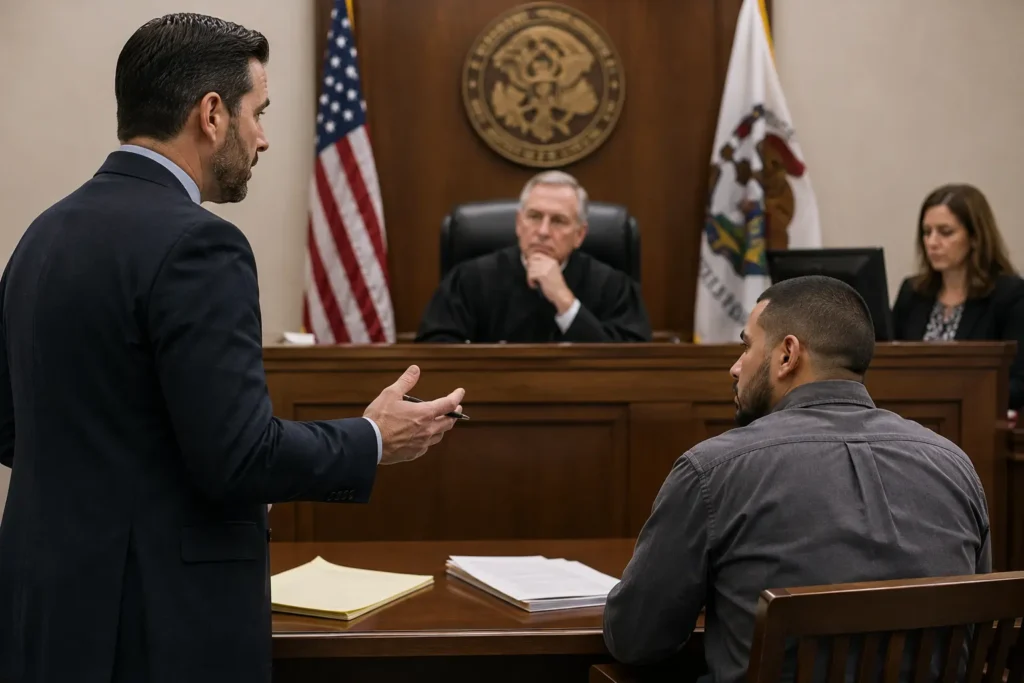
- Quick Answer
- Facing a Probation Violation Hearing in Illinois?
- What Is a Probation Violation in Illinois?
- Common Probation Violations and Possible Consequences
- The Probation Violation Process
- Notice of Violation
- Arrest and Warrant
- Types of Violations
- Technical Violations
- Substantive Violations
- What Happens at the Hearing?
- No Jury
- Lower Burden of Proof
- Potential Outcomes
- Facing a Probation Violation Hearing?
- Continue Probation
- Modify or Add Conditions
- Extend Probation
- Revoke Probation
- How to Defend Against a Violation
- Defenses Based on Good Faith Efforts and Circumstances
- Contesting the Evidence
- Negotiating a Resolution
- Underlying Circumstances
- What You Should Do After a Probation Violation Notice
- Why Legal Assistance Matters
- Speak With a Springfield Criminal Defense Attorney
- Need Help Defending a Probation Violation in Illinois?
- Final Thoughts
- Frequently Asked Questions
Probation can feel like a second chance, but it also comes with strict rules. If the court believes you violated those rules, the case can move quickly from a warning to a serious hearing. A probation violation in Illinois can lead to added conditions, extended probation, jail time, or even revocation of probation.
For many people, the scariest part is not knowing what happens next. You may receive a Notice of Violation, learn that a warrant was issued, or be told to appear in court without fully understanding what the judge can do.
A probation violation does not automatically mean you are going to jail. However, it does mean you need to take the allegation seriously and prepare a defense. The right response can help explain the underlying circumstances, show good faith efforts, contest weak evidence, and possibly negotiate a better resolution.
Quick Answer
A probation violation in Illinois occurs when someone is accused of breaking a condition of probation. The process may involve a Notice of Violation, court hearing, and possible penalties such as modified conditions, extended probation, or revocation. A defense attorney can challenge the evidence, explain the circumstances, and argue for a better outcome.
Facing a Probation Violation Hearing in Illinois?
A probation violation does not automatically mean you will go to jail. The outcome depends on the allegation, evidence, probation history, and how the defense presents your circumstances to the court.
What Is a Probation Violation in Illinois?
A probation violation happens when someone accused of or sentenced for a criminal offense does not follow the conditions ordered by the court.
Probation terms can vary depending on the case, but common conditions include:
- Reporting to a probation officer
- Avoiding new arrests or criminal charges
- Completing alcohol, drug, or mental health treatment
- Paying fines, fees, restitution, or court costs
- Completing community service
- Attending counseling
- Avoiding contact with certain people
- Staying away from certain places
- Submitting to drug or alcohol testing
- Following curfew or travel restrictions
- Maintaining employment or school attendance
A violation can be based on something small, like missing a meeting, or something serious, like being arrested for a new offense.
The court will look at what happened, why it happened, whether the violation can be proven, and what response is appropriate.
Common Probation Violations and Possible Consequences
| Type of Violation | Examples | Possible Consequences |
|---|---|---|
| Technical violation | Missed appointments, failed treatment, missed payments | Modified conditions, additional requirements, extended probation |
| Substantive violation | New criminal charge while on probation | Hearing, possible revocation, resentencing |
| Court-related violation | Missed court date or ignored conditions | Warrant, additional hearings, stricter conditions |
| Testing violation | Failed drug or alcohol test | Treatment requirements, monitoring, sanctions |
The Probation Violation Process
The probation violation process usually begins when a probation officer, prosecutor, or supervising agency believes a person failed to follow the terms of probation.
The process may include:
- A report from probation
- A Notice of Violation
- A petition to revoke probation
- A court date
- Arrest and warrant in some cases
- A probation violation hearing
- A judge’s decision on the outcome
The details can vary by county, judge, probation department, and the seriousness of the alleged violation.
In Springfield and Sangamon County, the court may treat technical violations differently from new criminal offenses, but both can still create serious consequences.
Notice of Violation
A Notice of Violation tells the person what probation rule they are accused of breaking. This notice is important because it gives the defense a chance to understand the allegation and prepare a response.
The notice may accuse the person of:
- Missing probation appointments
- Failing a drug or alcohol test
- Missing treatment sessions
- Failing to pay required amounts
- Leaving the county or state without permission
- Failing to complete community service
- Contacting a prohibited person
- Being arrested for a new offense
You should read the notice carefully and save a copy. Do not ignore it. A missed deadline or missed court date can make the situation worse.
Arrest and Warrant
In some probation violation cases, the court may issue a warrant. This can happen if the alleged violation is serious, if the person fails to appear in court, or if probation believes the person is not complying with supervision.
An arrest and warrant can create immediate problems. A person may be taken into custody and held until appearing before a judge. In some cases, bond or release conditions may be discussed. In other cases, the judge may keep the person in custody while the violation is pending.
If you believe there may be a warrant, do not wait and hope it disappears. A criminal defense attorney can help check the status of the case and explain the safest way to address it.
If you are facing a new criminal allegation while on probation, learn more about when to hire a criminal defense lawyer in Illinois .
Types of Violations
Probation violations usually fall into two broad categories: technical violations and substantive violations.
Understanding the difference matters because the court may view each type differently.
Technical Violations
Technical violations involve breaking a probation rule without being accused of a new crime.
Examples of technical violations include:
- Missing a meeting with probation
- Failing to complete treatment
- Missing community service
- Failing to pay fines or fees
- Missing a drug test
- Testing positive for drugs or alcohol
- Failing to update an address
- Leaving the approved area without permission
- Missing curfew
- Failing to attend school or work as required
Technical violations can still be serious, but they may allow room for explanation. For example, someone may have missed treatment because of a medical issue, transportation problem, work conflict, or lack of notice.
The defense may focus on good faith efforts and proof that the person was trying to comply.
Substantive Violations
Substantive violations involve allegations that the person committed a new criminal offense while on probation.
Examples may include:
- DUI
- Domestic battery
- Theft
- Drug possession
- Weapons charges
- Assault
- Driving while license suspended
- Resisting or obstructing a peace officer
- Criminal damage to property
A substantive violation can be more serious because it may create two problems at once: the probation violation and the new criminal case.
The State may try to use the new arrest as the basis for revoking probation. However, an arrest alone does not always tell the full story. The defense can still contesting the evidence, challenge witness claims, review police reports, and argue that the allegation has not been proven.
What Happens at the Hearing?
At a probation violation hearing, the judge decides whether the person violated probation and what should happen next.
The hearing may include:
- Testimony from the probation officer
- Police testimony
- Witness testimony
- Documents from treatment providers
- Drug test records
- Payment records
- Attendance records
- Defense evidence
- Arguments from both sides
The defense may present documents, witnesses, and explanations that show compliance, good faith efforts, or problems with the State’s evidence.
This is not the same as a full criminal trial, but it is still a serious court proceeding. The judge has the power to change the future of the case.
No Jury
A probation violation hearing does not involve a jury. The judge decides whether the violation occurred.
This is important because the case is presented directly to the court. The judge hears the evidence, weighs credibility, reviews the probation history, and decides the outcome.
Because there is no jury, preparation matters. The defense needs to present the facts clearly and focus on what the judge needs to know.
Lower Burden of Proof
A probation violation hearing has a lower burden of proof than a criminal trial.
In a criminal trial, the State usually must prove guilt beyond a reasonable doubt. In a probation violation hearing, the State generally must prove the violation by a preponderance of the evidence.
That means the judge must believe it is more likely than not that the violation happened.
This lower burden makes probation violation cases risky. Even if the evidence would not be enough for a criminal conviction, it may still be enough for a judge to find a probation violation.
That is why the defense should not treat the hearing casually.
Potential Outcomes
If the judge finds that a violation occurred, several outcomes are possible. The result depends on the type of violation, the person’s history, the seriousness of the original offense, the probation record, and the judge’s view of the underlying circumstances.
Facing a Probation Violation Hearing?
Probation hearings can move quickly. Preparing evidence, understanding the allegation, and explaining your circumstances early may help protect your options.
Continue Probation
The judge may decide to continue probation with the same conditions. This can happen when the violation is minor, the person has mostly complied, or the defense shows good faith efforts.
This is often one of the best outcomes because it allows the person to stay on the current path without added punishment.
Modify or Add Conditions
The judge may modify or add probation conditions. This means probation continues, but the rules may change.
New or modified conditions may include:
- More frequent reporting
- Additional drug or alcohol testing
- Treatment or counseling
- Community service
- Curfew
- Electronic monitoring
- Payment plan changes
- No-contact orders
- Travel restrictions
This outcome can be used when the court believes the person needs more structure but does not need probation revoked.
Extend Probation
The judge may extend probation. This means the person stays under court supervision for a longer period.
An extension may happen when the court believes more time is needed to complete treatment, payments, community service, or other requirements.
This can be frustrating, but it may still be better than revocation.
Revoke Probation
The most serious outcome is revocation. If the judge revokes probation, the person may be resentenced on the original case.
Depending on the original offense, this can lead to jail, prison, or other penalties that were available when the person was first sentenced.
Revocation is the big hammer. That is why a probation violation defense should be prepared before the hearing, not during the walk into court.
Understanding possible criminal penalties can help you prepare. Learn more about the criminal case timeline in Illinois .
How to Defend Against a Violation
A probation violation defense depends on the facts. The right strategy may involve showing that the violation did not happen, explaining why it happened, or negotiating a resolution that avoids revocation.
Defenses Based on Good Faith Efforts and Circumstances
A probation violation defense may focus on explaining why the violation occurred and showing that you were making efforts to comply.
Important factors may include:
- Medical issues
- Transportation problems
- Work conflicts
- Family emergencies
- Treatment progress
- Financial hardship
- Communication problems with probation
Documentation such as appointment records, payment receipts, messages, medical records, or proof of treatment can help support your explanation.
Contesting the Evidence
Sometimes the best defense is to challenge the evidence.
The defense may question:
- Whether the probation condition was clear
- Whether the person received proper notice
- Whether the alleged violation actually happened
- Whether records are accurate
- Whether a drug test was reliable
- Whether a witness is credible
- Whether the person was falsely accused
- Whether the new criminal charge is weak
- Whether the State can meet its burden
In some cases, the evidence may be incomplete, unclear, or based on assumptions. A criminal defense attorney can identify weaknesses and argue that the State has not proven the violation.
Negotiating a Resolution
Not every probation violation needs a full contested hearing. In some cases, negotiating a resolution may lead to a better outcome.
A negotiated resolution may include:
- Continuing probation
- Adding treatment
- Creating a payment plan
- Completing community service
- Agreeing to more reporting
- Extending probation
- Avoiding jail
- Avoiding revocation
Negotiation works best when the defense can present a strong reason for the court to give the person another chance.
Underlying Circumstances
Judges often want to know more than whether a rule was broken. They may want to understand why it happened.
Underlying circumstances may include:
- Medical problems
- Transportation issues
- Job schedule conflicts
- Family emergencies
- Mental health concerns
- Addiction recovery struggles
- Housing instability
- Miscommunication with probation
- Lack of notice
- Financial hardship
These facts do not automatically excuse a violation, but they can help the court understand the situation. They may also help the defense argue for treatment, support, or modified conditions instead of revocation.
What You Should Do After a Probation Violation Notice
If you receive a Notice of Violation or learn that a petition to revoke probation was filed, take action quickly.
You should:
- Save all paperwork
- Confirm your court date
- Contact your probation officer carefully
- Avoid missing any future appointments
- Gather proof of compliance
- Get treatment, payment, or attendance records
- Avoid new arrests
- Do not argue with probation
- Speak with a criminal defense attorney
- Prepare for the hearing
Do not wait until the hearing date to get organized. Probation violation hearings can move quickly, and the lower burden of proof makes preparation even more important.
Why Legal Assistance Matters
Legal assistance can make a major difference in a probation violation case. A defense attorney can review the notice, examine the evidence, speak with the prosecutor, prepare mitigation, and explain your options before the hearing.
A Springfield criminal defense attorney may help by:
- Reviewing the alleged violation
- Checking whether notice was proper
- Gathering documents and witnesses
- Challenging weak evidence
- Explaining good faith efforts
- Negotiating with the State
- Arguing for continued probation
- Fighting against revocation
- Protecting you from unnecessary statements
Probation violation cases are fact-specific. The defense should be built around the exact allegation, the probation history, and the judge’s options.
Speak With a Springfield Criminal Defense Attorney
If you are facing a probation violation in Springfield, Sangamon County, or Central Illinois, do not assume the judge will simply understand your side. You need to be ready to explain it clearly and support it with evidence.
A criminal defense attorney can help you prepare for the hearing, defend against the violation, and work toward the best available outcome.
Whether the issue involves a technical violation, substantive violation, arrest and warrant, missed appointment, failed test, or new charge, early legal help can protect your rights and reduce the risk of revocation.
Need Help Defending a Probation Violation in Illinois?
A probation violation can affect your freedom, record, and future. Andrew Affrunti helps clients in Springfield and Sangamon County prepare defenses, challenge allegations, and pursue the best available outcome.
Schedule a Confidential ConsultationFinal Thoughts
A probation violation in Illinois can lead to serious consequences, but it does not automatically mean probation will be revoked. The outcome depends on the allegation, the evidence, the probation history, and how the defense is presented.
The court may continue probation, modify or add conditions, extend probation, or revoke probation and resentence the person on the original case. Because there is no jury and the State has a lower burden of proof, preparation is critical, especially if the alleged violation involves a new charge such as DUI, theft, drug possession, or another criminal offense.
If you received a Notice of Violation or believe a probation warrant may have been issued, speak with a Springfield criminal defense attorney as soon as possible. Whether the violation involves a missed appointment, failed test, DUI arrest, theft allegation, drug possession charge, or another probation issue, the sooner you act, the more options you may have to protect your record, your freedom, and your future.
Frequently Asked Questions
Can you go to jail for a probation violation in Illinois?
Yes. A probation violation may result in continued probation, modified conditions, extended probation, or revocation that may lead to resentencing.
Do you need a lawyer for a probation violation hearing?
A lawyer can help review the allegation, challenge evidence, present mitigating circumstances, and negotiate for alternatives to revocation.
What happens if you miss a probation appointment in Illinois?
Missing a probation appointment may result in a violation allegation. The outcome depends on the reason, your probation history, and whether you can show good faith efforts.
Can a probation violation be dismissed in Illinois?
A probation violation may be challenged if the State cannot prove the violation or if the evidence is unreliable or insufficient.