

- Quick Answer
- What Replaced Cash Bail in Illinois?
- When Can Someone Be Detained Without Cash Bail?
- Step-by-Step: How Pretrial Release Works After an Arrest
- Cash Bail vs Pretrial Release in Illinois
- No Cash Bail Does Not Mean No Rules
- Common Pretrial Release Conditions in Illinois
- What Happens at a Pretrial Release Hearing in Illinois?
- What Families Should Do After Someone Is Arrested in Illinois
- What To Bring to a Pretrial Release Consultation
- What Changed Under the Illinois SAFE-T Act?
- What “No Cash Bail” Means in Illinois
- Facing a Pretrial Release or Detention Hearing?
- What Is the Difference Between Detention and Pretrial Release Conditions in Illinois?
- What Are Pretrial Release Conditions?
- What Crimes Can Lead to Pretrial Detention?
- How a Defense Attorney Challenges Detention at the Hearing
- What Happens If You Violate Pretrial Conditions?
- Facing a Pretrial Release or Detention Hearing in Sangamon County?
- Frequently Asked Questions
- Did Illinois really eliminate cash bail?
- What happens after an arrest in Springfield, Illinois?
- Can I be released without paying bail in Illinois?
- What are pretrial release conditions in Sangamon County?
- What is a detention hearing and how does it work?
- What crimes can lead to pretrial detention in Illinois?
- How can a defense attorney help at a detention hearing?
- What happens if I violate pretrial release conditions?
- How long can I be held before trial in Illinois?
- When should I contact a criminal defense attorney after an arrest?
- What happens at a pretrial release hearing in Illinois?
- Can someone still be held in jail without cash bail in Illinois?
- Can family members help before a pretrial release hearing?
- What should I avoid saying after being released before trial?
- Can pretrial release conditions be changed in Illinois?
- Can a defense attorney help prevent detention in Illinois?
- How quickly does a detention hearing happen after an arrest in Illinois?
Quick Answer
Illinois no cash bail means courts no longer use money as the deciding factor for release after an arrest. Instead, a judge determines whether a person should be released with conditions or detained based on factors such as public safety, court appearance history, flight risk, and the facts of the case.
Illinois no longer uses cash bail. After an arrest, the court decides whether the person should be released with conditions or detained based on public safety, flight risk, and the facts presented at the hearing. This means money is no longer the deciding factor. The key issue is whether the State proves detention is necessary.
What Replaced Cash Bail in Illinois?
Pretrial release replaced the cash bail system in Illinois. Instead of setting a money amount for release, the court decides whether the accused person should be released with conditions or detained while the criminal case is pending.
This means a person should not remain in jail only because they cannot afford to pay money. The focus is now on whether release conditions can reasonably address court appearance, public safety, and case-specific concerns.
Common release conditions may include appearing at all court dates, avoiding contact with certain people, following travel limits, checking in with pretrial services, avoiding weapons, complying with electronic monitoring in some cases, or following other court-ordered restrictions.
When Can Someone Be Detained Without Cash Bail?
Someone may still be detained in Illinois even though cash bail has been eliminated. Detention is usually tied to specific legal concerns, such as public safety, willful flight, or whether release conditions are enough to manage the risks raised by the State.
The State may file a request asking the judge to detain the accused person before trial. The defense can respond by challenging the State’s claims, presenting facts that support release, and proposing conditions that allow the person to remain out of custody while the case moves forward.
The judge should look at the specific person, the specific charge, and the available facts. No cash bail does not remove the court’s power to detain someone in serious cases, but it also does not allow detention simply because someone lacks money.
Step-by-Step: How Pretrial Release Works After an Arrest
- Arrest or charge: The person is arrested, charged, or given notice to appear in court.
- Booking or processing: Police may take fingerprints, photos, reports, and basic case information.
- Initial court appearance: The court reviews the case and begins deciding release, conditions, or detention.
- State request for detention, if filed: Prosecutors may ask the court to detain the person if legal grounds exist.
- Defense response: The defense may argue for release, challenge the State’s evidence, and propose reasonable conditions.
- Judge reviews case-specific factors: The court may consider the charge, facts, prior record, appearance history, safety concerns, and willful flight risk.
- Release or detention decision: The court determines whether release should continue, what conditions are necessary, or whether detention is authorized and the State has met the applicable legal standard.
- Compliance with court orders: If released, the person must follow every condition and appear at all future court dates.
Cash Bail vs Pretrial Release in Illinois
| Issue | Old Cash Bail System | Current Pretrial Release System |
|---|---|---|
| Release decision | Often tied to whether the person could pay a bail amount. | Based on release conditions, court appearance, public safety, and case-specific facts. |
| Money requirement | A person often had to post money to be released. | Cash payment is no longer used as the deciding factor for release. |
| Judge’s focus | Financial ability could strongly affect release. | The court reviews risk, conditions, and whether detention is legally justified. |
| Release conditions | Conditions could apply along with money bail. | Conditions are central to the release decision. |
| Detention | People could remain jailed if they could not afford bail. | Detention must be based on legal grounds, not inability to pay cash. |
| Defense role | The defense often argued for lower bail. | The defense argues for release, lower restrictions, or alternatives to detention. |
No Cash Bail Does Not Mean No Rules
Illinois no longer uses cash bail, but that does not mean every person is automatically released without restrictions. A judge can still order pretrial release conditions based on the charge, the facts of the case, public safety concerns, and whether the person is likely to appear in court.
Release conditions may include no contact orders, travel limits, supervision, court reminders, firearm restrictions, or other rules tied to the case. If those conditions are violated, the person may face stricter conditions, a warrant, or possible detention.
Common Pretrial Release Conditions in Illinois
| Condition | What It Means | Why It Matters |
|---|---|---|
| No contact order | You may be ordered not to contact a specific person. | A call, text, visit, or indirect message can create a violation. |
| Court appearance requirement | You must appear at scheduled court dates. | Missing court can lead to a warrant or stricter release conditions. |
| Travel restriction | You may need court permission before leaving the area. | Traveling without permission can hurt your case. |
| Supervision or check-ins | You may need to report to pretrial services. | Missed check-ins may be reported to the court. |
| Firearm or weapon restrictions | You may be ordered not to possess firearms or weapons. | Violations can lead to new charges or detention issues. |
What Happens at a Pretrial Release Hearing in Illinois?
At a pretrial release hearing, the judge reviews whether the accused person should be released while the case is pending or detained before trial. The court may consider the charge, the facts alleged by the State, public safety concerns, prior court history, and whether the person is likely to appear for future hearings.
A defense attorney can argue for release, challenge the State’s request for detention, propose reasonable conditions, and explain why the person can safely remain in the community while the case moves forward.
What Families Should Do After Someone Is Arrested in Illinois
- Find out where the person is being held.
- Write down the arrest date, location, and charge if known.
- Do not contact alleged victims or witnesses.
- Save paperwork, text messages, videos, and call records.
- Check for the next court date or pretrial hearing.
- Contact a criminal defense attorney before the hearing if possible.
If the case started with an arrest, read more about what happens after a first arrest in Springfield, Illinois.
What To Bring to a Pretrial Release Consultation
If you or a family member is preparing for a pretrial release or detention hearing, bring any paperwork connected to the arrest, charge, court date, jail location, release documents, prior court history, and any conditions already ordered by the court.
Helpful information may include proof of employment, housing stability, family responsibilities, medical needs, prior court attendance, and any facts showing that release conditions can address the court’s concerns. A criminal defense attorney can use this information to prepare arguments for release or less restrictive conditions.
What Changed Under the Illinois SAFE-T Act?
Before September 2023, a judge would set a cash bond amount. You either paid it or stayed in jail until trial. That system is gone.
Under the current law (725 ILCS 5/110), there are only two outcomes after an arrest: you are released with conditions, or you are detained. Money is no longer the deciding factor. For a broader breakdown of how release, detention, and court conditions work after an arrest, read our guide to Illinois pretrial release law.
What “No Cash Bail” Means in Illinois
No cash bail does not mean every person is automatically released after an arrest. It means money is no longer the factor that decides whether someone stays in jail or goes home while the case is pending.
In Illinois, the court now looks at risk. A person may be released with conditions if the judge believes those conditions are enough to protect the public and ensure future court appearances. A person may be detained only if the State meets its legal burden and proves that detention is necessary.
Common release conditions may include court reminders, pretrial services check-ins, travel limits, no-contact orders, drug or alcohol testing, firearm restrictions, curfews, or electronic monitoring.
If you or a family member was arrested in Springfield or Sangamon County, the detention hearing matters. The right argument early in the case can affect whether you go home or remain in custody while the case moves forward.
Facing a Pretrial Release or Detention Hearing?
A pretrial release decision can affect your freedom, family, employment, and defense strategy. A defense attorney can challenge detention requests, present evidence supporting release, and argue for reasonable conditions.
Schedule a Confidential ConsultationWhat Is the Difference Between Detention and Pretrial Release Conditions in Illinois?
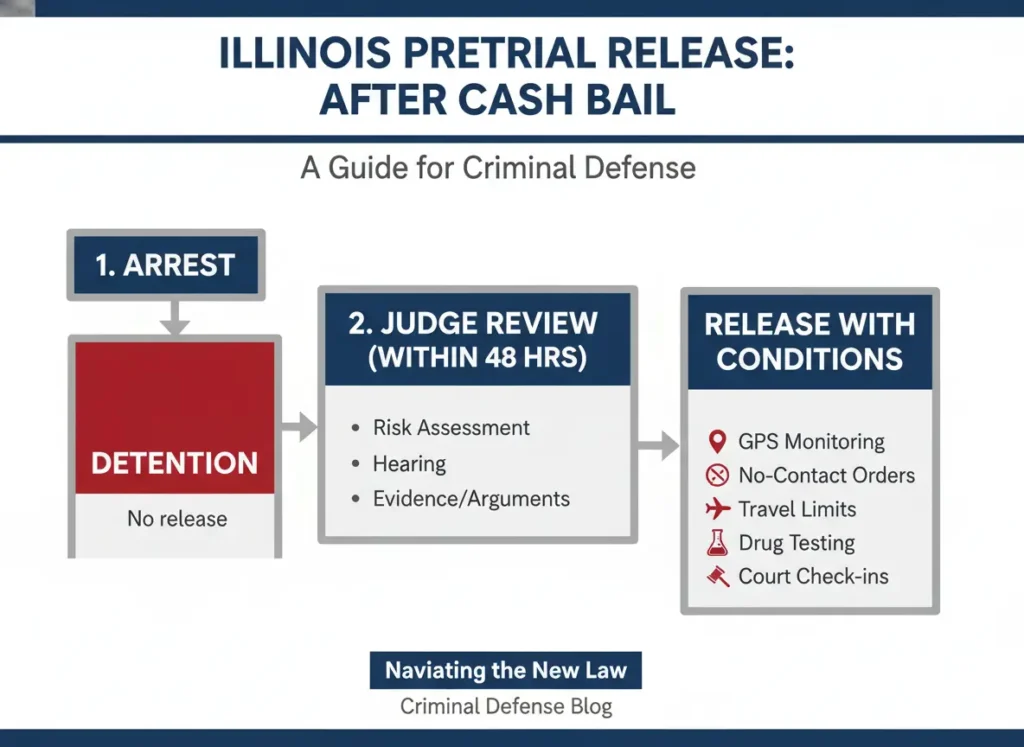
Under Illinois law after the SAFE-T Act, every person arrested faces one of two outcomes before trial: detention or release with conditions.
Detention means you remain in custody until your case is resolved. Under 725 ILCS 5/110, the State must prove at a hearing — by clear and convincing evidence — that you pose a real and present threat to community safety or are a willful flight risk. If the State cannot meet that burden, detention is not an option.
Pretrial release with conditions means you are released but must comply with court-ordered requirements. Those conditions can include electronic monitoring, travel restrictions, no-contact orders, drug testing, or regular check-ins with a pretrial services officer in Sangamon County. Conditions are supposed to be the least restrictive measures necessary for the situation.
The critical difference: money is no longer the deciding factor. Before September 18, 2023, whether you stayed in jail depended largely on whether you could pay cash bail. That system is gone. Now it depends entirely on what the evidence shows about risk — and whether a defense attorney challenges the State’s argument effectively at your detention hearing.
What Are Pretrial Release Conditions?
If you are released, the court will impose conditions to ensure you appear for future hearings and do not pose a safety risk. Common pretrial conditions in Illinois include: regular check-ins with a pretrial services officer, electronic monitoring (GPS ankle bracelet), restrictions on travel outside Sangamon County, no-contact orders with alleged victims or witnesses, prohibition on possessing firearms or other weapons, drug or alcohol testing, and curfews.
Conditions are supposed to be the least restrictive measures necessary. If a judge imposes conditions that are excessive given the charges, a defense attorney can argue for a modification.
What Crimes Can Lead to Pretrial Detention?
Illinois does not permit pretrial detention for every criminal charge. Section 110-6.1 identifies specific offenses and circumstances in which the State may file a verified petition seeking denial of pretrial release.
Depending on the subsection, qualifying cases may include certain forcible felonies, offenses carrying mandatory imprisonment, specified domestic-violence or stalking-related offenses, certain weapons offenses, and other statutorily listed situations.
Even when the charge qualifies, detention is not automatic. The State still must satisfy the statutory requirements at the detention hearing.
Forcible felonies (including murder, sexual assault, robbery, and burglary), domestic violence offenses, stalking, and certain weapons violations are among the offenses that can support a State petition to detain.
For non-detainable offenses, the State cannot seek detention at all. You must be released on conditions.
How a Defense Attorney Challenges Detention at the Hearing
The detention hearing is not a formality. The State has to prove its case, and an attorney who is prepared can challenge that proof in ways that directly affect whether you go home.
The most effective challenges focus on the quality of the State’s evidence. At the detention hearing stage, the prosecution often relies on a police report or a brief proffer rather than live witness testimony. A defense attorney can expose gaps in that account, contest whether the facts actually support the legal standard for detention, and present counter-evidence about your ties to the community, your employment, your family situation, and your history of appearing in court.
If the charge is one where the State is permitted to seek detention, the argument shifts to conditions. Even if some risk exists, the law requires the least restrictive conditions necessary. An attorney can propose a specific conditions package, electronic monitoring, no-contact provisions, travel restrictions and argue that those conditions adequately address the State’s concerns without full detention.
Timing matters. The hearing typically occurs within 48 hours of arrest. That window is short. An attorney who is retained early and has reviewed the charging documents before the hearing is in a significantly stronger position than one who is handed the file in the hallway outside the courtroom.
If you want to understand how long the process may take, read How Long Do Criminal Cases Take in Illinois?.
What Happens If You Violate Pretrial Conditions?
Violating the terms of your pretrial release is a serious matter. The State can file a petition to revoke your release. A judge can then hold a hearing and, if the violation is proven, order you detained until your trial.
An alleged violation of pretrial release conditions may lead the State to seek revocation, modification of conditions, or other sanctions depending on the conduct and applicable statutory requirements. A violation does not automatically mean detention. If you believe you may have accidentally violated a condition, contacting a defense attorney immediately gives you the best chance of avoiding detention.
If release conditions are violated or a missed court date creates a problem, review this guide on unknown warrants in Illinois.
Facing a Pretrial Release or Detention Hearing in Sangamon County?
Pretrial release decisions can affect your freedom, employment, family responsibilities, and defense strategy. Andrew Affrunti can review the detention petition, alleged risk factors, release conditions, court history, and evidence that may support release for cases in Springfield and Sangamon County.
Schedule a Confidential ConsultationFrequently Asked Questions
Did Illinois really eliminate cash bail?
Yes. Illinois eliminated cash bail on September 18, 2023 under the SAFE-T Act. Courts no longer require payment for release. Instead, a judge decides whether you are released with conditions or detained based on risk, not money.
What happens after an arrest in Springfield, Illinois?
After an arrest, you will either be released with conditions or held for a detention hearing. The State must decide quickly whether to seek detention, and the court reviews your case within a short timeframe, often within 48 hours.
Can I be released without paying bail in Illinois?
Yes. Payment is no longer part of the process. If the State does not prove that you are a danger or a flight risk, the court must release you with appropriate conditions.
What are pretrial release conditions in Sangamon County?
Pretrial conditions can include electronic monitoring, travel restrictions, no-contact orders, drug testing, curfews, and check-ins with pretrial services. These conditions must be the least restrictive necessary under Illinois law.
What is a detention hearing and how does it work?
A detention hearing is where the State tries to prove you should remain in custody. The prosecution must show clear and convincing evidence that you are a real threat or a willful flight risk. If they fail, the court must release you.
What crimes can lead to pretrial detention in Illinois?
Serious offenses such as forcible felonies, domestic violence, stalking, and certain weapons charges may qualify for detention. For many lower-level offenses, detention is not allowed and release is required.
How can a defense attorney help at a detention hearing?
A defense attorney challenges the State’s evidence, highlights weaknesses in the case, and argues for release or less restrictive conditions. Early representation can significantly improve your chances of going home instead of staying in custody.
What happens if I violate pretrial release conditions?
Violating conditions can lead to a petition to revoke your release. If proven, the court may order you detained until trial. Even minor violations can trigger serious consequences.
How long can I be held before trial in Illinois?
You can only be held if the court orders detention after a hearing. Otherwise, you must be released with conditions. The timeline depends on the case, but detention is not automatic and must be justified under strict legal standards.
When should I contact a criminal defense attorney after an arrest?
You should contact a defense attorney immediately. Early action allows your attorney to prepare for the detention hearing, challenge the State’s claims, and push for your release as soon as possible.
What happens at a pretrial release hearing in Illinois?
At a pretrial release hearing, the judge reviews the charge, the person’s background, the alleged facts, and any request from the State. The court decides whether the person should be released, released with conditions, or detained. The decision is based on risk and evidence, not money.
Can someone still be held in jail without cash bail in Illinois?
Yes. Illinois removed cash bail, but the court may still detain someone if the State proves detention is legally justified. The focus is whether release would create a safety risk or serious risk of willful flight.
Can family members help before a pretrial release hearing?
Yes. Family members can help by gathering arrest information, court paperwork, employment details, housing information, medical needs, and other facts that may support release or less restrictive conditions.
What should I avoid saying after being released before trial?
Avoid discussing the facts of the case with alleged victims, witnesses, or on recorded jail calls. You should also avoid posting about the case online or making statements that could be used against you.
Can pretrial release conditions be changed in Illinois?
In some cases, a criminal defense attorney may ask the court to modify release conditions if they are too restrictive, difficult to follow, or no longer necessary based on the facts of the case.
Can a defense attorney help prevent detention in Illinois?
Yes. A defense attorney can challenge the State’s detention request, present evidence supporting release, and argue for conditions that address the court’s concerns.
How quickly does a detention hearing happen after an arrest in Illinois?
Detention hearings can occur very early in the case. Once the State files a qualifying petition for detention, Illinois law generally requires a prompt hearing, subject to statutory continuance rules.
Last updated: October 2026. Illinois no longer uses cash bail, but courts can still order pretrial release conditions or detention depending on the case.