
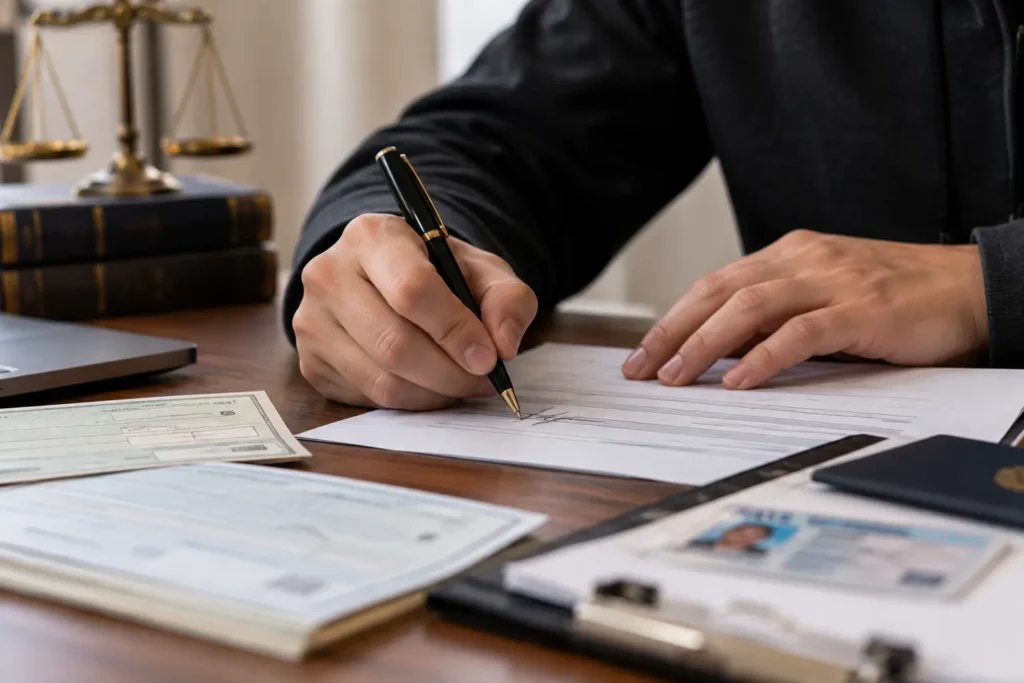
Forgery charges in Illinois can involve more than fake signatures. A forgery case may include checks, contracts, identification documents, financial records, prescriptions, titles, forms, electronic documents, academic credentials, Universal Price Code labels, coins, or other written instruments.
Many people think forgery only means signing someone else’s name. In Illinois, the law is broader. A person may be charged with forgery for making, altering, using, delivering, possessing, or attempting to use certain false documents or items with intent to defraud.
Forgery is often charged as a felony. The exact classification depends on the type of forged item, the conduct involved, and the facts of the case. If you were charged with forgery in Springfield, Sangamon County, or anywhere in Illinois, the key questions are what was allegedly forged, whether you knew it was false, whether there was intent to defraud, and whether the charge is classified correctly.
Quick Answer
Forgery in Illinois usually means knowingly creating, altering, possessing, delivering, issuing, or using a false document, signature, check, record, or other written instrument with intent to defraud. Most forgery charges are Class 3 felonies. Forgery involving only one Universal Price Code Label is generally a Class 4 felony. Forgery of an academic degree or coin is generally a Class A misdemeanor. A Springfield criminal defense attorney can review intent, authorization, identity, document evidence, and possible constitutional issues.
What Is Forgery in Illinois?
Under Illinois law, forgery generally involves knowingly making or altering a document, issuing or delivering a false document, possessing a forged document with intent to deliver it, or unlawfully using another person’s digital signature with intent to defraud.
Forgery may involve:
- Checks
- Signatures
- Contracts
- Titles
- Deeds
- Receipts
- Invoices
- Prescriptions
- Identification documents
- Financial records
- Academic credentials
- Universal Price Code labels
- Coins
- Electronic documents
- Digital signatures
The State must prove more than a false document. Prosecutors usually need to prove knowledge and intent to defraud.
Checks, Documents, and Signatures
Forgery cases often involve checks, documents, or signatures. A person may be accused of signing another person’s name, altering payment details, changing a document, or using paperwork that was not genuine.
Examples may include:
- Signing someone else’s name on a check
- Changing the amount on a check
- Creating a fake contract
- Altering a title or ownership record
- Using a false prescription
- Submitting altered financial documents
- Changing business paperwork
- Using another person’s signature without permission
- Presenting a document known to be false
Not every signature dispute is forgery. The defense may depend on permission, mistake, authorization, business practice, or lack of intent.
Types of Forgery and Classification
Types of Forgery and Classification matter because Illinois law treats different forged items differently.
The main categories include:
- Most forgeries as Class 3 felonies
- Universal Price Code labels as Class 4 felonies when only one UPC label is forged
- Academic degrees or coins as Class A misdemeanors
This means the same general word, forgery, can carry different penalties depending on what was allegedly forged.
Most Forgeries Class 3 Felony
Most Forgeries (Class 3 Felony) are the standard forgery charges in Illinois. The statute states that forgery is a Class 3 felony except for specific exceptions involving one UPC label, academic degrees, or coins.
Class 3 felony forgery may involve:
- Forged checks
- Forged signatures
- Forged contracts
- Forged financial documents
- Forged prescriptions
- Forged titles
- Forged identification-related documents
- Possession of forged documents with intent to deliver
- Delivery or use of a document known to be false
A Class 3 felony is serious. It can create prison exposure, probation, restitution, fines, and a permanent felony record if convicted.
Universal Price Code UPC Labels Class 4 Felony
Universal Price Code (UPC) Labels (Class 4 Felony) are treated differently under Illinois forgery law. Forgery is a Class 4 felony when only one Universal Price Code Label is forged.
A UPC forgery case may involve allegations such as:
- Altering a barcode
- Replacing a price label
- Using a false UPC label
- Changing product pricing through a barcode
- Attempting to scan an item at a lower price
UPC-related forgery may also overlap with theft, retail theft, identity theft, or fraud-related charges depending on the facts.
The word “only” matters. If the case involves more than one label or additional conduct, prosecutors may look at other charges or classifications.
Academic Degrees or Coins Class A Misdemeanor
Academic Degrees or Coins (Class A Misdemeanor) are another specific exception. Illinois law states that forgery is a Class A misdemeanor when an academic degree or coin is forged.
This may involve:
- A fake academic degree
- A false diploma
- A counterfeit or altered academic credential
- A forged coin
- Altered coin-related items
Even though a Class A misdemeanor is less serious than a felony, it is still a criminal charge. A conviction can affect employment, education, licensing, immigration status for non-citizens, and background checks.
Penalties and Sentencing
Penalties and Sentencing depend on whether the forgery is charged as a Class 3 felony, Class 4 felony, or Class A misdemeanor.
Possible consequences may include:
- Jail or prison exposure
- Probation
- Conditional discharge
- Fines and court costs
- Restitution
- Community service
- Criminal record
- Employment consequences
- Professional licensing issues
- Immigration concerns for non-citizens
- Financial consequences from alleged fraud loss
The court may also consider the amount of loss, number of documents, number of alleged victims, prior criminal history, and whether the case involved another charge such as theft, identity theft, drug possession, DUI, or burglary.
Class 3 Felony
Class 3 Felony forgery is the most common classification for most Illinois forgery charges.
A Class 3 felony in Illinois generally carries:
- 2 to 5 years in prison
- Probation if legally available
- Fines and court costs
- Restitution
- Felony record if convicted
- Collateral consequences for work, housing, and licensing
Examples may include forged checks, altered documents, false signatures, forged prescriptions, or knowingly delivering a false document with intent to defraud.
A Class 3 felony forgery charge should be handled carefully because the long-term record impact can be more damaging than people expect.
Class 4 Felony
Class 4 Felony forgery applies when only one Universal Price Code Label is forged under the Illinois forgery statute.
A Class 4 felony in Illinois generally carries:
- 1 to 3 years in prison
- Probation if eligible
- Fines and court costs
- Restitution
- Felony record if convicted
- Background check consequences
Although Class 4 is the lowest felony level in Illinois, it is still a felony. That means the consequences can affect jobs, housing, school, licensing, and future criminal exposure.
Class A Misdemeanor
Class A Misdemeanor forgery applies when an academic degree or coin is forged.
A Class A misdemeanor in Illinois may carry:
- Up to 364 days in jail
- Fines and court costs
- Probation
- Conditional discharge
- Community service
- Restitution if applicable
- Criminal record if convicted
A misdemeanor forgery case can still be serious, especially if it involves employment, school admission, professional credentials, financial loss, or another related offense.
Intent to Defraud
Intent to defraud is one of the most important parts of a forgery case. The State usually must prove that the accused acted with the purpose of deceiving another person, business, government agency, or institution.
Intent may be argued through:
- Use of a false name
- Altered payment information
- Attempts to obtain money, property, services, or benefits
- Possession of multiple forged documents
- Statements made before or after the incident
- Surveillance footage
- Bank or store records
- Digital evidence
- Prior communications
- Attempts to hide or destroy evidence
But intent can also be challenged. A person may possess or use a document without knowing it is false. A person may also have permission, believe the document was valid, or be involved in a misunderstanding.
No intent, no forgery. That is often the fulcrum of the defense.
Common Defense Options
Forgery charges can be defended. The best defense depends on the exact allegation and the evidence.
Common defense options may include:
- Lack of intent to defraud
- Consent or authorization
- Mistake of fact
- No knowledge the document was false
- Mistaken identity
- False accusation
- Insufficient evidence
- No delivery or attempted use
- Document was not legally forged
- Police violated search and seizure rights
- Statements were taken improperly
- Digital evidence is unreliable
A defense attorney may review whether the State can prove who created the document, who used it, who benefited, and whether the accused knew it was false.
Lack of Intent
Lack of intent may apply when the accused did not mean to deceive anyone.
Examples may include:
- Believing the document was valid
- Using a check provided by someone else
- Signing with permission
- Submitting paperwork prepared by another person
- Making a clerical error
- Misunderstanding authorization
- Using a document without knowing it had been altered
Forgery is not supposed to punish honest mistakes. The State must prove the required mental state.
Consent or Authorization
Consent or authorization may be a defense if the accused had permission to sign, use, submit, or modify the document.
This issue may arise in:
- Family financial matters
- Business transactions
- Employer and employee paperwork
- Caregiver situations
- Shared accounts
- Power of attorney misunderstandings
- Informal permission arrangements
- Prior course of dealing
A person may have authority to sign in some situations but not others. The defense may need to review messages, emails, business records, account history, and witness statements to show permission existed.
Mistaken Identity
Mistaken identity can be a major issue in forgery cases. Just because a forged document exists does not prove who made it or used it.
Mistaken identity may involve:
- Similar names
- Shared devices
- Shared bank accounts
- Stolen checks
- Stolen IDs
- Someone else using the accused person’s information
- Poor surveillance footage
- No fingerprints or handwriting proof
- Online account access by another person
The State must connect the accused person to the forged item and the intent to defraud.
Constitutional Violations
Constitutional violations may affect forgery cases when evidence is obtained through an unlawful search, seizure, or interrogation.
Potential issues may include:
- Illegal traffic stop
- Illegal vehicle search
- Illegal phone search
- Illegal computer search
- Invalid warrant
- Overbroad digital search
- Improper seizure of documents
- Statements taken without proper warnings
- Coerced confession
- Lack of probable cause
If evidence was collected illegally, a criminal defense attorney may file a motion to suppress. If important evidence is excluded, the prosecution’s case may become weaker.
Forgery and Other Criminal Charges
Forgery often appears with other charges. A person accused of forgery may also face:
- Theft
- Identity theft
- Credit card fraud
- Retail theft
- Possession of stolen property
- Deceptive practices
- Burglary
- Drug possession
- DUI
- Probation violation
- Financial exploitation
- Official misconduct in rare cases
For example, a forged check case may also involve theft or identity theft. A forged prescription case may also involve drug possession. A forged UPC label case may also involve retail theft. When charges overlap, the defense strategy must address the entire case.
Evidence Used in Forgery Cases
Forgery cases may involve different types of evidence, including:
- Checks
- Bank records
- Store records
- Receipts
- Surveillance video
- Handwriting samples
- Digital signatures
- Emails
- Text messages
- Account records
- Phone or computer data
- Witness statements
- Police reports
- Business records
- Expert analysis
Not all evidence is reliable. Handwriting comparisons, digital records, and witness assumptions should be reviewed carefully. A document may be false, but the State still must prove who knowingly used it and why.
What You Should Do If Charged
If you are charged with forgery in Illinois, take the case seriously.
You should:
- Save all court paperwork
- Identify the exact charge and class
- Write down what happened privately
- Preserve texts, emails, receipts, and records
- Do not contact alleged victims if restricted
- Do not delete digital evidence
- Do not discuss the case online
- Follow all release conditions
- Do not miss court
- Speak with a local criminal defense attorney
Do not try to explain the document issue to police without legal advice. A small statement about who signed what can become a big problem later.
How a Springfield Criminal Defense Attorney Can Help
A Springfield criminal defense attorney can review the charge, classification, evidence, and possible defenses.
An attorney may help by:
- Identifying whether the case is Class 3, Class 4, or Class A
- Reviewing the alleged forged document
- Challenging intent to defraud
- Investigating authorization or consent
- Reviewing bank, store, or business records
- Challenging digital evidence
- Reviewing search and seizure issues
- Filing motions to suppress
- Negotiating with prosecutors
- Seeking reduction or dismissal
- Preparing for trial
- Protecting your record
Forgery cases can be document-heavy and detail-heavy. Small facts can change the entire case.
Speak With a Springfield Forgery Defense Attorney
If you were charged with forgery in Springfield, Sangamon County, or Central Illinois, do not assume the charge is simple because it involves paperwork.
Whether the allegation involves a check, signature, document, UPC label, academic degree, coin, financial record, prescription, or digital signature, the State must still prove knowledge and intent to defraud.
A Springfield criminal defense attorney can explain the charge, review the evidence, and help protect your rights, record, and future.
Final Thoughts
Forgery charges in Illinois can involve checks, documents, signatures, UPC labels, academic degrees, coins, digital signatures, and financial records. Most forgery charges are Class 3 felonies. Forgery involving only one Universal Price Code Label is a Class 4 felony. Forgery involving an academic degree or coin is a Class A misdemeanor.
The most important issues are often intent, knowledge, authorization, identity, and whether the evidence was lawfully obtained. A forged document alone does not automatically prove who made it, who used it, or whether they intended to defraud anyone.
If you were charged with forgery in Springfield or Sangamon County, speak with a local criminal defense attorney as soon as possible. Early defense work can help challenge the evidence, protect your record, and pursue the best available outcome.