
- Quick Answer
- What Is Disorderly Conduct in Illinois?
- What Can Get You Charged
- False Reporting
- False Agency Reports
- Public Disturbances
- Intrusion
- What Happens Next Penalties
- Class C Misdemeanor
- Class B Misdemeanor
- Class A Misdemeanor
- Felony Charges
- Additional Penalties
- Specific Action or Charge
- First Offense?
- Common Defense Issues
- Disorderly Conduct and Other Charges
- What You Should Do After Being Charged
- How a Springfield Criminal Defense Attorney Can Help
- Speak With a Springfield Disorderly Conduct Defense Attorney
- Final Thoughts
Disorderly conduct in Illinois is a broad criminal charge. It can cover public disturbances, false reports, emergency-related calls, certain intrusive conduct, and other actions that police or prosecutors believe created alarm, disruption, or public safety problems.
Many people think disorderly conduct means yelling in public or causing a scene. Sometimes it does. But Illinois disorderly conduct law also covers more serious conduct, including false reports to law enforcement, false emergency calls, false agency reports, and certain behavior involving schools, public buildings, funerals, or emergency response.
The charge level depends on the specific action. Some disorderly conduct cases are Class C misdemeanors. Others may be Class B misdemeanors, Class A misdemeanors, or felonies. If it is a first offense, the outcome may be more flexible in some cases, but a first offense can still create jail exposure, fines, probation, court costs, and a criminal record if convicted.
If you were charged with disorderly conduct in Springfield, Sangamon County, or anywhere in Illinois, the first question is not just “What happened?” It is “Which specific disorderly conduct subsection did the State charge?”
Quick Answer
Disorderly conduct in Illinois can be charged when someone causes a public disturbance, makes a false report, files certain false agency reports, intrudes on another person’s privacy, or engages in other conduct covered by the statute. Penalties depend on the specific action or charge. A first offense may still carry misdemeanor or felony consequences depending on the facts. A Springfield criminal defense attorney can review the charge, evidence, witness statements, and possible defenses.
What Is Disorderly Conduct in Illinois?
Disorderly conduct is not one single type of behavior. It is a category of offenses under Illinois law. The most common form involves knowingly doing something in an unreasonable manner that alarms or disturbs another person and provokes a breach of the peace.
In plain English, disorderly conduct may involve behavior that police believe crossed the line from annoying or rude into disruptive, alarming, or dangerous.
Disorderly conduct cases may involve:
- Public arguments
- Fighting words or threatening behavior
- False police reports
- False emergency calls
- False fire or medical reports
- False agency reports
- Intrusive or privacy-related conduct
- Disturbances at public places
- Disturbances near schools, businesses, or events
- Conduct connected to DUI, theft, drug possession, battery, or a traffic stop
The statute is broad, which means the defense often focuses on the exact words, actions, location, intent, and evidence.
What Can Get You Charged
What Can Get You Charged depends on the conduct police claim happened. Because disorderly conduct covers many situations, two cases with the same charge name can look completely different.
Common examples include:
- Creating a public disturbance
- Making threats in a public place
- Refusing to calm down after police arrive
- Giving false information to police
- Reporting a fake emergency
- Calling in a false threat
- Making false reports to certain public agencies
- Disturbing a funeral or memorial service
- Acting in a way that alarms others and provokes a breach of the peace
- Interfering with public order in a business, school, or public area
A disorderly conduct charge may also be added to other cases. For example, police may charge disorderly conduct after a DUI arrest if the person allegedly causes a scene. A theft investigation may include disorderly conduct if store employees report threats or disruption. A drug possession stop may become more complicated if police claim the person gave false information or created a disturbance.
False Reporting
False Reporting can lead to serious disorderly conduct charges. Illinois law includes several false-report situations, and the penalty depends on what was falsely reported and who received the report.
False reporting may include:
- Making a false report to police
- Reporting a fake crime
- Reporting a fake emergency
- Making a false 911 call
- Reporting a false fire
- Reporting a false request for ambulance or emergency medical help
- Reporting a false bomb, explosive, or dangerous substance threat
- Causing emergency resources to respond unnecessarily
False reporting cases are treated seriously because they can waste emergency resources, create public fear, and place others at risk.
Some false-report offenses under the disorderly conduct statute can be felonies. For example, the Illinois disorderly conduct statute lists certain false bomb or explosive-related reports as a Class 3 felony and includes a mandatory fine of at least $3,000 and no more than $10,000 for that subsection.
False Agency Reports
False Agency Reports involve knowingly making false reports to certain government or public agencies. These cases are different from ordinary public disturbance allegations because they often involve written reports, official complaints, public health concerns, or emergency response systems.
False agency reports may involve:
- False reports to law enforcement
- False reports to a public safety agency
- False reports to fire departments
- False reports involving emergency medical services
- False reports to public health-related agencies
- False reports involving nursing homes or care facilities
- False claims that trigger agency investigation or emergency response
Some false agency report allegations may be charged more seriously than basic disorderly conduct. The key issue is the exact subsection charged.
A defense attorney may review:
- What was reported
- Whether the report was actually false
- Whether the person knew it was false
- Whether there was a good-faith mistake
- Whether the report was made to the type of agency covered by the statute
- Whether the report caused emergency response costs
- Whether statements were taken properly
A false report case often turns on knowledge. Being wrong is not always the same as knowingly lying.
Public Disturbances
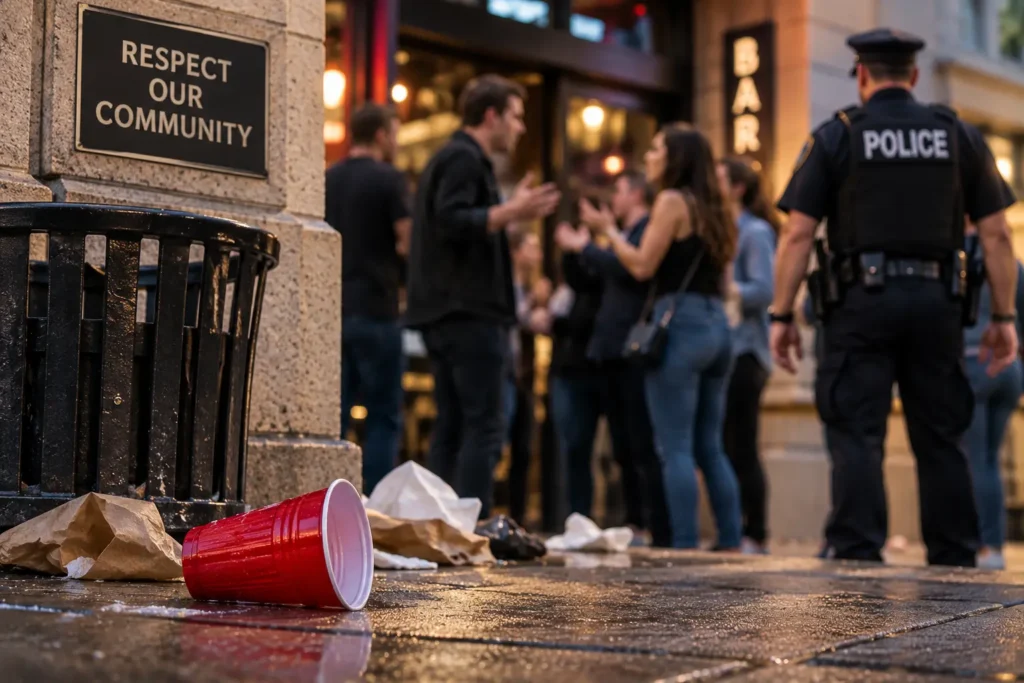
Public Disturbances are the classic disorderly conduct cases people usually imagine. These may involve acting in an unreasonable way that alarms or disturbs others and provokes a breach of the peace.
Public disturbance allegations may involve:
- Loud arguments
- Threatening words or gestures
- Fighting in public
- Causing panic in a business
- Disrupting a public event
- Creating a disturbance near a school
- Refusing to leave after conflict begins
- Aggressive behavior toward employees or customers
- Disturbing neighbors or nearby residents
Basic public disturbance disorderly conduct under subsection (a)(1) is listed as a Class C misdemeanor under Illinois law.
However, the facts matter. Speech alone may raise constitutional issues. The State may need to show more than unpopular words, anger, or embarrassment. The conduct must fit the legal standard.
Intrusion
Intrusion can also lead to disorderly conduct allegations in certain situations. This may involve conduct that invades privacy, creates alarm, or intrudes into places or circumstances where another person has a protected interest.
Intrusion-related disorderly conduct may involve:
- Peeping or looking into a dwelling in certain circumstances
- Entering or remaining in restricted areas
- Interfering with another person’s privacy
- Disturbing people in places where quiet or privacy is expected
- Conduct that overlaps with trespass, harassment, or stalking concerns
These cases may overlap with other charges, such as criminal trespass, harassment, violation of an order of protection, or electronic communication offenses.
The defense may look at whether the person had permission, whether the area was public or private, whether notice was given, and whether the conduct fits the charged statute.
What Happens Next Penalties
What Happens Next (Penalties) depends on the exact charge level. Disorderly conduct is not always punished the same way.
Possible outcomes may include:
- Citation or arrest
- Court date
- Arraignment
- Pretrial release conditions
- No-contact or stay-away order
- Discovery review
- Plea negotiations
- Trial
- Sentencing if convicted
- Court supervision or other alternatives if available
The penalties may depend on:
- Specific action or charge
- Whether it is a first offense
- Whether anyone was harmed
- Whether emergency services responded
- Whether the case involved a school, public building, or protected location
- Whether there was a false report
- Whether the person has prior convictions
- Whether the case is connected to DUI, theft, drug possession, battery, or another charge
This is why the exact subsection matters. “Disorderly conduct” on the ticket is only the beginning of the analysis.
Class C Misdemeanor
Class C Misdemeanor disorderly conduct is commonly associated with the basic public disturbance form of the offense.
A Class C misdemeanor in Illinois can carry:
- Up to 30 days in jail
- Fines
- Court costs
- Probation or conditional discharge
- Community service
- Criminal record if convicted
Illinois sentencing law states that a Class C misdemeanor carries a determinate jail sentence of not more than 30 days and a fine of up to $1,500 unless another amount is specified by law.
For a first offense, the court may consider alternatives depending on the facts, record, and local practice. But “first offense” does not mean “no consequences.” It only means there may be more room to negotiate.
Class B Misdemeanor
Class B Misdemeanor disorderly conduct may apply to certain specific disorderly conduct subsections, including some false-report or agency-report situations depending on the charge.
A Class B misdemeanor in Illinois can carry:
- Up to 6 months in jail
- Fines
- Court costs
- Probation or conditional discharge
- Community service
- Criminal record if convicted
Illinois sentencing law classifies Class B misdemeanors as offenses with imprisonment of 6 months or less but more than 30 days.
A Class B misdemeanor is more serious than a basic Class C charge. The defense should review exactly why the State chose the higher classification.
Class A Misdemeanor
Class A Misdemeanor disorderly conduct can apply to certain more serious disorderly conduct actions, including some false emergency or false report situations depending on the subsection.
A Class A misdemeanor in Illinois can carry:
- Less than one year in jail
- Fines up to $2,500 unless otherwise specified
- Court costs
- Probation
- Conditional discharge
- Community service
- Restitution
- Criminal record if convicted
Illinois sentencing law states that a Class A misdemeanor carries a determinate sentence of less than one year and a fine of up to $2,500 unless another amount is specified by law.
A Class A misdemeanor may also create collateral consequences for employment, housing, licensing, school discipline, and immigration status for non-citizens.
Felony Charges
Felony Charges may apply to certain disorderly conduct allegations, especially serious false-report cases.
Felony disorderly conduct may involve:
- False bomb or explosive threats
- False reports involving dangerous substances
- False public safety reports
- False reports that trigger major emergency response
- Repeat or aggravated false-report conduct
- Certain reports involving schools or public safety agencies
- Conduct charged under related felony statutes
The Illinois disorderly conduct statute lists certain false bomb or explosive-related reports as a Class 3 felony with a mandatory fine between $3,000 and $10,000 in addition to other penalties.
Felony consequences may include:
- Prison exposure
- Felony probation if legally available
- Higher fines
- Restitution
- Emergency response reimbursement
- Permanent felony record
- Employment and housing problems
- Professional licensing issues
- Immigration concerns for non-citizens
A felony disorderly conduct charge is not a “minor disturbance” case. It should be handled urgently.
Additional Penalties
Additional Penalties may apply beyond jail, fines, or probation.
Depending on the facts, a court may order:
- Restitution
- Reimbursement of emergency response costs
- No-contact order
- Stay-away order
- Mental health evaluation
- Anger management
- Community service
- Counseling
- Drug or alcohol evaluation if relevant
- Firearm restrictions in related cases
- Compliance with pretrial release conditions
Illinois law provides that in certain false alarm cases involving a school bomb or explosive threat requiring emergency response, the court must order reimbursement of emergency response costs.
These extra consequences can matter as much as the formal charge level. Sometimes the “side penalties” are where the real sting lives.
Specific Action or Charge
Specific action or charge is the key phrase in disorderly conduct cases. The exact conduct determines the classification.
A public argument may be a Class C misdemeanor. A false agency report may be a different misdemeanor level. A false bomb threat may be a felony. A first offense may be treated differently from repeat conduct, but the action itself still controls the starting point.
A defense attorney should review:
- The citation or complaint
- The exact statutory subsection
- Police reports
- Witness statements
- Body camera footage
- 911 audio
- Dispatch records
- Agency reports
- Public safety response records
- Any alleged false statements
- Whether the conduct actually fits the charge
Without checking the exact subsection, it is easy to misunderstand the risk.
First Offense?
First offense disorderly conduct cases may have more options, but the outcome depends on the facts.
Possible first-offense outcomes may include:
- Dismissal
- Reduction
- Court supervision
- Conditional discharge
- Probation
- Community service
- Fine-only resolution
- Counseling or classes
- Restitution
- No-contact or stay-away agreement
A first offense may be treated more favorably when:
- No one was injured
- No emergency response was wasted
- No weapon was involved
- No false threat was made
- No protected location was involved
- The person has no prior record
- The conduct was brief
- The accused complied with police
- The evidence is weak
But a first offense can still be serious if the case involves a false emergency report, bomb threat, school-related allegation, public safety response, DUI, theft, drug possession, battery, or another criminal charge.
First offense does not erase the charge. It may only affect negotiation and sentencing options.
Common Defense Issues
Disorderly conduct cases can be defended. The right defense depends on the exact allegation.
Possible defenses may include:
- The conduct did not provoke a breach of the peace
- The accusation is exaggerated
- The statement was not knowingly false
- The person made a good-faith report
- The person had reasonable grounds to call for help
- The speech was protected
- The person was misidentified
- Witnesses are unreliable
- Video contradicts the police report
- Police lacked probable cause
- The charged subsection does not fit the facts
- The incident was a misunderstanding
- Emergency response costs were not caused by the accused
The defense may also challenge whether prosecutors overcharged the case. A noisy argument is not the same as a false emergency threat.
Disorderly Conduct and Other Charges
Disorderly conduct may appear by itself or with other charges.
Related charges may include:
- DUI
- Theft
- Drug possession
- Battery
- Criminal trespass
- Resisting or obstructing
- Violation of an order of protection
- Harassment
- Stalking
- Weapons charges
- Probation violation
For example, a person arrested for DUI may also face disorderly conduct if police claim they caused a disturbance during the stop. A theft case may include disorderly conduct if store employees claim threats were made. A drug possession case may become more serious if police allege false statements or disruption.
When charges overlap, the defense strategy must address the whole case.
What You Should Do After Being Charged
If you are charged with disorderly conduct in Illinois, take the case seriously.
You should:
- Save the ticket, complaint, or court paperwork
- Identify the exact charge and subsection
- Write down what happened privately
- Save texts, calls, videos, or messages
- Identify witnesses
- Preserve receipts, location records, or other proof
- Do not contact alleged victims or complaining witnesses
- Follow all no-contact or stay-away orders
- Do not post about the case online
- Speak with a criminal defense attorney
Do not assume the case is “just disorderly.” That phrase can hide very different penalties.
How a Springfield Criminal Defense Attorney Can Help
A Springfield criminal defense attorney can review the charge, evidence, and possible defenses.
An attorney may help by:
- Identifying the exact disorderly conduct subsection
- Reviewing police reports
- Requesting body camera footage
- Reviewing 911 recordings
- Checking dispatch records
- Challenging false report allegations
- Challenging public disturbance claims
- Negotiating first-offense options
- Seeking reduction or dismissal
- Preparing for trial
- Protecting your record
The goal is to reduce the damage and pursue the best available outcome based on the facts.
Speak With a Springfield Disorderly Conduct Defense Attorney
If you were charged with disorderly conduct in Springfield, Sangamon County, or Central Illinois, do not rely on the charge name alone. The specific action or charge determines the risk.
Whether the case involves a public disturbance, false report, false agency report, intrusion, DUI, theft, drug possession, battery, or another allegation, early legal help can make a difference.
A Springfield criminal defense attorney can explain the charge, review the evidence, and help protect your rights and record.
Final Thoughts
Disorderly conduct in Illinois can include public disturbances, false reporting, false agency reports, intrusive conduct, and other actions covered by the statute. Penalties can range from a Class C misdemeanor to a Class B misdemeanor, Class A misdemeanor, or felony charge depending on the exact conduct.
For a first offense, there may be more room for negotiation, but the charge can still create jail exposure, fines, court costs, probation, restitution, emergency response costs, and a criminal record if convicted.
If you were charged with disorderly conduct in Springfield or Sangamon County, speak with a criminal defense attorney as soon as possible. Early defense work can help identify the exact charge, challenge the evidence, and pursue the best available outcome.