
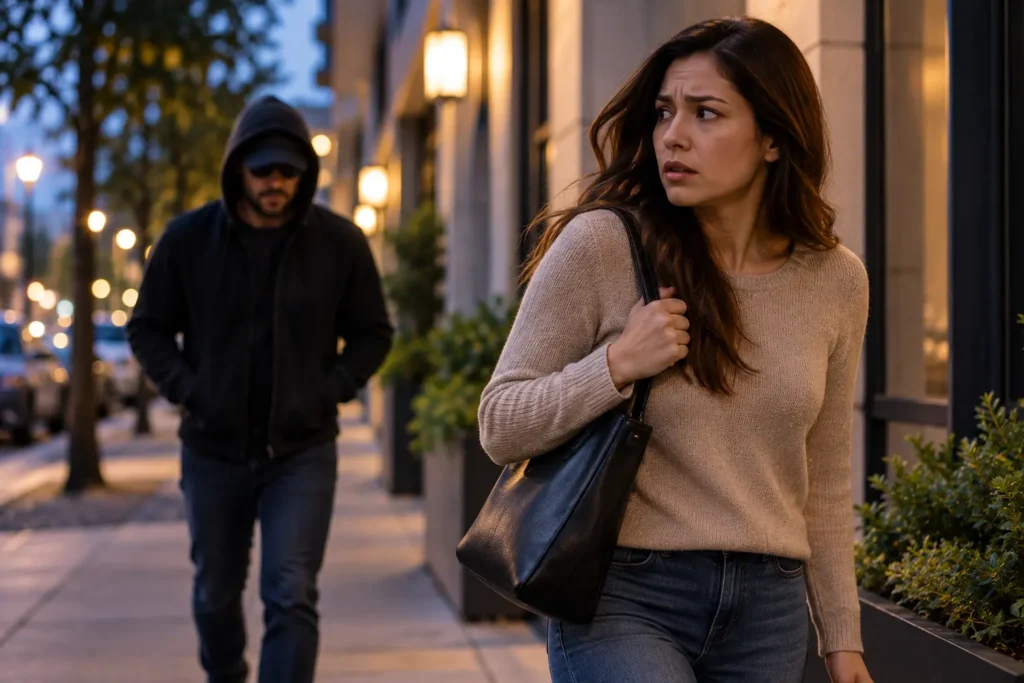
Stalking charges in Illinois can arise when repeated contact, surveillance, threats, tracking, online messages, or unwanted communication crosses the line into criminal conduct. What may begin as texts, calls, visits, social media contact, or showing up in person can become a felony if prosecutors believe the conduct was repeated, knowingly directed at someone, and would cause a reasonable person to fear for safety or suffer emotional distress.
Stalking cases often involve online and in-person behavior. A person may be accused of following someone, appearing at their home or workplace, sending repeated messages, monitoring their location, contacting them through fake accounts, or continuing communication after being told to stop.
Illinois also allows civil protective measures, including a Stalking No Contact Order, and in some situations an Order of Protection may apply if the people involved have the required domestic or family relationship.
If you were charged with stalking in Springfield, Sangamon County, or anywhere in Illinois, the key issues are whether there were two or more qualifying acts, whether the conduct was knowingly directed at the person, whether the reasonable person standard is met, and whether the evidence supports a criminal stalking charge.
Quick Answer
Stalking in Illinois generally requires a course of conduct, meaning two or more acts, knowingly directed at a specific person, that would cause a reasonable person to fear for safety or suffer emotional distress. Stalking is generally a Class 4 felony, and a second or subsequent conviction can become a Class 3 felony. Cyberstalking, in-person tracking, incarcerated contact, and repeated unwanted messages may all trigger charges depending on the facts. Civil remedies may include a Stalking No Contact Order, protective order, or other court restrictions.
The Legal Threshold: When Contact Becomes Stalking
The Legal Threshold: When Contact Becomes Stalking depends on more than one text, one call, or one awkward encounter. Illinois stalking law focuses on repeated conduct and the effect that conduct would have on a reasonable person.
The State may look at:
- Number of contacts
- Type of contact
- Whether contact was unwanted
- Whether threats were made
- Whether the person was followed
- Whether digital accounts were used
- Whether tracking devices or apps were involved
- Whether the accused knew the contact was unwanted
- Whether the alleged victim feared for safety
- Whether emotional distress resulted
- Whether a protective order already existed
Not every uncomfortable interaction is stalking. But repeated conduct can become serious quickly, especially when online and in-person contact are combined.
The “Two-Strike” Rule Course of Conduct
The “Two-Strike” Rule (Course of Conduct) is a simple way to understand one key part of Illinois stalking law. The statute defines “course of conduct” as 2 or more acts, including acts where someone directly, indirectly, or through third parties follows, monitors, observes, surveils, threatens, or communicates with or about a person, among other listed conduct.
This does not mean any two contacts automatically equal stalking. The State still needs to prove the required legal elements. But the “two or more acts” requirement is important because stalking usually involves a pattern, not a single isolated moment.
Examples of a possible course of conduct may include:
- Showing up at someone’s workplace twice
- Sending repeated unwanted messages
- Calling and then appearing at the person’s home
- Following the person and later contacting them online
- Using two different social media accounts to reach them
- Asking another person to deliver messages after being blocked
- Monitoring someone’s location more than once
The exact facts matter. Two normal messages are not the same as two threatening or invasive acts.
Two Separate Incidents
Two separate incidents may satisfy the course-of-conduct requirement if the incidents fit the statute and are connected to the alleged stalking behavior.
Examples may include:
- One in-person encounter and one threatening message
- Two unwanted visits
- Repeated online messages over different days
- Multiple calls after being told to stop
- Following someone on one day and appearing near their home another day
- Contacting the person directly, then through a friend
- Sending messages from one account, then another account after being blocked
The defense may challenge whether the incidents were truly separate, whether they were knowingly directed at the alleged victim, and whether they would meet the reasonable person standard.
A stalking case often turns on context. A message that seems harmless alone may look different when paired with repeated visits, tracking, or threats. That is where the legal analysis gets granular.
The Reasonable Person Standard
The Reasonable Person Standard asks whether the conduct would cause a reasonable person to fear for their safety or suffer emotional distress. This is not based only on what the alleged victim personally felt, although their experience may still be evidence.
The question is whether the conduct would cause a reasonable person in that situation to react with fear or distress.
A court may consider:
- The history between the parties
- Prior threats
- Prior violence
- Frequency of contact
- Time and location of contact
- Whether the contact continued after warnings
- Whether the person showed up at private places
- Whether messages were threatening or obsessive
- Whether tracking or surveillance was involved
- Whether children, family members, or coworkers were contacted
This standard helps separate ordinary conflict from criminal stalking. Annoying, rude, or embarrassing conduct is not automatically stalking. But repeated behavior that creates fear or emotional distress can lead to felony charges.
Knowingly Directed
Knowingly Directed means the State must connect the accused person’s conduct to the specific alleged victim. The issue is not just whether the person acted, but whether the conduct was knowingly directed at that person.
Examples may include:
- Sending messages directly to the person
- Appearing at places the person is known to be
- Tagging, posting about, or contacting the person online
- Contacting the person’s family, employer, or friends
- Using another person to send messages
- Tracking the person’s location
- Sending threats related to the person
The defense may challenge this element if the contact was accidental, misinterpreted, directed at someone else, or not knowingly connected to the alleged victim.
For example, being in the same public place is not always stalking. But repeatedly appearing at specific places after being told not to contact someone may create a very different case.
Common Actions That Trigger Charges
Common Actions That Trigger Charges may include both online/digital contact and in-person actions.
Stalking allegations may involve:
- Repeated texts
- Repeated calls
- Social media messages
- Fake accounts
- Emails
- Contact through friends or family
- Showing up at home
- Showing up at work
- Following someone
- Watching someone from a distance
- Tracking location
- Threatening messages
- Contact after being blocked
- Contact after a protective order
- Messages sent from jail or prison
- Public posts meant to intimidate or harass
Some cases involve one type of conduct. Others involve a mix of digital and physical contact.
Physical Tracking
Physical Tracking may include following, monitoring, watching, or appearing near someone repeatedly.
Examples may include:
- Following someone in a car
- Waiting outside a home
- Showing up at a workplace
- Appearing at a school, gym, church, or business
- Watching from a parked vehicle
- Repeatedly driving by a residence
- Following someone in public places
- Leaving items or notes at a location
Physical tracking can be especially serious because it may make the alleged victim feel unsafe in places where they should feel secure.
The defense may review whether the locations were public, whether there was a legitimate reason to be there, whether the conduct was actually repeated, and whether the accused person knowingly targeted the alleged victim.
Cyberstalking
Cyberstalking is stalking behavior that occurs through electronic communication or digital tools. Illinois law separately addresses cyberstalking under 720 ILCS 5/12-7.5, including certain repeated electronic communications, threats, and use of electronic monitoring software or spyware in ways covered by the statute. Cyberstalking is generally a Class 4 felony, with a second or subsequent conviction treated as a Class 3 felony.
Cyberstalking may involve:
- Repeated unwanted texts
- Repeated emails
- Social media messages
- Fake profiles
- Online threats
- Posting about the alleged victim repeatedly
- Contacting friends or family online
- Tracking through apps
- Spyware or monitoring software
- Location sharing without permission
- Harassing posts or comments
Online contact can create real criminal exposure. Screenshots, account logs, IP data, call records, and social media records may become evidence.
Digital contact is not “less serious” just because it happens through a screen. The internet is not a magic invisibility cloak. Screenshots have entered the chat.
Incarcerated Contact
Incarcerated Contact means contact made while someone is in jail, prison, or another penal institution. Illinois stalking law states that incarceration of a person who commits the course of conduct or transmits a threat is not a bar to prosecution under the stalking statute.
This matters because a person may still face stalking allegations based on:
- Jail calls
- Prison calls
- Letters
- Messages sent through third parties
- Contact through other inmates
- Threats made from custody
- Repeated attempts to communicate despite restrictions
A person in custody may also violate no-contact orders, protective orders, or pretrial release conditions by attempting to communicate with a protected person.
Penalties and Escalations
Penalties and Escalations depend on the charge, criminal history, and whether other orders or offenses are involved.
Possible consequences may include:
- Felony conviction
- Prison exposure
- Probation if legally available
- Fines and court costs
- No-contact orders
- Stay-away orders
- Stalking No Contact Order
- Firearm restrictions in some cases
- Loss of FOID card rights in some circumstances
- Restitution or counseling requirements
- Immigration concerns for non-citizens
- Employment and housing consequences
- Violation of probation or pretrial release
Illinois stalking is generally a Class 4 felony, while a second or subsequent conviction is a Class 3 felony.
Civil Protective Measures
Civil Protective Measures may be available even when a criminal case is not yet resolved. These are court orders designed to stop contact and protect the petitioner.
Civil protective measures may include:
- Stalking No Contact Order
- Emergency order
- Plenary order
- Order of Protection in qualifying domestic or family cases
- Civil injunction or other court relief in certain situations
- Workplace or school-related safety restrictions
Civil orders are separate from criminal prosecution. A person can face both a criminal stalking charge and a civil protective order.
Stalking No-Contact Order SNCO
Stalking No-Contact Order (SNCO) is a civil court order under the Illinois Stalking No Contact Order Act. Illinois law defines a stalking no contact order as an emergency order or plenary order granted under the Act that includes authorized remedies.
An SNCO may order the respondent to:
- Stop contacting the petitioner
- Stay away from the petitioner
- Stay away from specific locations
- Stop contacting family or household members in certain circumstances
- Stop surveillance or monitoring
- Follow other court-ordered restrictions
Illinois law states that stalking victims should be able to seek a civil remedy requiring offenders to stay away from victims and third parties.
Violating a stalking no contact order can create additional legal problems. If an SNCO is entered, read it carefully and follow every term.
Class A Misdemeanor
Class A Misdemeanor may come up in related cases, even though stalking itself is generally charged as a felony under Illinois law. Some related conduct, order violations, harassment-related allegations, or other offenses may be charged at the misdemeanor level depending on the statute and facts.
A Class A misdemeanor in Illinois generally carries less than one year in jail and may include fines, probation, conditional discharge, court costs, and a criminal record if convicted.
Possible related misdemeanor issues may include:
- Harassment-type conduct charged under a different statute
- Disorderly conduct
- Violation of certain court conditions
- Communication-based offenses
- Related domestic or protective order conduct depending on facts
The key is to check the exact charge. “Stalking” and “stalking-related behavior” are not always charged the same way.
Class 4 Felony
Class 4 Felony is the general classification for stalking and cyberstalking in Illinois.
A Class 4 felony may involve:
- Repeated unwanted contact
- Physical following or tracking
- Threatening course of conduct
- Cyberstalking
- Electronic monitoring or spyware allegations
- Repeated contact that causes fear or emotional distress
- Conduct after prior warnings
- Contact connected to a protective order or civil injunction
A Class 4 felony in Illinois generally carries 1 to 3 years in prison, although probation may be available in some cases depending on the charge, criminal history, and circumstances. Sentencing can become more serious for later convictions or related violations.
A felony stalking charge can have long-term consequences even if no physical contact occurred.
Order of Protection
Order of Protection may apply when the parties have a qualifying relationship under Illinois domestic violence law, such as certain family, household, dating, spouse, former spouse, co-parent, or related relationships.
An Order of Protection may restrict:
- Contact
- Communication
- Residence access
- Workplace or school contact
- Firearm possession in some cases
- Parenting time in some situations
- Third-party contact
- Harassment, intimidation, or interference
An Order of Protection is different from a Stalking No Contact Order. An SNCO is often used when the relationship does not fit domestic violence order requirements, while an Order of Protection is tied to domestic or family-type relationships.
If a protective order already exists, any contact can create added criminal risk. Even a “friendly” message can become a violation if the order says no contact. The order controls, not the mood of the message.
Online/Digital Contact or In-Person Actions
Online/digital contact or in-person actions can both support stalking allegations.
Online or digital contact may include:
- Texts
- Calls
- Emails
- Social media messages
- Fake accounts
- Commenting on posts
- Tagging
- Location tracking
- Spyware
- Contact through apps
- Sending photos, videos, or threats
In-person actions may include:
- Following
- Watching
- Showing up at home
- Showing up at work
- Appearing at school
- Driving by repeatedly
- Waiting outside
- Leaving items
- Contacting friends, relatives, or coworkers
The State may combine online and in-person acts to argue there was a course of conduct. The defense may challenge whether the acts were truly directed at the person, whether they caused the required fear or distress, and whether the conduct was protected, accidental, or misunderstood.
Protective Order or Civil Injunction
A protective order or civil injunction can change the entire case. Once a court order exists, conduct that might otherwise be argued as unclear can become a direct violation if it breaches the order’s terms.
Important rules include:
- Read every line of the order
- Do not contact the protected person unless the order clearly allows it
- Do not use friends or family to pass messages
- Do not contact through fake accounts
- Do not show up at restricted locations
- Do not respond to contact unless legally permitted
- Keep proof of compliance
- Ask the court to modify the order if changes are needed
Do not assume contact is allowed because the protected person reached out first. If the order restricts you, you must follow it unless the court changes it.
Common Defense Issues in Stalking Cases
Stalking cases can be defended. The right strategy depends on the evidence, relationship history, messages, timelines, and protective orders.
Possible defense issues include:
- No course of conduct
- Fewer than two qualifying acts
- Contact was not knowingly directed
- No credible threat or required emotional distress
- Reasonable person standard not met
- Misidentification
- Fake account not connected to the accused
- Messages taken out of context
- Protected speech issues
- Accidental or lawful presence
- Legitimate purpose for contact
- No intent to harass, threaten, or intimidate
- Protective order terms were unclear
- Digital evidence is incomplete or unreliable
- Police obtained evidence unlawfully
The defense may also review whether prosecutors are using isolated awkward or emotional communication to support a felony charge. Not every bad breakup becomes stalking. But repeated unwanted contact after warnings can create serious legal risk.
Evidence Used in Stalking Cases
Evidence may include:
- Text messages
- Call logs
- Emails
- Social media screenshots
- Direct messages
- Location data
- GPS or tracking app records
- Doorbell camera footage
- Security footage
- Witness statements
- Police reports
- Prior warnings
- Protective orders
- Jail call recordings
- Letters
- Account login records
Screenshots should be reviewed carefully. They may not show the whole conversation, dates may be unclear, and context may be missing.
What You Should Do If Charged
If you are charged with stalking in Illinois, take immediate steps to protect yourself legally.
You should:
- Stop all contact unless your attorney tells you otherwise
- Follow every court order exactly
- Save all messages and call logs
- Do not delete evidence
- Do not post about the case online
- Do not contact the alleged victim through friends
- Avoid restricted places listed in any order
- Write down a timeline privately
- Save proof of your location if relevant
- Speak with a criminal defense attorney
Do not try to explain yourself to the alleged victim. That can create new evidence or a new violation.
How a Springfield Criminal Defense Attorney Can Help
A Springfield criminal defense attorney can review the charge, evidence, and possible defenses.
An attorney may help by:
- Reviewing the alleged course of conduct
- Challenging the two-incident requirement
- Reviewing texts, emails, and social media evidence
- Challenging digital evidence
- Reviewing GPS or tracking claims
- Challenging protective order violations
- Reviewing whether the conduct was knowingly directed
- Evaluating reasonable person standard issues
- Negotiating with prosecutors
- Seeking reduction or dismissal
- Preparing for trial
- Protecting your record
Stalking cases are evidence-heavy. Small details in timing, wording, and context can matter.
Speak With a Springfield Stalking Defense Attorney
If you were charged with stalking, cyberstalking, or violating a protective order in Springfield, Sangamon County, or Central Illinois, do not handle the case casually.
Whether the allegation involves online contact, in-person actions, physical tracking, incarcerated contact, a Stalking No Contact Order, an Order of Protection, or another civil injunction, early legal help can make a major difference.
A Springfield criminal defense attorney can explain the charge, review the evidence, and help protect your rights, record, and future.
Final Thoughts
Stalking charges in Illinois usually involve repeated conduct, not just one isolated contact. The State often focuses on the course of conduct, the two or more acts requirement, the reasonable person standard, and whether the conduct was knowingly directed at the alleged victim.
Stalking and cyberstalking are generally Class 4 felonies, with more serious consequences for later convictions or related order violations. Civil protective measures, such as a Stalking No Contact Order, Order of Protection, or civil injunction, can also create strict no-contact rules.
If you were accused of stalking in Springfield or Sangamon County, speak with a criminal defense attorney as soon as possible. Early defense work can help challenge the alleged pattern, review digital evidence, and protect your record.