
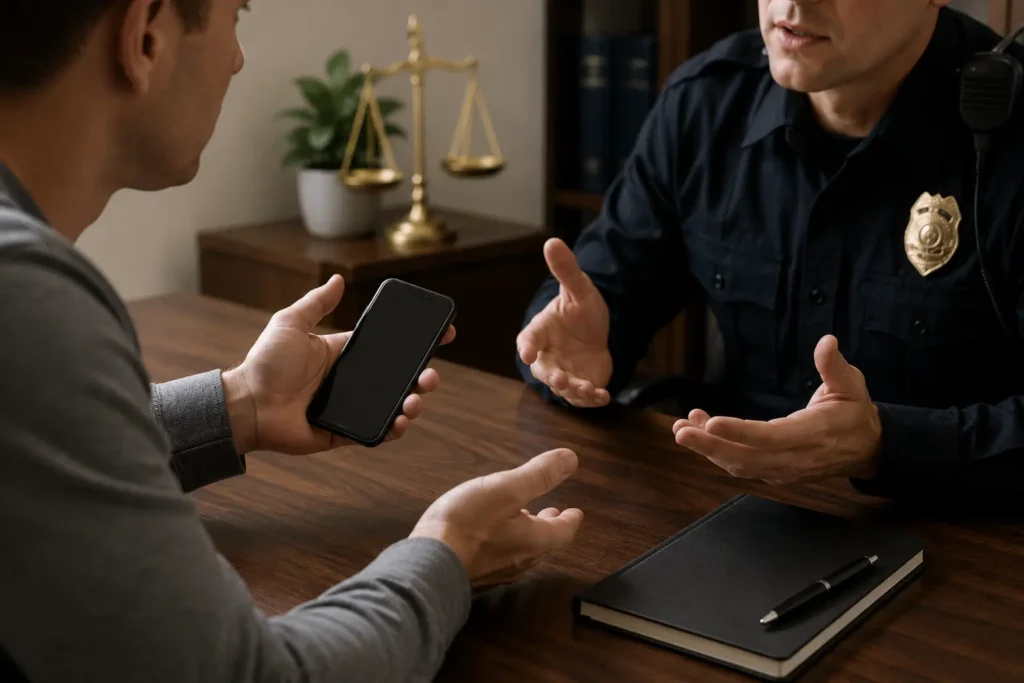
- Can police search your phone without a warrant in Illinois?
- When Illinois Police Need a Warrant to Search Your Phone
- Exceptions That May Allow a Warrantless Phone Search
- Why Smartphones Receive Stronger Privacy Protection
- Why Police Usually Need a Search Warrant for Phone Data
- When Police May Access Phone Data Without a Warrant
- How Consent Can Allow Police to Search Your Phone
- When an Emergency May Justify a Warrantless Phone Search
- How Plain View and Third-Party Records Affect Phone Searches
- What Police Can Legally Do With Your Phone During an Investigation
- Can Police Seize Your Phone Without Searching It?
- Can Police Use Your Fingerprint or Face to Unlock Your Phone?
- Can Police Force You to Provide Your Phone Passcode?
- Your Rights When Police Ask to Search Your Phone
- Mistakes to Avoid When Police Want to Search Your Phone
- What to Do If Police Already Searched Your Phone
- Criminal Cases Where Phone Evidence Commonly Matters
- Can Illegally Obtained Phone Evidence Be Thrown Out?
- Why Early Legal Help Matters After a Phone Search
- Worried About an Illinois Phone Search?
- Frequently Asked Questions
- Can police search your phone after an arrest in Illinois?
- Can police seize your phone without searching it?
- What counts as consent for a phone search?
- Does a traffic stop allow police to search my phone?
- Can police force you to provide your phone passcode in Illinois?
- Can police use your fingerprint or face to unlock your phone?
- Can evidence from an illegal phone search be thrown out?
- What should you do if police already searched your phone?
- Bottom Line: Phone Searches Usually Require a Warrant
Your phone is not just a phone. It is your messages, photos, videos, banking apps, location history, emails, social media accounts, call logs, passwords, and private conversations. For many people, it holds more personal information than their home, wallet, and car combined.
So what happens if police stop you, arrest you, or question you in Illinois and ask to search your phone?
In most cases, police cannot search the contents of your phone without a warrant. A phone search is treated differently from checking your pockets, looking inside a bag, or taking items from you during an arrest. Digital information receives strong constitutional protection because of how much private data a phone contains.
However, there are exceptions. Police may be able to seize the phone, secure it, ask for consent, act in an emergency, use information already visible on the screen, or seek data from third parties through legal process. That is why knowing your rights matters before you answer questions or unlock your device.
Quick Answer
Can police search your phone without a warrant in Illinois?
Generally, no. Police usually need a search warrant before accessing the digital contents of your phone, even after an arrest. Limited exceptions may apply, including valid consent or genuine exigent circumstances. Police may sometimes seize and secure the physical device while seeking a warrant, but taking possession of the phone does not automatically give them authority to search its messages, photos, apps, or other private data.
When Illinois Police Need a Warrant to Search Your Phone
Illinois courts generally require police to obtain a search warrant to access phone contents. A warrant protects your Fourth Amendment rights and ensures that any evidence collected is legally admissible.
- Accessing text messages, emails, and call logs
- Downloading apps or cloud data
- Searching photos or videos stored on the device
Exceptions That May Allow a Warrantless Phone Search
- Consent: Voluntary permission may allow police to search within the scope of the consent given.
- Exigent circumstances: A genuine emergency may justify limited warrantless access in some situations.
- Plain view: Information already visible without manipulating or opening the phone may raise different issues.
- Third-party records: Some information held by service providers may be obtained through the appropriate legal process.
An arrest by itself does not generally allow police to search the digital contents of a phone under the search-incident-to-arrest exception.
Why Smartphones Receive Stronger Privacy Protection
A phone search is not like opening a glove box or checking a backpack. A smartphone can reveal years of private activity.
Police may find:
- Text messages
- Photos and videos
- Emails
- Social media messages
- Call records
- Search history
- GPS and location data
- Financial apps
- Medical information
- Private notes
- Cloud accounts
- Deleted or hidden files
Because phones contain so much personal information, courts treat digital searches with special caution. Police cannot automatically search your phone just because you were arrested.
That means an officer may be allowed to take the phone from you, but that does not always mean the officer may open it and start looking through your data.
Why Police Usually Need a Search Warrant for Phone Data
The general rule is simple. Police usually need a search warrant before they can search the contents of your phone. In Riley v. California, the U.S. Supreme Court held that police generally must obtain a warrant before searching digital information on a cell phone seized from an arrested person.
A warrant should describe what police are allowed to search for and where they are allowed to search. In a phone case, that may involve specific apps, messages, photos, date ranges, files, contacts, or other digital evidence.
A warrant does not always give police unlimited permission to search everything forever. The scope of the warrant matters.
For example, if police are investigating a specific drug transaction, the warrant may focus on messages, call logs, photos, or app data connected to that investigation. If police search far beyond what the warrant allows, your attorney may be able to challenge the evidence.
When Police May Access Phone Data Without a Warrant
Although the warrant requirement is strong, it is not absolute. Police may argue that an exception allowed them to search or access phone-related information without first getting a warrant.
The most common exceptions include consent, exigent circumstances, plain view, and third-party data.
How Consent Can Allow Police to Search Your Phone
Consent is one of the biggest exceptions. If you voluntarily give police permission to search your phone, they may not need a warrant.
This can happen when an officer says something like:
- “Can I look through your phone?”
- “Do you mind opening your messages?”
- “Can you unlock it for me?”
- “You have nothing to hide, right?”
- “Just show me the conversation.”
You are allowed to say no. Refusing consent is not the same as resisting arrest, and it is not an admission of guilt.
A clear response may be:
“I do not consent to a search of my phone.”
If police search your phone after you clearly refused consent, the defense may be able to challenge the search. If you agree, unlock the phone, hand it over, or help officers find information, police may argue that you gave valid consent.
Consent can become complicated if police pressure you, threaten you, mislead you, or keep asking after you refuse. That is why it is usually safer to politely decline and ask for an attorney.
When an Emergency May Justify a Warrantless Phone Search
Exigent circumstances are emergency situations where police may argue they needed to act immediately without waiting for a warrant.
Examples may include:
- A threat of imminent harm
- A kidnapping or missing person situation
- A bomb threat
- Active violence
- A need to prevent immediate destruction of evidence
- A situation where someone’s life or safety is at risk
This exception is narrow. Police cannot simply say they were curious, wanted to move fast, or thought the phone might contain evidence. They usually need a real emergency.
For example, if police believe a phone contains information that could help locate a person in immediate danger, they may argue that exigent circumstances justified limited access.
However, even in an emergency, the search should usually be limited to the emergency purpose. Police should not use a safety concern as an excuse to browse through unrelated photos, apps, or messages.
How Plain View and Third-Party Records Affect Phone Searches
Plain view can apply when police lawfully see something without searching for it.
For example, if your phone screen is already lit up and a message appears while the phone is in plain view, police may argue they did not search the phone because the information was visible. This does not always give police permission to open the phone and keep searching.
Plain view is limited. Seeing one notification is not the same as having permission to scroll through your conversations.
Third-party data is another issue. Some phone-related information is not stored only on your device. It may also be held by phone companies, app providers, cloud services, social media platforms, or internet companies.
Police may try to get certain records from third parties, such as:
- Subscriber information
- Call detail records
- Cloud backups
- Social media records
- App account information
- Location-related data
- Stored messages
Depending on the type of data, police may need a warrant, subpoena, court order, or other legal process. Your attorney may review whether the government used the correct process and whether the request was too broad.
What Police Can Legally Do With Your Phone During an Investigation
Even when police cannot search your phone immediately, they may still take certain actions during an arrest or investigation.
Can Police Seize Your Phone Without Searching It?
Police may be allowed to seize the phone to preserve evidence while they apply for a warrant. This means they can take physical control of the device so it is not destroyed, hidden, altered, or wiped.
Seizing the phone is different from searching it.
Police may:
- Take the phone from your hand or pocket
- Place it into evidence
- Turn it off
- Put it in airplane mode
- Use a signal-blocking bag
- Hold it while seeking a warrant
However, taking the phone does not automatically allow officers to open your apps, read your texts, check your gallery, or search private data.
Can Police Use Your Fingerprint or Face to Unlock Your Phone?
Biometric unlocking includes fingerprint scans, facial recognition, and similar features. This area of law can be complicated and may depend on the facts, the warrant, the jurisdiction, and how police attempt to unlock the device.
Police may try to use biometrics to unlock a phone, especially if the phone is taken while still active. They may argue that a fingerprint or face scan is physical evidence rather than testimony.
However, phone unlocking raises serious constitutional issues. A defense attorney may review whether the police had a warrant, whether the warrant covered unlocking, whether you were forced to act, whether the method was lawful, and whether your rights were violated.
If police ask you to unlock your phone with your face, finger, or passcode, do not argue or physically resist. Instead, clearly say that you do not consent and that you want to speak with a lawyer.
Can Police Force You to Provide Your Phone Passcode?
Fingerprint and facial-recognition unlocking raise different constitutional issues from manually entering a passcode. Whether police may compel biometric unlocking can depend on the warrant, the method used, applicable case law, and the facts of the investigation.
A warrant authorizing the search of a phone does not necessarily resolve every question about how officers may unlock it, so the method used to gain access may still be reviewed by a defense attorney.
Illinois law treats compelled phone unlocking as a fact-specific Fifth Amendment issue. In People v. Sneed, the Illinois Supreme Court held that entering a passcode can be testimonial because it communicates that the person can unlock the device. However, the court also held that the foregone conclusion doctrine may permit compelled entry when the State already knows the relevant facts with sufficient particularity.
Whether police or prosecutors can compel a passcode therefore depends on the warrant, what the State already knows, and the circumstances of the case.
A safe response is:
“I do not consent to a search of my phone. I want to speak with a lawyer.”
Do not lie about the passcode. Do not delete data. Do not physically resist. Just clearly invoke your rights.
Your Rights When Police Ask to Search Your Phone
If police ask to search your phone in Illinois, you have rights.
You have the right to:
- Stay silent
- Refuse consent
- Ask whether police have a warrant
- Ask to see the warrant
- Ask what the warrant allows
- Ask for an attorney
- Avoid giving your passcode voluntarily
- Avoid explaining what is on the phone
- Avoid answering questions about messages, photos, apps, or contacts
You do not need to explain why you are refusing. You do not need to prove you are innocent. You do not need to help police search your own device.
The best approach is calm, clear, and simple.
Say:
“I do not consent to a search of my phone. I want to speak with an attorney.”
Then stop talking about the phone.
Mistakes to Avoid When Police Want to Search Your Phone
A phone search situation can get stressful quickly. What you do in that moment can affect the case.
Do not:
- Physically fight police for the phone
- Delete messages or photos
- Factory reset the phone
- Tell someone else to delete evidence
- Give false information
- Guess about what police may find
- Explain private conversations
- Unlock the phone because you feel pressured
- Sign a consent form without legal advice
- Post about the search online
Trying to destroy evidence can create new criminal problems. Even if the original case is weak, deleting data or telling someone to hide evidence can make things worse.
What to Do If Police Already Searched Your Phone
If police already searched your phone, that does not mean the evidence is automatically allowed in court.
A criminal defense attorney may review:
- Whether police had a warrant
- Whether the warrant was valid
- Whether the warrant was too broad
- Whether police searched outside the warrant
- Whether you gave consent
- Whether consent was voluntary
- Whether an exception actually applied
- Whether police used biometrics lawfully
- Whether third-party records were obtained properly
- Whether evidence should be suppressed
If the search violated your rights, your attorney may file a motion to suppress. A motion to suppress asks the court to keep illegally obtained evidence out of the case.
This can be a major turning point in criminal defense. If key phone evidence is suppressed, the prosecution’s case may become weaker. If phone evidence is being used in a criminal investigation or prosecution, a criminal defense attorney in Springfield, Illinois can review the warrant, consent, seizure, search scope, and whether a motion to suppress may be appropriate.
Criminal Cases Where Phone Evidence Commonly Matters
Phone searches may come up in many Illinois criminal cases, including:
- Drug cases
- DUI investigations
- Domestic battery cases
- Theft allegations
- Weapons charges
- Harassment or stalking allegations
- Solicitation cases
- Fraud investigations
- Probation violation cases
- Juvenile cases
- Traffic stop investigations
- Conspiracy allegations
Police often look for texts, photos, call logs, social media messages, location data, and app activity to connect a person to an alleged offense.
Because phone evidence can be powerful, it must be challenged carefully.
Can Illegally Obtained Phone Evidence Be Thrown Out?
If police access your phone without a warrant or applicable exception, a defense attorney can file a motion to suppress evidence. Courts will review whether constitutional rights were violated.
Why Early Legal Help Matters After a Phone Search
If your phone was seized or searched in Illinois, do not wait to get legal help. Phone evidence can shape the entire case.
A defense attorney can help determine whether police crossed the line and whether the evidence can be challenged.
An attorney may:
- Review the warrant
- Challenge an illegal search
- File a motion to suppress
- Review consent issues
- Examine biometric unlocking issues
- Investigate third-party data requests
- Protect your Fifth Amendment rights
- Communicate with prosecutors
- Build a defense strategy based on the facts
The earlier you get help, the better chance your attorney has to protect your rights before the case moves too far.
Worried About an Illinois Phone Search?
If police seized or searched your phone, the legality of the search may depend on whether officers had a valid warrant, obtained voluntary consent, relied on a recognized exception, or stayed within the scope of the authority they had. Reviewing those details early can help determine whether digital evidence may be challenged.
Schedule a Confidential ConsultationFrequently Asked Questions
Can police search your phone after an arrest in Illinois?
Police generally need a warrant before searching the digital contents of a phone seized during an arrest. An arrest by itself does not create automatic authority to search messages, photos, apps, or other stored data.
Can police seize your phone without searching it?
Potentially. Police may sometimes seize and secure a phone while seeking a warrant or preserving evidence. Seizing the physical device does not automatically authorize a search of its digital contents.
What counts as consent for a phone search?
Consent must generally be voluntary. Police may argue that permission was given verbally, in writing, or through conduct such as unlocking the phone and allowing officers to access it. The scope of the consent also matters.
Does a traffic stop allow police to search my phone?
No. A traffic stop by itself does not authorize police to search the digital contents of your phone. Police generally need a warrant or a recognized exception such as valid consent or exigent circumstances.
Can police force you to provide your phone passcode in Illinois?
Possibly in some circumstances. Illinois courts treat compelled passcode entry as a fact-specific Fifth Amendment issue. Whether it may be compelled can depend on what the State already knows, the warrant, and whether the foregone conclusion doctrine applies.
Can police use your fingerprint or face to unlock your phone?
Biometric unlocking raises separate constitutional questions. Whether police may compel it can depend on the warrant, the method used, applicable case law, and the specific circumstances.
Can evidence from an illegal phone search be thrown out?
Potentially. A defense attorney may ask the court to suppress evidence obtained through an unlawful search. Whether suppression applies depends on how the evidence was obtained and whether a constitutional or statutory violation occurred.
What should you do if police already searched your phone?
Preserve any paperwork related to the seizure or warrant, avoid deleting or altering data, do not post about the investigation, and have an attorney review how the phone was seized, unlocked, searched, and used as evidence.
Bottom Line: Phone Searches Usually Require a Warrant
Police generally need a warrant to search the private digital contents of a phone. An arrest alone does not authorize that search. Exceptions such as consent or exigent circumstances may apply, and police may sometimes seize the device while seeking legal authority to search it.
Whether a search was lawful depends on the warrant, scope of consent, circumstances of the seizure, and how officers accessed the data.