
- Quick Answer
- Illinois Self-Defense Tools and Their Legal Status at a Glance
- When Pepper Spray and Mace Can Lead to Criminal Charges
- Illinois Taser and Stun Gun Rules You Need to Know
- When Carrying a Knife Can Trigger a Weapons Charge
- Why Batons and Brass Knuckles Carry Higher Legal Risk
- Common Criminal Charges Involving Self-Defense Tools
- When Using a Self-Defense Tool Can Lead to Aggravated Battery Charges
- Locations Where Self-Defense Tools Can Become Illegal
- How Illinois Self-Defense Law Treats Retreat and Use of Force
- What Police and Prosecutors Look for in Self-Defense Tool Cases
- Defense Options for Illinois Self-Defense Tool Charges
- What To Do After a Self-Defense Tool Arrest in Illinois
- Facing Weapons Charges in Springfield?
- Frequently Asked Questions
- Is pepper spray legal for self-defense in Illinois?
- Do you need a FOID card for a Taser or stun gun in Illinois?
- Are brass knuckles illegal in Illinois?
- Are knives legal to carry in Illinois?
- Does saying I carried a weapon for self-defense make possession legal?
- Can a passenger be charged for a weapon found in a vehicle?
- Can illegally obtained weapon evidence be suppressed?
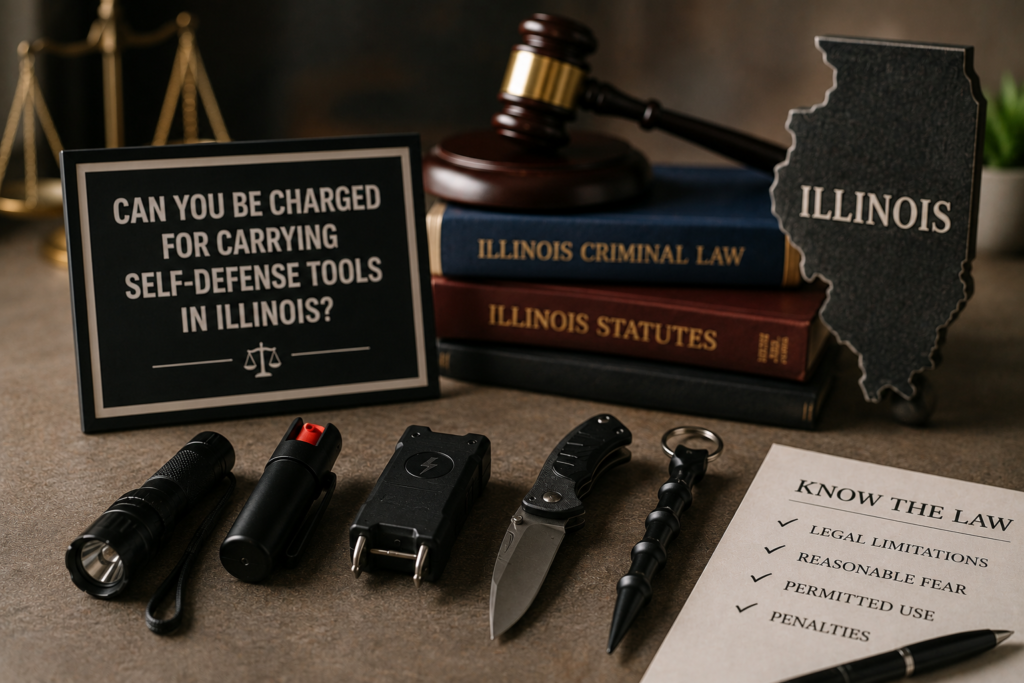
- Can you be charged for carrying a self-defense tool in Illinois?
- Can police charge me if a self-defense tool was found during a vehicle search?
Many people carry self-defense tools because they want to feel safer. Pepper spray, a pocketknife, a stun gun, or another personal safety device may seem harmless when the goal is protection. In Illinois, however, carrying the wrong item in the wrong place can lead to serious criminal charges.
Illinois weapons laws are strict, and the law does not always treat self-defense tools the way ordinary people expect. Some tools may be legal to possess under certain conditions, while others may be banned, restricted, or treated as weapons depending on how they are carried or used.
If you were arrested or questioned for carrying a self-defense tool in Illinois, the most important question is not just what you had. Police and prosecutors may also look at where you had it, how it was carried, whether it was concealed, whether you used it, and whether they believe you intended to use it unlawfully.
Quick Answer
Illinois does not treat every self-defense tool the same. Pepper spray may be lawful for personal defense under applicable rules, while Tasers, stun guns, knives, brass knuckles, and other weapons may be subject to different possession, FOID, location, intent, and use restrictions. Even a lawfully possessed self-defense tool can lead to criminal charges if possession is prohibited in the circumstances or the use of force is not legally justified.
Illinois Self-Defense Tools and Their Legal Status at a Glance
| Tool | General Illinois Rule | Important Issue |
|---|---|---|
| Pepper spray / personal-defense spray | Generally permitted for personal defense when the statutory requirements are met. | Age, purpose, use of the spray, location, and other applicable law. |
| Stun gun / Taser | Illinois residents generally need a valid FOID card to acquire or possess one unless an exception applies. | FOID eligibility, manner of carrying, location, and alleged unlawful use. |
| Ordinary knife | Not generally prohibited merely because of blade length under statewide weapons law. | Knife type, intent, location, local ordinance, and statutory exception. |
| Switchblade | Regulated under Section 24-1(a)(1), with a statutory exception for a person with a currently valid Illinois FOID card. | FOID status and whether the item meets the statutory definition. |
| Brass knuckles / knuckle weapon | Generally prohibited under Section 24-1(a)(1). | Knowing possession, item classification, and possible location enhancement. |
| Firearm | Subject to separate FOID, concealed-carry, transportation, possession, and location rules. | Do not apply knife, Taser, or spray rules to firearm possession. |
Illinois does not apply one rule to every self-defense tool.
Important distinctions include:
- Whether the item is specifically prohibited
- Whether a FOID card is required
- Whether unlawful intent is an element
- Whether the tool is carried in a restricted location
- Whether another statute or local ordinance applies
- Whether the item was merely possessed or actually used
A person’s statement that an item was carried “for self-defense” does not automatically make otherwise prohibited possession lawful, but lawful possession also does not automatically make every use of the tool criminal.
When Pepper Spray and Mace Can Lead to Criminal Charges
Illinois weapons law generally allows a person age 18 or older to carry an object containing a non-lethal noxious substance when it is designed solely for personal defense.
The legal issue can change when the spray is actually used.
Potential questions include:
- Was there an imminent unlawful threat?
- Was the spray used for protection or retaliation?
- Did the person continue using force after the threat ended?
- Was the person the initial aggressor?
- Did the circumstances support a legally justified use of force?
Possessing personal-defense spray and using it against another person are separate legal questions.
Illinois Taser and Stun Gun Rules You Need to Know
Illinois regulates stun guns and Tasers under both the Criminal Code and the Firearm Owner’s Identification Card Act.
Unless an exemption applies, an Illinois resident generally must have a valid FOID card to acquire or possess a stun gun or Taser.
Additional issues can include:
- How the device was carried or transported
- Where it was possessed
- Whether the person was legally eligible to possess it
- Whether prosecutors allege an intent to use it unlawfully
- Whether it was actually used against another person
A FOID card does not automatically make every manner of carrying or using a Taser lawful.
For the detailed rules, review Illinois Taser and stun gun laws.
When Carrying a Knife Can Trigger a Weapons Charge
Illinois does not impose one general statewide blade-length rule that makes every ordinary knife over a particular length illegal.
Instead, knife cases can depend on:
- The type of knife
- Whether the knife is specifically regulated
- Whether a statutory exception applies
- Alleged intent to use the knife unlawfully against another
- The location
- Local ordinances
- The circumstances in which the knife was found
For example, Section 24-1 separately regulates switchblades and ballistic knives and also addresses dangerous knives, daggers, dirks, and stilettos when accompanied by the unlawful intent required by subsection (a)(2).
For a detailed breakdown, review Illinois knife laws and what knives may be legal to carry.
Why Batons and Brass Knuckles Carry Higher Legal Risk
Brass knuckles are specifically addressed by Illinois weapons law.
Section 24-1(a)(1) prohibits knowingly selling, manufacturing, purchasing, possessing, or carrying metal knuckles or another knuckle weapon regardless of its composition.
Other impact weapons require separate analysis. A baton, billy, bludgeon, or similar object should not automatically be treated as legally identical to brass knuckles because the applicable subsection and required intent can differ.
Relevant issues may include:
- The exact item
- How it was carried
- Knowing possession
- Statements about intended use
- Location
- Whether the item falls within the specific statutory language
For the knuckle-weapon rules specifically, review Illinois brass knuckles laws and penalties.
Common Criminal Charges Involving Self-Defense Tools
The precise charge depends on the item and alleged conduct.
Possible charges can involve:
- Unlawful possession of weapons
- A location-based weapons offense
- Possession by a prohibited person
- Battery or aggravated battery
- Assault-related allegations
- Other offenses arising from the same incident
Do not assume that every self-defense-tool case is simply an “unlawful use of weapons” charge. The charging document should be checked for the exact statute and subsection.
When Using a Self-Defense Tool Can Lead to Aggravated Battery Charges
Using a self-defense tool against another person may create battery or aggravated-battery allegations depending on the resulting injury, the object used, the alleged victim, the location, and the statutory subsection prosecutors rely on.
A claim of self-defense requires a separate analysis.
Under Section 7-1, a person may use force when and to the extent they reasonably believe it is necessary to defend against another person’s imminent use of unlawful force. Force intended or likely to cause death or great bodily harm is subject to a higher statutory standard.
The existence of a self-defense tool does not itself prove whether the use of force was justified or criminal.
Locations Where Self-Defense Tools Can Become Illegal
Location restrictions depend heavily on the particular item.
Illinois weapons law contains special provisions involving certain weapons in locations such as:
- Schools
- Courthouses
- Certain government property
- Public transportation property or vehicles
- Certain establishments licensed to sell alcohol
- Certain public gatherings
But not every listed location applies identically to pepper spray, knives, Tasers, brass knuckles, and firearms.
The correct approach is to identify:
- The item involved
- The statute governing that item
- The specific location
- Any applicable local ordinance or separate law
Avoid using a generic “restricted locations” list as though every self-defense tool is regulated the same way.
How Illinois Self-Defense Law Treats Retreat and Use of Force
Illinois self-defense law focuses primarily on whether the person reasonably believed the use of force was necessary to defend against another person’s imminent use of unlawful force.
Force intended or likely to cause death or great bodily harm is justified only under the more demanding circumstances stated in Section 7-1.
Defense of a dwelling is governed separately by Section 7-2, which addresses force used to prevent or terminate unlawful entry or an attack on a dwelling.
Avoid describing Illinois simply as either a “stand your ground state” or a “duty to retreat state.” The justification analysis depends on the statutory elements, the threat, the amount of force used, and the surrounding facts.
What Police and Prosecutors Look for in Self-Defense Tool Cases
Investigators may focus on:
- Who owned the item
- Where it was found
- Who had access
- Statements about intended use
- Whether another confrontation had occurred
- Video or witness evidence
- Whether the item was actually used
- Whether the search was lawful
Statements made during a police encounter can become evidence regarding knowledge, possession, intent, or use.
A criminal defense attorney in Springfield can review whether police properly obtained evidence and whether the charges are supported by the facts.
If the item was discovered during a traffic stop, vehicle search, home search, or warrant execution, the legality and scope of the search may also matter.
Defense Options for Illinois Self-Defense Tool Charges
Defense issues depend on the exact weapon and subsection charged.
Knowing Possession
An item found near someone does not always establish knowing possession. Shared cars, residences, bags, or storage areas can raise questions about knowledge and control.
Weapon Classification
The defense may examine whether the seized object actually falls within the statutory category alleged.
Required Intent
Some Illinois weapons provisions require proof of an intent to use an item unlawfully against another person, while other prohibited-weapon provisions do not contain that same intent element.
FOID Status or Other Statutory Exception
FOID status or another statutory exception can be important for certain items, such as switchblades or Tasers.
Illegal Search or Seizure
Evidence found during an unlawful search may be subject to a suppression motion.
Justified Use of Force
When the case involves actual use of the tool rather than mere possession, the defense may examine whether the force was legally justified under Illinois self-defense law.
A successful argument on one issue does not automatically guarantee dismissal. The result depends on the remaining evidence and exact charge.
What To Do After a Self-Defense Tool Arrest in Illinois
After an arrest involving a self-defense tool:
- Keep the charging document, release paperwork, and court notices.
- Identify the exact statute and subsection charged.
- Preserve photographs of the item.
- Record where police say it was found.
- Preserve FOID information if a Taser, stun gun, or switchblade is involved.
- Identify other people who had access to the place where the item was discovered.
- Preserve video, receipts, messages, and witness information.
- Avoid unnecessary additional statements about ownership or intended use.
- Follow all pretrial release conditions.
- Have the weapon classification, search, possession evidence, and any self-defense claim reviewed before making major case decisions.
Facing Weapons Charges in Springfield?
A self-defense tool charge can depend on the exact item, possession rules, FOID requirements, location, alleged intent, search legality, and how the tool was used. Andrew Affrunti can review the charging statute, police evidence, possession issues, search circumstances, and possible defenses for weapons cases in Springfield and Sangamon County.
Schedule a Confidential ConsultationLearn more about specific weapons:
- Brass Knuckles Laws in Illinois
- Taser & Stun Gun Laws in Illinois
- Weapons Found During Traffic Stops
- Criminal Defense Attorney in Springfield, IL
Frequently Asked Questions
Is pepper spray legal for self-defense in Illinois?
Illinois state weapons law generally permits a person age 18 or older to carry a non-lethal noxious spray designed solely for personal defense. How the spray is used can still lead to criminal charges if the use of force is not legally justified.
Do you need a FOID card for a Taser or stun gun in Illinois?
Generally, yes for an Illinois resident. The Illinois FOID Act generally requires a valid FOID card to acquire or possess a stun gun or Taser unless a statutory exception applies.
Are brass knuckles illegal in Illinois?
Yes. Illinois generally prohibits knowingly selling, manufacturing, purchasing, possessing, or carrying metal knuckles or another knuckle weapon regardless of its composition.
Are knives legal to carry in Illinois?
Many ordinary knives are not prohibited merely because of blade length, but legality depends on the knife type, statutory exceptions, alleged intent, location, and local ordinances.
Does saying I carried a weapon for self-defense make possession legal?
Not automatically. Some items are prohibited regardless of a general self-defense explanation, while other weapons statutes depend on intent or circumstances.
Can a passenger be charged for a weapon found in a vehicle?
Potentially. Prosecutors still need evidence connecting the passenger to the required knowing possession or control. Mere presence near an item does not necessarily resolve the possession question.
Can illegally obtained weapon evidence be suppressed?
Potentially. A defendant may ask the court to suppress evidence obtained through an unlawful search or seizure. Whether suppression is granted and how it affects the case depend on the facts and remaining admissible evidence.
Can you be charged for carrying a self-defense tool in Illinois?
Yes. Charges may depend on the type of tool, where it was carried, whether possession was lawful, whether restrictions applied, and how the item was allegedly used.
Can police charge me if a self-defense tool was found during a vehicle search?
Potentially. The legality of the search, ownership, access to the item, and evidence connecting a person to possession may affect whether charges can proceed.