

Quick Answer
Spousal maintenance in Illinois is not automatic. A court first decides whether support is appropriate by reviewing each spouse’s income, property, financial needs, earning ability, marriage length, health, and standard of living. When the statutory guidelines apply, maintenance is generally calculated using 33.3 percent of the paying spouse’s net income minus 25 percent of the receiving spouse’s net income, subject to a 40 percent combined-income cap.
- What Factors Affect Spousal Maintenance in Illinois?
- What Is Spousal Maintenance in Illinois?
- How Illinois Courts Calculate Spousal Maintenance
- How Illinois Courts Calculate Spousal Maintenance Payments
- A Simple Example
- The Illinois Maintenance Formula Explained
- Why Online Alimony Calculators Often Get It Wrong
- What Income Counts for Spousal Maintenance in Illinois?
- How Long Spousal Maintenance Lasts in Illinois
- Types of Spousal Maintenance Awards
- When Spousal Maintenance Ends Automatically
- When Maintenance Can Be Modified or Terminated
- Does Cohabitation End Maintenance in Illinois
- How to Modify Spousal Maintenance in Sangamon County
- What Evidence Helps in an Illinois Maintenance Case?
- Why Spousal Maintenance Decisions Affect Long-Term Finances
- Talk to a Springfield Family Law Attorney About Spousal Maintenance
- Can Spousal Maintenance Be Modified in Illinois?
- When Does Spousal Maintenance End in Illinois?
- Need Help Calculating or Changing Spousal Maintenance?
- Frequently Asked Questions
- Is spousal maintenance automatic in an Illinois divorce?
- How is spousal maintenance calculated in Illinois?
- Does the Illinois maintenance formula apply to every divorce?
- How long does spousal maintenance last in Illinois?
- Can maintenance be changed after divorce?
- Does maintenance end when the receiving spouse remarries?
- Does living with a new partner end maintenance?
- Can maintenance be modified retroactively?
When spouses divorce in Illinois, one of the most important financial questions is whether either spouse will receive maintenance, commonly called alimony. Maintenance is not awarded simply because one spouse earns more than the other.
The court must first determine whether support is appropriate by reviewing the parties’ income, property, needs, earning capacity, health, marriage length, standard of living, childcare responsibilities, and other statutory factors. Only after making that decision does the court calculate the possible amount and duration.
For divorces in Springfield and Sangamon County, accurate income records and evidence of financial need can significantly affect the result. Bonuses, commissions, business income, employment benefits, career sacrifices, and future earning ability may all become disputed issues.
What Factors Affect Spousal Maintenance in Illinois?
Spousal maintenance is not automatic in an Illinois divorce. The court first decides whether one spouse needs support and whether the other spouse has the ability to pay. The judge then reviews several factors before deciding the amount, duration, and terms of support.
| Factor | Why It Matters |
|---|---|
| Income and property of each spouse | The court reviews each spouse’s income, assets, debts, and property awarded in the divorce. |
| Financial needs of each spouse | A spouse seeking support must show a real financial need based on expenses, obligations, and available resources. |
| Present and future earning capacity | The judge looks at each spouse’s ability to earn income now and in the future. |
| Time needed for education or training | If one spouse needs time to become self-supporting, that may affect the maintenance decision. |
| Standard of living during the marriage | The court may consider the lifestyle established during the marriage when reviewing support. |
| Length of the marriage | Longer marriages often lead to longer maintenance periods if support is awarded. |
| Age and health of each spouse | Medical issues, disability, or age-related limits may affect income and support needs. |
| Childcare responsibilities | If one spouse has primary childcare duties, that may limit work availability or earning capacity. |
| Tax consequences | The court may review how maintenance affects each spouse financially after taxes. |
| Any valid agreement between spouses | Prenuptial, postnuptial, or settlement agreements may affect maintenance rights. |
What Is Spousal Maintenance in Illinois?
Spousal maintenance exists to address the financial imbalance that often results when one spouse sacrificed career advancement, education, or earning capacity to support the marriage or raise children. It is a financial bridge intended to help the lower-earning spouse maintain a reasonable standard of living while building toward self-sufficiency after the divorce.
Illinois law makes maintenance gender-neutral. Either spouse can seek it, and either spouse can be ordered to pay it regardless of who filed for divorce.
The court does not automatically grant maintenance. Under 750 ILCS 5/504, the court must first review a set of statutory factors to determine whether an award is appropriate at all. These include the income and property of each spouse (including marital property being divided in the divorce), the realistic earning capacity of both parties now and in the future, any impairment to the requesting spouse’s earning capacity caused by time devoted to domestic duties or delayed education and career development during the marriage, the length of the marriage, the standard of living established during the marriage, the age and health of both spouses, and any existing premarital or postmarital agreements.
Only after finding that maintenance is appropriate does the court move to calculating the amount and duration. The fact that one spouse earns less than the other is not by itself enough to guarantee a maintenance award.
How Illinois Courts Calculate Spousal Maintenance
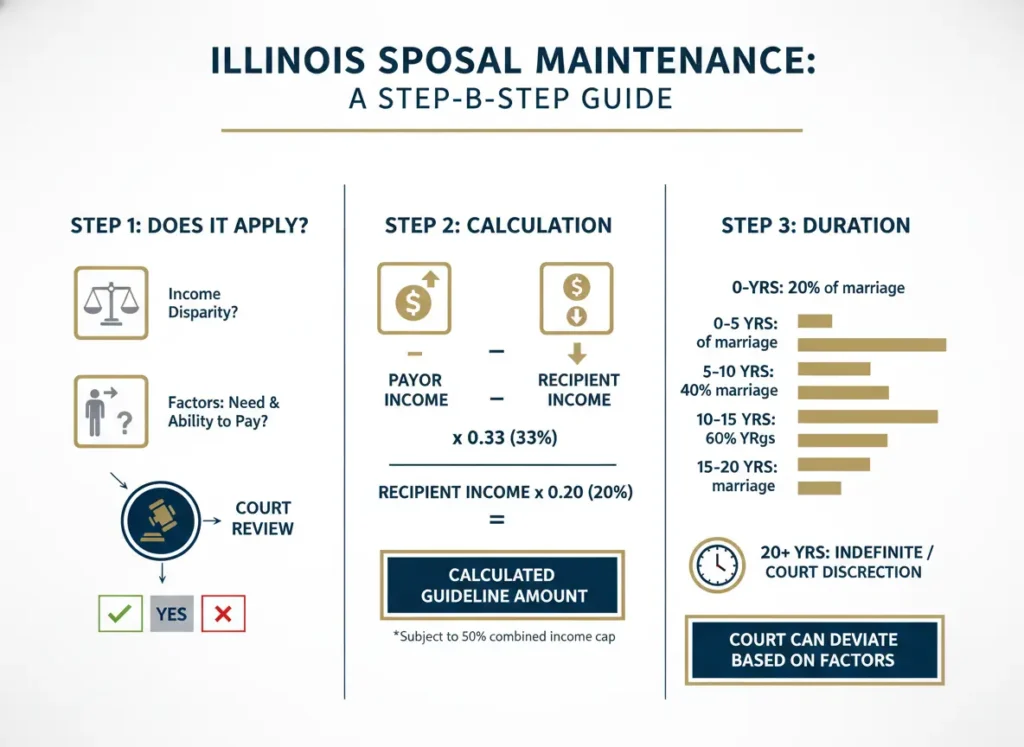
For divorces where the combined gross income of both spouses is less than $500,000 per year and neither party has prior child support or maintenance obligations from a previous relationship, Illinois courts use a statutory formula under 750 ILCS 5/504(b-1)(1)(A).
The formula works as follows: take 33.3 percent of the paying spouse’s net annual income and subtract 25 percent of the receiving spouse’s net annual income. The result is the annual maintenance amount.
There is a cap. The maintenance payment, when added to the receiving spouse’s own income, cannot push that spouse’s total income above 40 percent of the couple’s combined net income. If the formula produces a number that would exceed that threshold, the maintenance amount is reduced to stay within the 40 percent cap.
For maintenance purposes, net income is determined under the statutory income rules rather than by looking only at the amount deposited into a spouse’s bank account. The calculation may involve gross income, applicable taxes, Social Security or self-employment taxes, mandatory retirement contributions, and other permitted adjustments.
Income may include more than base salary. Bonuses, commissions, overtime, self-employment income, rental income, investment income, recurring employment benefits, and other compensation may affect the calculation. Disputes frequently arise when income fluctuates or one spouse owns a business.
| Calculation Step | How It Works |
|---|---|
| Step 1 | Calculate 33.3% of the paying spouse’s net annual income. |
| Step 2 | Calculate 25% of the receiving spouse’s net annual income. |
| Step 3 | Subtract Step 2 from Step 1 to estimate annual maintenance. |
| Step 4 | Apply the 40% cap based on the spouses’ combined net income. |
| Step 5 | Review whether a statutory deviation or different calculation is appropriate. |
How Illinois Courts Calculate Spousal Maintenance Payments
Illinois courts generally consider statutory guidelines when determining maintenance amounts and duration, but judges may also review the specific circumstances of each marriage.
| Factor | Why It Matters |
|---|---|
| Income of both spouses | Determines financial ability and need. |
| Length of marriage | May affect how long maintenance continues. |
| Standard of living during marriage | Helps evaluate reasonable financial needs. |
| Age and health | May affect employment ability and future earning potential. |
| Education and career history | Shows earning capacity and financial independence. |
| Contributions during marriage | Includes homemaking, childcare, and career support. |
A Simple Example
If the paying spouse has a net monthly income of $6,500 and the receiving spouse has a net monthly income of $2,500, the formula produces: ($6,500 x 33.3%) minus ($2,500 x 25%) = $2,165 minus $625 = $1,540 per month. The combined net income is $9,000. Forty percent of that is $3,600. Adding $1,540 to the receiving spouse’s $2,500 gives $4,040, which exceeds $3,600. In that case, the maintenance would be adjusted downward so the receiving spouse’s total does not exceed $3,600 per month.
When children are involved, maintenance and Illinois child support may both affect the parties’ financial obligations.
The Illinois Maintenance Formula Explained
When combined gross income exceeds $500,000 per year, or when a party has prior maintenance or child support obligations from a previous relationship, the formula does not automatically apply. In those cases, the court uses the 14 statutory factors in 750 ILCS 5/504(a) to determine an appropriate amount on a case-by-case basis. Even in formula cases, a court can deviate from the guideline amount if the specific facts of the case justify a different result.
Why Online Alimony Calculators Often Get It Wrong
Online alimony calculators can give a rough estimate, but they do not decide whether maintenance will actually be awarded in the first place. In Illinois, the court must first determine whether maintenance is appropriate, and even when the statutory formula applies, the final number can still be limited by the 40 percent cap or adjusted based on the facts of the case. That means a calculator can help you understand the range, but it cannot replace a case-specific review of income, marriage length, and the statutory factors that drive the court’s decision.
What Income Counts for Spousal Maintenance in Illinois?
Spousal-maintenance calculations may involve more than regular wages. Courts may examine salaries, bonuses, commissions, overtime, self-employment earnings, business distributions, rental income, investment income, pensions, and other recurring sources of compensation.
Income can become particularly complicated when one spouse owns a business, receives irregular bonuses, is paid partly in cash, has recently changed employment, or voluntarily earns less than their qualifications would reasonably allow.
Tax returns, pay stubs, profit-and-loss statements, bank records, employment contracts, and business records may be needed to establish each spouse’s actual income. A court may also examine whether income has been deferred, understated, or manipulated during the divorce.
How Long Spousal Maintenance Lasts in Illinois
The duration of maintenance under Illinois law is tied directly to the length of the marriage. The longer the marriage, the longer the maintenance obligation. Under 750 ILCS 5/504(b-1)(1)(B), the duration is calculated by multiplying the length of the marriage by a statutory percentage that increases with marriage length.
The guideline duration of maintenance depends on the length of the marriage on the date the divorce case was filed. Illinois applies a statutory multiplier to the number of years of marriage.
For example:
- A marriage lasting less than five years generally uses a multiplier of 20 percent.
- A five-year marriage generally uses a multiplier of 24 percent.
- A ten-year marriage generally uses a multiplier of 44 percent.
- A fifteen-year marriage generally uses a multiplier of 64 percent.
- A nineteen-year marriage generally uses a multiplier of 84 percent.
- For a marriage lasting 20 years or more, the court may award maintenance for a period equal to the length of the marriage or for an indefinite term.
Because the multiplier increases at different marriage-length intervals, the exact filing date and duration of the marriage should be calculated carefully. A simplified online chart may not produce the correct duration.
Types of Spousal Maintenance Awards
Illinois courts issue four types of maintenance designations under 750 ILCS 5/504(b-4.5). Fixed-term maintenance has a specific end date after which no further payments are owed. Indefinite maintenance has no designated termination date and continues until the court modifies or terminates it under Section 510. Reviewable maintenance is ordered for a specific term but is subject to court review at the end of that period. Reserved maintenance preserves the court’s right to award support later without ordering payments immediately.
The type of maintenance awarded matters significantly because it affects how and when the obligation can later be changed.
When Spousal Maintenance Ends Automatically
Certain events end a maintenance obligation by operation of law, meaning the paying spouse does not need to file anything with the court for the obligation to stop.
Maintenance terminates automatically when the receiving spouse remarries. Illinois law requires the receiving spouse to notify the paying spouse at least 30 days before remarrying, or within 72 hours if the remarriage was not planned in advance. Any maintenance paid after the date of remarriage must be returned to the paying spouse.
Maintenance also terminates automatically upon the death of either party. The estate of a deceased paying spouse does not continue the obligation, and the heirs of a deceased receiving spouse have no right to continue receiving payments unless a life insurance arrangement was specifically built into the divorce judgment.
When Maintenance Can Be Modified or Terminated
Outside of the automatic termination events, maintenance can only be modified or ended through a formal court proceeding under 750 ILCS 5/510. The party seeking a change must demonstrate a substantial change in circumstances since the original order was entered.
A substantial change in circumstances can include a significant increase or decrease in either spouse’s income, job loss by the paying spouse, a disabling medical condition affecting either party’s ability to work or need for support, or the receiving spouse’s failure to make reasonable efforts toward self-sufficiency when self-sufficiency was a stated goal of the maintenance award.
Does Cohabitation End Maintenance in Illinois
Illinois is one of relatively few states that allows maintenance to be terminated when the receiving spouse begins living with a new partner in a relationship that resembles a marriage. This is called conjugal cohabitation under 750 ILCS 5/510(c). Unlike remarriage, cohabitation does not terminate maintenance automatically. The paying spouse must file a petition with the court and prove that the cohabitation qualifies as a relationship that resembles a marriage.
Courts look at the totality of the circumstances, including the length of the relationship, how much time the couple spends together, whether they vacation and spend holidays together, whether their finances are intermingled, and the overall nature of their domestic arrangements. Simply having a roommate or dating someone does not meet the standard. The relationship must resemble a marriage in a meaningful way.
2025 Law Update: Maintenance Continues During Incarceration
Effective January 1, 2025, Illinois law generally provides that a maintenance obligation continues to accrue as a debt while the paying party is imprisoned. Imprisonment alone does not automatically modify or terminate the order.
The paying party must normally file a petition and establish grounds for modification. However, the statute includes an exception stating that maintenance does not accrue during imprisonment for failure to comply with the court’s maintenance order.
Because modification generally affects installments accruing only after notice of the petition, delaying a filing can allow unpaid maintenance to continue accumulating.
How to Modify Spousal Maintenance in Sangamon County
Maintenance cases in Sangamon County are handled in the 7th Judicial Circuit. A petition to modify or terminate maintenance must be filed in the same court that entered the original order. The modification takes effect only for payments accruing after the other party receives notice of the petition. You cannot retroactively undo payments that already came due before the petition was filed.
The court does not apply the statutory formula when reviewing a modification request. The focus is on whether the current circumstances justify a change to the existing order, not on what the original formula would produce today.
If a modification is granted, the court can increase, decrease, extend, or terminate the maintenance obligation. It can also convert a fixed-term award to an indefinite one if circumstances warrant, or terminate maintenance entirely.
Important: Do not wait to file a maintenance-modification request after a job loss, disability, retirement, or major income change. Illinois courts generally cannot modify payments that became due before the other party received notice of the petition.
What Evidence Helps in an Illinois Maintenance Case?
The documents needed depend on whether maintenance is being requested, opposed, modified, or terminated. Useful evidence may include:
- Recent pay stubs and tax returns
- Bank and investment-account statements
- Business income and expense records
- Employment contracts and bonus records
- Monthly budgets and household expenses
- Medical records affecting employment
- Education and job-training costs
- Evidence of job searches or efforts toward self-support
- Records showing a significant income change
- Evidence relevant to alleged conjugal cohabitation
Complete financial disclosure is important. Missing or inaccurate income information can affect the maintenance amount and may damage a party’s credibility before the court. Preparing financial records before speaking with counsel can make the first meeting more productive. Review what to expect during a family law consultation in Springfield, Illinois.
Why Spousal Maintenance Decisions Affect Long-Term Finances
Whether you are the spouse likely to pay maintenance or the spouse likely to receive it, the amount and duration of that obligation will shape your financial picture for years after the divorce is final. Errors in how net income is calculated, failure to document career sacrifices made during the marriage, or accepting an informal arrangement instead of a court order all create problems that are difficult to fix later.
A family law attorney in Sangamon County can help review financial disclosures, present the relevant maintenance factors, and protect your interests during negotiations or court proceedings. Maintenance is only one financial issue addressed during divorce. Learn more about divorce and legal separation in Illinois.
Talk to a Springfield Family Law Attorney About Spousal Maintenance
Spousal maintenance can affect your finances long after a divorce is final. Whether you are requesting support or being asked to pay it, you need to understand how Illinois courts review income, need, earning ability, and marriage history.
Contact Andrew Affrunti, Attorney at Law, for a family law consultation in Springfield, Illinois.
Schedule a Family Law ConsultationCan Spousal Maintenance Be Modified in Illinois?
Yes. Spousal maintenance may be modified when there is a substantial change in circumstances, depending on the terms of the original order and Illinois law.
Common reasons for modification include:
- Significant income changes
- Job loss or career changes
- Disability or health issues
- Changes in financial needs
- Retirement
- Other major life changes
When Does Spousal Maintenance End in Illinois?
Maintenance may end when the court order expires, when certain conditions occur, or when circumstances change. Common reasons include remarriage, cohabitation in some situations, death of a spouse, or completion of the maintenance term.
Need Help Calculating or Changing Spousal Maintenance?
Whether you may pay or receive maintenance, the outcome can affect your finances for years. Andrew Affrunti can review income records, statutory factors, marriage length, modification issues, and the terms of a proposed divorce agreement.
Schedule a Family Law ConsultationCall 217-528-2183
Frequently Asked Questions
Is spousal maintenance automatic in an Illinois divorce?
No. The court first determines whether maintenance is appropriate by reviewing the parties’ income, property, needs, earning capacity, marriage length, health, standard of living, and other statutory factors.
How is spousal maintenance calculated in Illinois?
When the statutory guidelines apply, annual maintenance is generally calculated by taking 33.3 percent of the paying spouse’s net annual income and subtracting 25 percent of the receiving spouse’s net annual income. The result remains subject to the 40 percent combined-net-income cap.
Does the Illinois maintenance formula apply to every divorce?
No. The guideline formula generally applies only when the spouses’ combined gross annual income is below the statutory threshold and the parties do not have certain prior support obligations. Courts may also deviate from the guideline result when justified.
How long does spousal maintenance last in Illinois?
The guideline duration is based on the length of the marriage and a statutory multiplier. For marriages of 20 years or longer, the court may award maintenance for a period equal to the marriage length or for an indefinite term.
Can maintenance be changed after divorce?
Maintenance may generally be modified or terminated when there has been a substantial change in circumstances, unless the judgment or agreement makes maintenance non-modifiable.
Does maintenance end when the receiving spouse remarries?
Maintenance generally terminates when the receiving spouse remarries. Illinois law also imposes notice requirements related to an intended remarriage.
Does living with a new partner end maintenance?
Not automatically. The paying spouse generally must petition the court and prove that the receiving spouse is living with another person on a resident, continuing, conjugal basis.
Can maintenance be modified retroactively?
Generally, modification applies only to installments accruing after the other party receives due notice of the modification petition. Filing promptly is therefore important.