
- What Makes a DUI More Serious in Illinois?
- Quick Comparison of DUI Offense Levels in Illinois
- How Illinois Defines DUI Under 625 ILCS 5/11-501
- The Statutory Summary Suspension: What Happens to Your License Before Court
- First Offense DUI in Illinois: Class A Misdemeanor
- Second Offense DUI in Illinois: Class A Misdemeanor With Mandatory Minimums
- Third Offense DUI in Illinois: Felony Aggravated DUI
- How DUI Cases Are Handled in Sangamon County
- When DUI Becomes a Felony Before the Third Offense
- Common Defense Strategies for DUI Charges in Springfield
- How a DUI Charge Affects Your Future in Sangamon County
- Facing a First, Second, or Third DUI in Springfield?
- Frequently Asked Question
- What is the penalty for a first DUI in Illinois?
- What is the penalty for a second DUI in Illinois?
- Is a third DUI a felony in Illinois?
- What is the maximum fine for a third DUI in Illinois?
- Does a BAC of 0.16 increase Illinois DUI penalties?
- Is license suspension after a DUI arrest separate from a DUI conviction?
- Can a first DUI become a felony in Illinois?
Quick Answer
A first Illinois DUI is generally a Class A misdemeanor unless an aggravating factor applies. A second DUI is also generally a Class A misdemeanor but carries a mandatory minimum of 5 days in jail or 240 hours of community service. A third DUI is aggravated DUI and a Class 2 felony. DUI convictions can also cause separate driver’s license revocation, with minimum revocation periods generally increasing from 1 year for a first conviction to 5 years for a qualifying second conviction and 10 years for a third conviction.
Illinois DUI Law: Illinois DUI cases are governed by 625 ILCS 5/11-501, the state law that prohibits driving or being in actual physical control of a vehicle while impaired by alcohol, drugs, intoxicating compounds, or a combination of substances. In plain English, this law explains when impaired driving becomes a criminal offense and when aggravating facts may increase the penalties.
A DUI arrest in Illinois puts two separate legal processes in motion at the same time. One is the criminal case handled in court. The other is an administrative action against your driver’s license handled by the Illinois Secretary of State. Both begin immediately after your arrest, and both carry serious consequences that can affect your freedom, your record, your finances, and your ability to drive. If the DUI arrest happened recently, review this first-day checklist on what to do after being arrested in Springfield.
What Makes a DUI More Serious in Illinois?
DUI penalties may increase because of statutory aggravating circumstances such as:
- Prior DUI history
- BAC of 0.16 or higher
- Certain child-passenger circumstances
- Great bodily harm or death
- Certain license-status issues
- Lack of required vehicle insurance in circumstances identified by the aggravated-DUI statute
- Other circumstances specifically listed in Section 11-501
Some aggravating factors can turn even a first or second DUI into a felony. For the felony exceptions, review when a DUI becomes aggravated DUI in Illinois.
Quick Comparison of DUI Offense Levels in Illinois
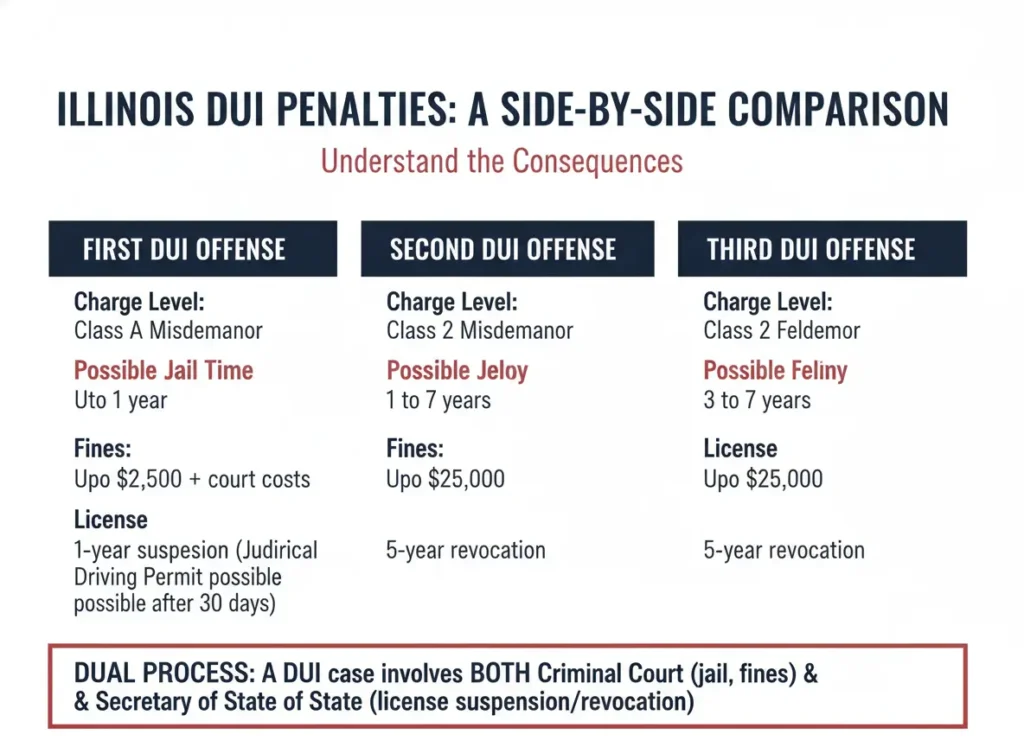
A first DUI in Illinois is usually a Class A misdemeanor and may lead to fines, jail exposure, treatment requirements, and license revocation. A second DUI is still a misdemeanor, but it brings harsher mandatory minimum penalties and longer license consequences. A third DUI becomes an aggravated DUI felony, which raises the stakes sharply and can expose you to prison, major collateral consequences, and a much longer revocation period.
| DUI Conviction | General Classification | Key Penalty | License Consequence |
|---|---|---|---|
| First DUI | Generally Class A misdemeanor | Possible jail and fine; additional mandatory penalties may apply for aggravating circumstances. | Minimum 1-year revocation upon conviction for most adult drivers. |
| Second DUI | Generally Class A misdemeanor unless aggravated | Mandatory minimum 5 days imprisonment or 240 hours community service. | Minimum 5-year revocation when the second conviction occurs within 20 years. |
| Third DUI | Aggravated DUI, Class 2 felony | Felony sentencing exposure; high-BAC enhancements may add mandatory jail and fines. | Minimum 10-year revocation. |
How Illinois Defines DUI Under 625 ILCS 5/11-501
Illinois law makes it illegal to drive or be in actual physical control of a motor vehicle while under the influence of alcohol, drugs, intoxicating compounds, or any combination of these. The most common standard is a blood alcohol concentration (BAC) of .08 percent or higher, but prosecutors do not always need a BAC reading to charge you. You can be charged based on observed impairment alone, or for having any amount of a controlled substance in your system.
Illinois also has separate zero-tolerance driver’s license rules for drivers under age 21. Those administrative rules should not be confused with the elements required to prove a criminal DUI charge under Section 11-501. For cannabis, a THC concentration of 5 nanograms or more per milliliter of blood or 10 nanograms or more in another bodily substance within two hours of driving can support a DUI charge.
Prior DUI convictions in Illinois or any other state count against you, and Illinois uses a lifetime lookback period. A DUI from 20 years ago still qualifies as a prior offense. There is no expiration date on DUI history in this state.
The Statutory Summary Suspension: What Happens to Your License Before Court
A DUI arrest can create a separate administrative driver’s license issue before the criminal charge is resolved.
When statutory summary suspension applies, the suspension generally begins on the 46th day after notice. The length can depend on whether testing was failed or refused and whether the person has a qualifying prior DUI-related history.
This administrative suspension is separate from the driver’s license revocation that may follow a DUI conviction. For the full license process, review Illinois breath-test refusal and statutory summary suspension rules.
First Offense DUI in Illinois: Class A Misdemeanor
A first DUI conviction in Illinois is a Class A misdemeanor under 625 ILCS 5/11-501. It is the least severe of the three offense levels, but it still carries real criminal consequences. If this is your first criminal arrest, review what happens after a first arrest in Springfield, Illinois.
Criminal Penalties for a First DUI
- Up to 364 days in jail (most first-time offenders do not serve jail time)
- Fines up to $2,500
- Mandatory drug and alcohol evaluation
- Possible alcohol education or treatment program
- Minimum 1-year driver’s license revocation upon conviction (2 years if under age 21)
If your BAC was .16 percent or higher, additional mandatory penalties apply: a minimum fine of $500 on top of other fines, and a mandatory minimum of 100 hours of community service.
If a child under 16 was in the vehicle at the time, the charge is still a first offense but the mandatory minimum fine increases to $1,000 and 25 days of community service in a program benefiting children are required.
Court Supervision for First-Time DUI Offenders
Court supervision may be available in an eligible first-offense DUI case. Supervision is different from a DUI conviction, but eligibility and the appropriate disposition depend on the defendant’s prior history and the facts of the case.
Do not assume that every person with no prior DUI conviction automatically qualifies for supervision.
If this is your first arrest, read First Arrest in Springfield, Illinois: What Happens Next.
Second Offense DUI in Illinois: Class A Misdemeanor With Mandatory Minimums
A second DUI is generally a Class A misdemeanor unless an aggravating circumstance elevates the charge.
Illinois law requires, in addition to other penalties, a mandatory minimum of:
- 5 days of imprisonment, or
- 240 hours of community service
for a second DUI violation.
If the BAC was 0.16 or higher, Illinois law additionally requires at least 2 days of imprisonment and a mandatory minimum fine of $1,250.
A second DUI conviction within 20 years of the first generally results in a minimum 5-year driver’s license revocation.
Criminal Penalties for a Second DUI
- Mandatory minimum of 5 days in jail or 240 hours of community service
- Fines up to $2,500
- Mandatory drug and alcohol evaluation and treatment
- 5-year driver’s license revocation
If your BAC was .16 percent or higher on a second offense, there is a mandatory minimum of 2 days in jail and community service is not a substitute for that jail time.
If a child under 16 was in the vehicle, the second offense becomes an Aggravated DUI and is elevated to a Class 2 felony, carrying 3 to 7 years in prison and a mandatory minimum of 10 days in jail or 480 hours of community service.
A Restricted Driving Permit (RDP) may be available for repeat offenders during the revocation period, but obtaining one requires a formal hearing before the Secretary of State. An ignition interlock device is required as a condition of any restricted permit, and must be maintained for 5 years as a condition of full reinstatement.
Third Offense DUI in Illinois: Felony Aggravated DUI
A third DUI violation is aggravated DUI and is generally classified as a Class 2 felony.
A Class 2 felony normally carries substantially greater sentencing exposure than a misdemeanor DUI.
Illinois State Police currently identifies:
- Possible imprisonment of up to 7 years
- A maximum fine of $25,000
- Minimum 10-year loss of full driving privileges after conviction
If the BAC was 0.16 or higher, Section 11-501 requires at least 90 days of imprisonment and a mandatory minimum fine of $2,500, in addition to other sanctions.
Criminal Penalties for a Third DUI
- 3 to 7 years in prison
- Probation may be granted in lieu of prison (up to 4 years), but is not guaranteed
- Mandatory minimum of 10 days in jail or 480 hours of community service if sentenced to probation
- Fine: Up to $25,000, with additional mandatory minimum fines applying in certain circumstances.
- 10-year driver’s license revocation
If your BAC was .16 percent or higher on a third offense, there is a mandatory 90-day jail sentence with no option to substitute community service.
If a child under 16 was in the vehicle, additional mandatory community service and enhanced penalties apply.
Because a third DUI is a felony, it carries all the collateral consequences of a felony conviction: loss of voting rights while incarcerated, potential impact on professional licenses, restrictions on firearm ownership and FOID card eligibility, and a permanent felony record that appears on background checks.
How DUI Cases Are Handled in Sangamon County
A DUI case arising in Springfield or Sangamon County can involve two separate tracks:
- The criminal DUI case in court
- Separate driver’s license consequences
Important early issues may include the next court date, release conditions, police reports, video, chemical testing, and license paperwork.
The exact process depends on the charge and evidence, so a first, second, and felony third DUI should not be treated as though they follow identical paths.
When DUI Becomes a Felony Before the Third Offense
A DUI can become aggravated DUI even before a third offense when one of the circumstances identified in Section 11-501(d) applies.
Because aggravated DUI classifications and sentencing vary depending on the specific aggravating factor, this article should not treat every felony DUI as carrying the same penalty. For the specific felony factors, review Illinois aggravated DUI charges and penalties.
Common Defense Strategies for DUI Charges in Springfield
Depending on the case, defense review may focus on:
- Whether police had a lawful basis for the traffic stop
- Whether there was probable cause for the DUI arrest
- Body-camera and squad-car video
- Field sobriety testing
- Breath or blood testing
- Testing procedures and records
- Whether the accused was driving or in actual physical control
- Statements made during the investigation
- Whether prior DUI convictions were properly counted
- Whether court supervision or another disposition is legally available
A problem with one piece of evidence does not automatically dismiss a DUI. The remaining evidence and legal effect of any successful motion must still be evaluated.
How a DUI Charge Affects Your Future in Sangamon County
A DUI conviction stays on your criminal record permanently in Illinois. Unlike most other misdemeanors, DUI convictions cannot be expunged or sealed under any circumstances. That record is visible to employers, landlords, licensing boards, and anyone conducting a background check.
Beyond the record, a DUI conviction affects your car insurance rates significantly, can jeopardize professional licenses in fields that require clean records.
Early legal representation in the 7th Judicial Circuit protects more than just the outcome of the criminal case. It protects your license, your record, and the options available to you long after the case is closed.
If you were arrested for DUI in Springfield or Sangamon County, speak with a Springfield DUI defense attorney before making decisions about your license, plea options, or court date.
Facing a First, Second, or Third DUI in Springfield?
Illinois DUI penalties increase significantly with prior convictions and aggravating circumstances. Andrew Affrunti can review your DUI history, traffic stop, chemical testing, license paperwork, and possible defense issues before your case moves forward in Springfield or Sangamon County.
Schedule a Confidential ConsultationCall 217-528-2183
Frequently Asked Question
What is the penalty for a first DUI in Illinois?
A standard first DUI is generally a Class A misdemeanor. Possible consequences include jail, a fine of up to $2,500, driver’s license revocation after conviction, evaluation or treatment requirements, and court supervision when legally available.
What is the penalty for a second DUI in Illinois?
A standard second DUI is generally a Class A misdemeanor unless an aggravating circumstance applies. Illinois law requires a mandatory minimum of 5 days in jail or 240 hours of community service in addition to other penalties.
Is a third DUI a felony in Illinois?
Yes. A third DUI is aggravated DUI and is generally classified as a Class 2 felony. It carries felony sentencing exposure and a minimum 10-year driver’s license revocation after conviction.
What is the maximum fine for a third DUI in Illinois?
Illinois State Police lists a maximum fine of $25,000 for a third DUI conviction. Additional mandatory minimum fines can apply when aggravating circumstances such as a BAC of 0.16 or higher are present.
Does a BAC of 0.16 increase Illinois DUI penalties?
Yes. Illinois law imposes additional mandatory penalties for DUI violations involving a BAC of 0.16 or higher. The specific minimum fine, jail, or community-service requirement depends on whether it is the first, second, third, or later violation.
Is license suspension after a DUI arrest separate from a DUI conviction?
Yes. Statutory summary suspension is an administrative driver’s license action that can begin before the criminal DUI case is resolved. A DUI conviction may later result in a separate driver’s license revocation.
Can a first DUI become a felony in Illinois?
Yes. A DUI can become aggravated DUI because of specific statutory circumstances even when the person does not have two prior DUI convictions. The particular aggravating factor determines the felony classification and possible penalties.