
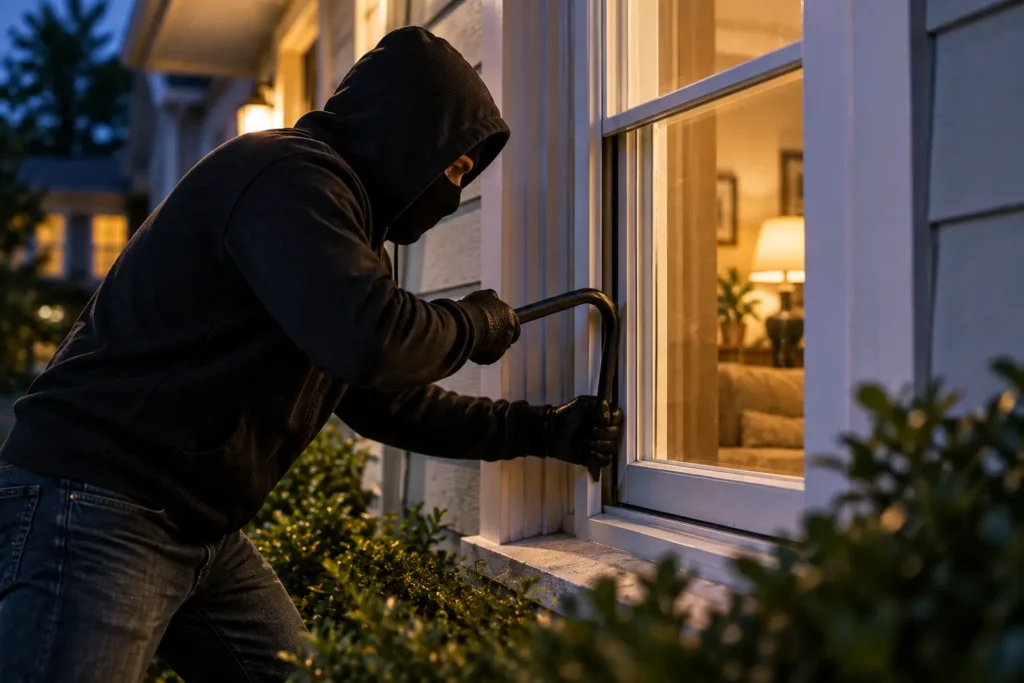
Burglary charges in Illinois are serious felony offenses. Many people think burglary always means breaking into someone’s home, but Illinois law separates general burglary from residential burglary. The difference matters because the property involved, the alleged intent, and whether the place is a dwelling can change the charge and penalties.
General burglary may involve buildings, vehicles, trailers, watercraft, aircraft, railroad cars, or freight containers. Residential burglary focuses on dwelling places, which means places used or intended for people to live. Both charges usually require proof that the person entered or remained without authority and intended to commit theft or another felony.
If you were charged with burglary or residential burglary in Springfield, Sangamon County, or anywhere in Illinois, the key issues are what type of property was involved, whether the entry was unauthorized, and whether prosecutors can prove criminal intent.
Quick Answer
Burglary in Illinois can be charged when someone enters or remains in certain property without authority and with intent to commit theft or another felony. General burglary can be a Class 3, Class 2, or Class 1 felony depending on the property and circumstances. Residential burglary involves a dwelling place and is generally a Class 1 felony. Common defenses may involve lack of intent, consent, mistaken identity, no unauthorized entry, weak evidence, or the property not qualifying as a dwelling.
General Burglary
General Burglary is the broader burglary charge in Illinois. It may apply to many types of property, not just homes.
General burglary may involve:
- Buildings
- House trailers
- Motor vehicles
- Watercraft
- Aircraft
- Railroad cars
- Freight containers
- Schools
- Early care and education centers
- Places of worship
A burglary charge can arise from entering a store, business, garage, vehicle, storage area, trailer, or other structure with alleged criminal intent. The State does not always need to prove that a theft or felony was completed. In many cases, the intent at the time of entry or remaining is the central issue.
Definition
Under Illinois law, a person commits burglary when they knowingly enter or remain without authority in certain places with intent to commit a felony or theft. Illinois law also includes burglary by use of a device that can unlock or start a motor vehicle without authority from the vehicle owner.
In plain English, prosecutors usually focus on three questions:
- Did the person enter or remain somewhere?
- Was the entry or remaining without authority?
- Did the person intend to commit theft or another felony?
This means burglary is not only about breaking a lock or smashing a window. A person can be accused of burglary even without forced entry if prosecutors claim they entered or stayed somewhere without permission and had criminal intent.
Penalties
Penalties for general burglary depend on the type of property and facts of the case. Illinois law separates burglary into different felony levels.
The charge may be affected by:
- Whether the property was a vehicle or building
- Whether damage occurred
- Whether the property was a school
- Whether the property was an early care or education facility
- Whether the property was a place of worship
- Whether the case involved theft, drug possession, weapons, or another felony
- Whether the person has prior convictions
- Whether multiple people were involved
Burglary is never just a simple ticket. It is a felony case that can create prison exposure, probation risks, restitution, and a permanent criminal record if convicted.
Class 3 Felony
Class 3 felony burglary may apply when burglary is committed in a watercraft, aircraft, motor vehicle, railroad car, freight container, or part of those places without causing damage.
Examples may include allegations involving:
- Entering a parked car without authority
- Entering a boat storage area or watercraft
- Entering a railroad car
- Entering a freight container
- Entering a vehicle with intent to steal property
A Class 3 felony in Illinois generally carries 2 to 5 years in prison, although probation may be available in some cases depending on the facts and criminal history.
Class 2 Felony
Class 2 felony burglary may apply when burglary is committed in a building, house trailer, or part of those places. It may also apply when burglary involves a watercraft, aircraft, motor vehicle, railroad car, or freight container and damage occurs.
Examples may include:
- Entering a business after hours with alleged intent to steal
- Entering a garage without authority
- Entering a house trailer with intent to commit theft
- Breaking into a vehicle and causing damage
- Damaging a lock, door, window, or container during entry
A Class 2 felony in Illinois generally carries 3 to 7 years in prison, although probation may be possible depending on eligibility and the facts.
Class 1 Felony
Class 1 felony burglary may apply when burglary is committed in a school, early care and education center, early care and education home, group early care and education home, part day program, or place of worship. Illinois law includes an exception for certain early care or education programs operated in a private residence used as a dwelling.
Examples may include burglary allegations involving:
- A school building
- A place of worship
- Certain child care facilities
- Certain education-related facilities
A Class 1 felony in Illinois generally carries 4 to 15 years in prison. This is a serious felony level, and the property type can change the entire case.
Residential Burglary
Residential Burglary is different from general burglary because it involves a dwelling place. Illinois treats residential burglary seriously because it involves places where people live or are expected to feel safe.
Residential burglary may involve:
- Houses
- Apartments
- Condos
- Residential units
- Occupied or temporarily unoccupied homes
- Dwelling spaces within larger buildings
- Certain situations involving false representation to gain entry
Residential burglary is generally a Class 1 felony in Illinois.
Definition
A person commits residential burglary in Illinois when they knowingly and without authority enter or remain within the dwelling place of another, or any part of it, with intent to commit a felony or theft. Illinois law also includes situations where someone falsely represents who they are, such as pretending to be from the government, construction, telecommunications, or a utility company, to gain entry into a dwelling place with intent to commit theft or a felony.
In plain English, residential burglary usually requires proof of:
- Entry or remaining
- No authority to be there
- A dwelling place
- Intent to commit theft or another felony
The intent element is extremely important. Entering a home by mistake is different from entering with intent to steal. Being invited inside is different from entering without authority. Staying after permission is revoked can also raise complicated legal questions.
Dwelling Place
Dwelling Place is a key issue in residential burglary cases. A dwelling generally means a place used or intended for people to live.
A dwelling place may include:
- A house
- An apartment
- A condominium
- A mobile home used as a residence
- A residential unit inside a larger building
- A home that is temporarily unoccupied
- A living space attached to or part of a residence
The State may try to prove that the location was a dwelling based on how the property was used, whether people lived there, whether it had sleeping or living areas, and whether it was intended as a residence.
The defense may question whether the property actually qualifies as a dwelling. For example, an abandoned structure, storage area, commercial space, detached garage, or vacant building may raise legal issues depending on the facts. That detail can matter because residential burglary carries serious consequences.
Burglary vs. Residential Burglary
The main difference between burglary and residential burglary is the type of property involved.
General burglary may involve businesses, buildings, vehicles, trailers, freight containers, and other listed places. Residential burglary involves a dwelling place.
Important differences include:
| Issue | General Burglary | Residential Burglary |
| Property Type | Buildings, vehicles, trailers, containers, schools, places of worship | Dwelling place |
| Common Felony Level | Class 3, Class 2, or Class 1 | Class 1 |
| Key Question | What type of property was entered? | Was it a dwelling place? |
| Intent Required | Intent to commit theft or felony | Intent to commit theft or felony |
| Common Defense Focus | Authority, intent, property type, identity | Dwelling status, authority, intent, identity |
Both charges are serious. Residential burglary is often treated more harshly because homes are involved.
Intent
Intent is one of the most important issues in any burglary case. The State must prove that the person intended to commit theft or another felony when they entered or remained without authority.
Intent may be argued through:
- Possession of stolen property
- Tools or bags
- Forced entry
- Flight from the scene
- Statements
- Surveillance video
- Prior messages
- Location and timing
- Attempts to hide identity
- Entering restricted areas
- Conduct inside the property
But intent can also be challenged. The defense may argue:
- The entry was accidental
- The person believed they had permission
- The person entered for a lawful reason
- No theft or felony was intended
- The person was confused, intoxicated, or mistaken
- The evidence only shows presence, not criminal intent
- Witness assumptions are unreliable
This matters because being somewhere without permission may support trespass in some cases, but burglary requires proof of intent to commit theft or another felony. Without that intent, the State may have a weaker burglary case.
Potential Legal Defense Strategies
Potential legal defense strategies depend on the facts, evidence, and charge level. Burglary and residential burglary cases can be defended, but the strategy must focus on the legal elements prosecutors must prove.
Common defense strategies may include:
- Lack of intent
- Consent or permission
- Mistaken identity
- No unauthorized entry
- No evidence of theft or felony intent
- Property was not a dwelling
- Property type does not match the charge
- The person did not enter or remain
- Surveillance video is unclear
- Witness statements are unreliable
- Police violated search or seizure rules
- Statements were taken improperly
- The charge is overfiled
- The evidence supports trespass, not burglary
A defense attorney may also challenge the way police collected evidence, whether a confession was voluntary, whether stolen property was actually connected to the accused, or whether prosecutors can prove the timing of intent.
Lack of Intent Defense
Lack of intent is often the central defense in burglary cases. The State must prove the accused intended to commit theft or another felony, not just that they were present.
A lack of intent defense may apply when:
- The person entered by mistake
- The person believed they had permission
- The person was looking for someone
- The person entered for shelter, help, or safety
- The person did not take anything
- No tools, stolen property, or suspicious items were found
- The accusation is based only on assumption
No intent, no burglary. That is the legal fulcrum of many cases.
Consent or Permission
Consent or permission can defeat the “without authority” element. If someone had permission to enter, burglary may be harder to prove.
Permission may come from:
- The property owner
- A tenant
- A resident
- An employee with authority
- A family member
- A business representative
- A prior arrangement
- A text message or call
Consent issues can become complicated if permission was limited, revoked, disputed, or misunderstood. For example, being allowed into a store during business hours does not mean being allowed into employee-only areas. Being invited into a home once does not always mean permission exists later.
Mistaken Identity
Mistaken identity may be a defense when the State cannot prove who entered or remained in the property.
This may involve:
- Poor-quality surveillance footage
- Bad lighting
- Masked or covered faces
- Similar clothing
- Unreliable witness identification
- Lack of fingerprints or DNA
- No stolen property found
- No direct evidence connecting the accused
Burglary cases sometimes rely heavily on video or witness descriptions. Those should be reviewed carefully.
Property Was Not a Dwelling
In residential burglary cases, the defense may argue that the property was not a dwelling place. This can matter if the State charged residential burglary instead of general burglary or trespass.
Questions may include:
- Did anyone live there?
- Was it intended for overnight living?
- Was it abandoned?
- Was it under construction?
- Was it used only for storage?
- Was it a commercial space?
- Was the area entered actually part of the dwelling?
- Was the property temporarily vacant or permanently uninhabitable?
If the property does not qualify as a dwelling, the residential burglary charge may be vulnerable.
Burglary and Other Criminal Charges
Burglary charges may appear with other allegations.
Related charges may include:
- Theft
- Retail theft
- Criminal trespass
- Criminal damage to property
- Possession of burglary tools
- Drug possession
- Weapons charges
- Battery
- Robbery
- Home invasion
- Resisting or obstructing
- Probation violation
For example, if police claim someone entered a garage and stole tools, the case may involve burglary and theft. If a window was broken, criminal damage to property may be added. If police find drugs during the arrest, drug possession may also be charged.
When charges overlap, the defense strategy must address the whole case, not just the burglary count.
What Happens After a Burglary Arrest?
After a burglary or residential burglary arrest, the case may involve:
- Police questioning
- Booking
- Pretrial release or detention hearing
- Arraignment
- Discovery
- Plea negotiations
- Motions
- Trial
- Sentencing if convicted
Burglary cases often involve evidence such as:
- Surveillance video
- Fingerprints
- DNA
- Police reports
- Witness statements
- Stolen property
- Cell phone records
- Text messages
- Vehicle evidence
- Body camera footage
- Statements made to police
Do not try to explain the situation to police without a lawyer. A small statement about why you were there can become a major part of the prosecution’s intent theory.
What You Should Do If Charged
If you are charged with burglary or residential burglary in Illinois, take action quickly.
You should:
- Save all paperwork
- Do not miss court
- Do not contact witnesses or alleged victims
- Write down what happened privately
- Save texts, calls, receipts, photos, or location records
- Identify possible witnesses
- Avoid posting about the case online
- Follow all release conditions
- Speak with a criminal defense attorney
Burglary is a felony. Residential burglary is especially serious. Waiting too long can make it harder to preserve evidence.
How a Springfield Criminal Defense Attorney Can Help
A Springfield criminal defense attorney can review the charge, evidence, and possible defenses.
An attorney may help by:
- Reviewing police reports
- Checking surveillance footage
- Challenging intent
- Challenging unauthorized entry
- Reviewing whether property qualifies as a dwelling
- Challenging identification evidence
- Reviewing search and seizure issues
- Challenging statements
- Negotiating with prosecutors
- Seeking reduction or dismissal
- Preparing for trial
- Protecting your record
The goal is to force the State to prove every element, not just rely on suspicion.
Speak With a Springfield Burglary Defense Attorney
If you were charged with burglary or residential burglary in Springfield, Sangamon County, or Central Illinois, do not assume the case is hopeless. These charges are serious, but the details matter.
The defense may depend on intent, authority, property type, identity, surveillance footage, witness statements, and whether the property qualifies as a dwelling place.
A Springfield criminal defense attorney can explain the charge, review the evidence, and help protect your rights, record, and future.
Final Thoughts
Burglary and residential burglary are serious felony charges in Illinois. General burglary may be charged as a Class 3, Class 2, or Class 1 felony depending on the property and circumstances. Residential burglary involves a dwelling place and is generally a Class 1 felony.
The main issues are whether the person entered or remained without authority and whether they intended to commit theft or another felony. In residential burglary cases, the State must also prove the property qualifies as a dwelling place.
If you were charged with burglary in Springfield or Sangamon County, speak with a criminal defense attorney as soon as possible. Early defense work can help challenge intent, identity, property classification, and the State’s evidence.