

- Quick Answer
- How Illinois Classifies Controlled Substances by Schedule
- How the Type and Amount of Drug Affect Illinois Charges
- Drug Possession Charge Classes in Illinois Explained
- What Determines a Drug Possession Charge in Illinois?
- Penalties by Substance: What Each Drug Charge Means
- What Prosecutors Must Prove in an Illinois Drug Possession Case
- Common Defense Strategies for Drug Possession Charges
- Long-Term Consequences of a Drug Possession Conviction
- When to Contact a Criminal Defense Attorney in Springfield
- Can Drug Possession Charges Be Challenged in Illinois?
- Charged With Drug Possession in Springfield, IL?
- Frequently Asked Questions
- What is the lowest drug possession charge in Illinois?
- Is possession of cocaine or heroin a felony in Illinois?
- What are the penalties for methamphetamine possession in Illinois?
- How much cannabis can an Illinois resident legally possess?
- Can a drug possession charge be dismissed in Illinois?
- What is constructive possession in an Illinois drug case?
- Can police search my car for drugs without a warrant?
Quick Answer
Drug possession charges in Illinois range from misdemeanors to serious felonies depending on the type of substance, amount, prior record, and circumstances of the arrest. A defense attorney may challenge the search, possession evidence, drug testing, or whether prosecutors can prove every element of the charge.
A drug possession charge in Illinois can change everything fast. What begins as a traffic stop, a search, or a call to police can become a felony record that follows you into job applications, housing decisions, and professional licensing reviews for years. Many people charged with drug possession in Sangamon County underestimate how serious the charge is until they are already in a courtroom facing consequences they were not prepared for.
Illinois does not treat all drug possession charges the same. The substance involved, the amount in your possession, your prior record, and where you were arrested all affect what charge the State’s Attorney files and what penalties you face if convicted. Understanding how these factors work before your first court date gives you and your attorney more room to act.
If you are facing a drug possession charge in Springfield or anywhere in Sangamon County, speaking with a criminal defense attorney early is the most important decision you can make.
How Illinois Classifies Controlled Substances by Schedule
Illinois regulates most controlled-substance possession under the Illinois Controlled Substances Act, which places substances into Schedules I through V. However, the criminal charge for possession is not determined by schedule alone. Section 402 uses substance-specific and quantity-specific thresholds, and some substances are treated differently from others.
Methamphetamine is governed separately by the Illinois Methamphetamine Control and Community Protection Act rather than the ordinary possession provisions of Section 402.
Identifying the exact substance and quantity is therefore necessary before determining the applicable charge class.
How the Type and Amount of Drug Affect Illinois Charges
The substance involved and the amount allegedly possessed can significantly affect the charge level and possible penalties. Illinois law treats different controlled substances differently, and larger quantities may lead to more serious charges.
Important factors include:
- Type of controlled substance
- Amount allegedly possessed
- Packaging and surrounding evidence
- Prior criminal history
- Location where the substance was found
Drug Possession Charge Classes in Illinois Explained
Illinois uses a combination of drug type and quantity to determine the charge class. The class directly controls the sentencing range a judge can impose if you are convicted.
Illinois drug-possession charges cannot be accurately classified from the felony class alone. Section 402 sets specific thresholds for substances such as heroin, cocaine, fentanyl, LSD, and other controlled substances. Methamphetamine uses a separate penalty structure under 720 ILCS 646/60.
For example, possession of a controlled substance in an amount not otherwise assigned a higher penalty under Section 402 is generally a Class 4 felony, subject to statutory exceptions. Larger quantities of specified substances can trigger Class 1 felony or other enhanced sentencing provisions.
Always identify the substance, quantity, and governing statute before stating the potential penalty.
Most controlled substance possession charges in Illinois are felonies. Even a small amount of a Schedule I or II drug typically starts as a Class 4 felony, and amounts escalate quickly from there. Probation is possible in many cases, particularly for first-time offenders, but it is not guaranteed and depends heavily on the substance, the amount, and your criminal history.
What Determines a Drug Possession Charge in Illinois?
| Factor | Why It Matters |
|---|---|
| Type of Drug | Different substances have different penalties under Illinois law. |
| Amount Possessed | Larger quantities can increase the felony classification and prison exposure. |
| Prior Criminal History | Previous convictions may affect sentencing and available options. |
| Where the Drug Was Found | The location and circumstances can affect possession arguments and defenses. |
| How Police Obtained Evidence | An unlawful search may allow evidence to be challenged. |
Penalties by Substance: What Each Drug Charge Means
Cocaine and Heroin Charges: How Quantity Increases Penalties
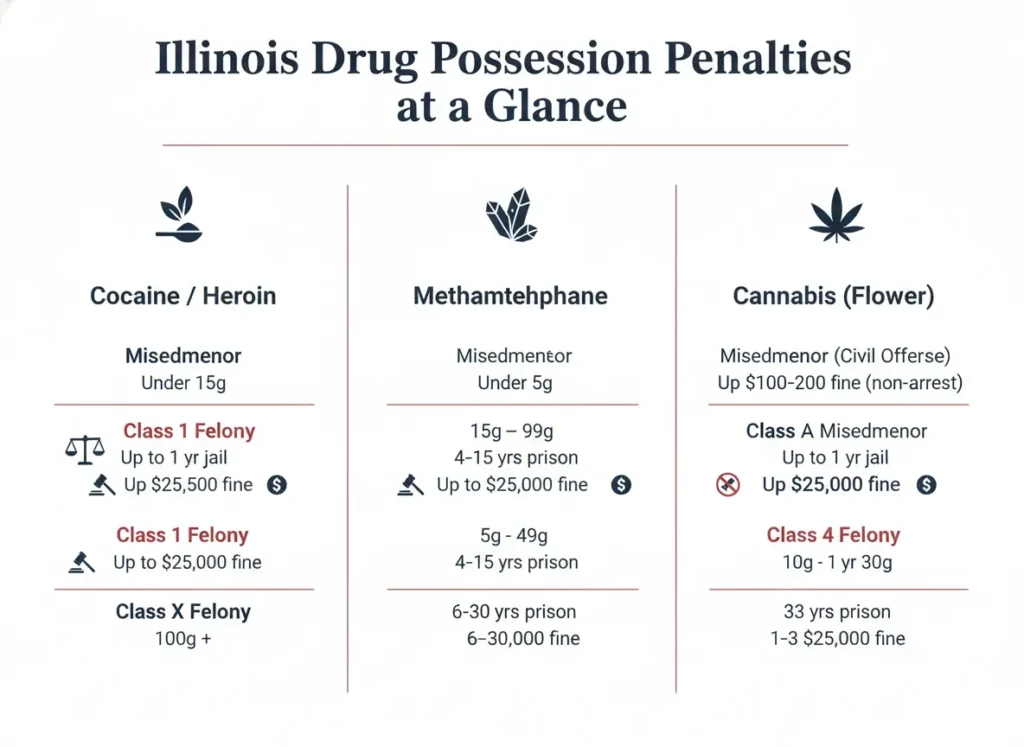
Possession of cocaine or heroin in an amount below the enhanced thresholds in Section 402 is generally prosecuted as a Class 4 felony. At 15 grams or more, Section 402 imposes higher felony penalties and special sentencing ranges.
- 15 to 99 grams: Class 1 felony, 4 to 15 years
- 100 to 399 grams: 6 to 30 years
- 400 to 899 grams: 8 to 40 years
- 900 grams or more: 10 to 50 years, fines up to $200,000
Quantity therefore matters significantly because Section 402 uses specific statutory thresholds.
Methamphetamine Charges Under Illinois Law
Meth is regulated under the Methamphetamine Control and Community Protection Act and carries some of the harshest possession penalties in Illinois.
- Less than 5 grams: Class 3 felony, 2 to 5 years, $25,000 fine
- 5 to 15 grams: Class 2 felony, 3 to 7 years, $25,000 fine
- 15 to 100 grams: Class 1 felony, 4 to 15 years
- 100 to 400 grams: Class X felony, 6 to 30 years, up to $100,000 fine
- 400 to 900 grams: Class X felony, 8 to 40 years, up to $200,000 fine
- More than 900 grams: Class X felony, 10 to 50 years, up to $300,000 fine
There is no probation available for Class X felonies. Class X felonies are generally not probation-eligible under Illinois sentencing law.
Cannabis Possession Laws in Illinois After Legalization
Illinois allows adults age 21 and older to possess cannabis within the limits established by the Cannabis Regulation and Tax Act.
For an Illinois resident age 21 or older, the current statutory possession limits include:
- Up to 60 grams of cannabis flower
- Up to 10 grams of cannabis concentrate
- Up to 1,000 milligrams of THC in cannabis-infused products
Lower limits apply to nonresidents, including up to 30 grams of cannabis flower and 5 grams of cannabis concentrate.
Possession outside the limits authorized by Illinois law, possession by an underage person, unauthorized cultivation, distribution, or other prohibited conduct may still create civil or criminal consequences depending on the facts and applicable statute.
Prescription Drug Possession Without a Valid Prescription
Possessing certain controlled prescription medications without lawful authorization can violate the Illinois Controlled Substances Act. The applicable charge depends on the substance, quantity, and circumstances.
A valid prescription or other lawful authorization may be highly relevant to whether the possession was legally permitted, but the analysis depends on the medication, prescription, person possessing it, and manner of possession.
LSD and Hallucinogenic Drug Charges by Dose and Quantity
Illinois law provides specific LSD possession thresholds based on either the weight of the substance or, when LSD is contained on objects or segregated parts such as tabs, the number of those objects.
For example, Section 402 provides enhanced penalties beginning at 15 grams or 15 objects containing LSD, with higher sentencing ranges as the quantity increases.
- 15 to 199 objects or doses: Class 1 felony, 4 to 15 years
- 200 to 599 objects: 6 to 30 years
- Larger quantities escalate further
What Prosecutors Must Prove in an Illinois Drug Possession Case
To convict you of drug possession in Illinois, the State must prove two things beyond a reasonable doubt: that you knew the substance was present, and that you had control over it. If you are facing criminal charges after a drug arrest, a criminal defense attorney in Springfield can review whether police followed proper procedures and whether the evidence can be challenged. Both can be challenged.
Possession may be actual or constructive. Actual possession generally involves the substance being physically on the person. Constructive possession can be proved through evidence that the defendant knew the substance was present and exercised control over the area or item where it was found.
Drugs discovered in a shared vehicle, residence, or other location do not automatically establish constructive possession by every person present. The State must establish the required connection to the defendant from the evidence in the particular case.
If the drug possession charge followed an arrest, understanding your immediate rights can help avoid mistakes. Learn more about what happens after a first arrest in Springfield, Illinois .
Common Defense Strategies for Drug Possession Charges
A drug possession charge is not a conviction. Experienced defense attorneys challenge these charges in several ways depending on the facts of the case.
Illegal Search and Seizure: Challenging Evidence Under the Fourth Amendment
Drug-possession cases sometimes involve Fourth Amendment issues concerning traffic stops, vehicle searches, homes, personal belongings, or consent to search.
A search conducted without a warrant is not automatically unlawful because several recognized exceptions to the warrant requirement may apply. Likewise, suppression is not automatic whenever a constitutional issue is raised.
A court may suppress evidence when the defense establishes that evidence was obtained through an unlawful search or seizure and the applicable suppression rules require exclusion. The correct analysis depends on the facts surrounding the stop, detention, search, warrant, consent, and any claimed exception.
Lack of Knowledge: Defending Against Constructive Possession Claims
This defense argues that you did not know the substance was present. It comes up frequently in vehicle searches where drugs belong to another occupant, in shared residences, or when someone else placed the substance in your property without your knowledge. Constructive possession requires both knowledge and control. Whether the evidence proves knowledge and control is therefore a central issue in many constructive-possession cases.
Chain of Custody Issues: When Evidence Becomes Unreliable
The prosecution must establish the identity and integrity of the substance offered as evidence. Chain-of-custody records may become important when evidence changed hands, was stored, transported, or tested.
A minor recordkeeping discrepancy does not automatically make evidence inadmissible. The significance of a claimed gap depends on whether it creates a genuine question about the identity, integrity, or condition of the evidence.
Entrapment Defense in Illinois Drug Cases
Entrapment is a fact-specific affirmative defense. It generally concerns whether government conduct induced the offense and whether the defendant was predisposed to commit it.
Merely providing an opportunity to commit an offense is not necessarily entrapment. Whether the defense applies depends on how the investigation occurred and the defendant’s conduct and predisposition.
Drug Court and Diversion Programs in Illinois
Illinois law permits drug-court and other problem-solving-court programs, but eligibility, procedures, and outcomes vary by jurisdiction and program. Participation is not automatically available merely because a case involves drug possession.
Eligibility may depend on the offense, criminal history, treatment needs, prosecutorial or court requirements, and local program rules. The legal effect of successful completion also depends on the specific program and case disposition.
Long-Term Consequences of a Drug Possession Conviction
A drug possession conviction creates consequences that go well beyond the sentence. Felony convictions affect employment, housing, professional licenses, and financial aid eligibility. A felony drug conviction can also affect your eligibility for a Firearm Owner’s Identification Card. For noncitizens, a drug-related arrest, plea, or conviction can create serious immigration consequences under federal law. Immigration consequences can depend on the exact offense, substance, disposition, and immigration status, so separate immigration advice may be necessary before entering a plea.
Even a misdemeanor conviction appears on background checks. Many first-time offenders are eligible for expungement or record sealing after completing their sentence, but certain drug convictions carry restrictions.
Sangamon County cases are handled in the 7th Judicial Circuit. How a charge resolves (whether through a motion to suppress, a negotiated plea, or trial) depends significantly on the facts, the attorney representing you, and how quickly you act after the arrest.
Depending on the outcome of your case, record relief may become an important concern later. Learn more about expungement and sealing options in Illinois .
When to Contact a Criminal Defense Attorney in Springfield
Legal review may be useful when a drug-possession case involves a disputed search, constructive possession, laboratory testing, prescription authorization, quantity disputes, alleged intent to deliver, prior convictions, or questions about diversion or sentencing eligibility.
Reviewing the police reports, search circumstances, laboratory evidence, and charging statute can help identify which issues actually matter in the case.
Early legal guidance can help protect evidence, identify possible defenses, and address issues before they become harder to correct.
Can Drug Possession Charges Be Challenged in Illinois?
Yes. A drug possession case may depend heavily on how police found the alleged substance and whether the evidence can legally be used in court.
Possible defenses include:
- Illegal search or seizure
- Lack of probable cause
- No proof of knowing possession
- Problems with testing or identification
- Chain of custody issues
Charged With Drug Possession in Springfield, IL?
A drug-possession case may depend on the exact substance, weight or quantity, laboratory testing, search and seizure issues, prescription status, alleged knowledge and control, and prior record. Reviewing those details can help clarify the applicable charge and available legal issues.
Schedule a Confidential ConsultationFrequently Asked Questions
What is the lowest drug possession charge in Illinois?
There is no single minimum charge for every substance. The classification depends on the substance, quantity, governing statute, and whether possession is otherwise legally authorized. Cannabis also has separate adult-possession rules, while methamphetamine is governed by its own Illinois statute.
Is possession of cocaine or heroin a felony in Illinois?
Yes. Unauthorized possession of cocaine or heroin can be prosecuted as a felony under the Illinois Controlled Substances Act. The applicable penalty increases when the quantity reaches statutory thresholds identified in Section 402.
What are the penalties for methamphetamine possession in Illinois?
Illinois uses a separate methamphetamine statute. Possession of less than 5 grams is a Class 3 felony, 5 to less than 15 grams is a Class 2 felony, 15 to less than 100 grams is a Class 1 felony, and larger quantities can trigger Class X felony sentencing ranges.
How much cannabis can an Illinois resident legally possess?
For an Illinois resident age 21 or older, current state law permits possession within statutory limits that include up to 60 grams of cannabis flower, 10 grams of cannabis concentrate, and 1,000 milligrams of THC in cannabis-infused products. Different limits apply to nonresidents.
Can a drug possession charge be dismissed in Illinois?
A charge may be dismissed in some cases, but dismissal is not automatic. Possible issues can include insufficient evidence, suppression of unlawfully obtained evidence, problems proving knowing possession, or a legally authorized program or disposition that affects the charge. The result depends on the facts and procedure of the individual case.
What is constructive possession in an Illinois drug case?
Constructive possession may be alleged when the substance was not physically on the defendant but the State claims the defendant knew it was present and exercised control over the location or item where it was found. Presence near drugs alone does not automatically establish constructive possession.
Can police search my car for drugs without a warrant?
Sometimes. A warrant is not required for every lawful vehicle search. Whether a search is valid depends on the circumstances and whether a recognized exception to the warrant requirement applies, such as consent or another legally sufficient basis.