
- Quick Answer
- What Is Resisting or Obstructing a Police Officer in Illinois?
- Resisting vs. Obstructing a Police Officer in Illinois: What’s the Difference?
- What Can Lead to a Resisting or Obstructing Charge in Illinois?
- What Happens After a Resisting or Obstructing Arrest in Illinois?
- Can You Be Released After a Resisting Arrest in Illinois?
- What Happens at a Pretrial Release or Detention Hearing in Illinois?
- What Is the Court Process for Resisting or Obstructing in Illinois?
- What Happens at an Illinois Resisting or Obstructing Arraignment?
- What Happens During Pretrial Conferences in a Resisting Case?
- How Body Camera Footage Can Affect a Resisting Arrest Case
- What Happens if a Resisting or Obstructing Charge Goes to Trial?
- What Are the Penalties for Resisting or Obstructing in Illinois?
- Class A Misdemeanor Resisting or Obstructing Penalties in Illinois
- When Is Resisting or Obstructing a Felony in Illinois?
- Long-Term Consequences of a Resisting or Obstructing Conviction in Illinois
- What Are Common Defenses to Resisting or Obstructing in Illinois?
- Can a Resisting or Obstructing Charge Be Dismissed in Illinois?
- What Should You Do After a Resisting or Obstructing Arrest in Illinois?
- How a Criminal Defense Attorney Can Fight a Resisting or Obstructing Charge
- Charged With Resisting or Obstructing a Police Officer?
- Frequently Asked Questions
- Is resisting or obstructing a police officer a felony in Illinois?
- What is the penalty for resisting or obstructing a police officer in Illinois?
- Does resisting arrest in Illinois require physical force?
- Can resisting or obstructing charges be dismissed in Illinois?
- Can body-camera footage help fight a resisting arrest charge?
- Can you be charged with resisting even if the original charge is dismissed?
- What should you do after being arrested for resisting or obstructing in Illinois?
- Can a resisting or obstructing conviction affect your criminal record?
- Can police charge me with resisting if I did not hurt anyone?
- Does body camera footage help prove a resisting arrest defense?
A resisting or obstructing charge in Illinois can happen fast. A traffic stop, DUI investigation, theft call, drug possession arrest, domestic disturbance, warrant check, or street encounter can quickly turn into a separate criminal charge if police believe someone interfered with an officer’s duties.
Many people are surprised by this charge because it does not always involve violence. A person may be accused of resisting arrest, pulling away, refusing to follow commands, blocking an officer, giving false information, interfering with an investigation, or delaying police activity. Even if the original reason for police contact was minor, the resisting or obstructing charge can become the bigger problem.
If you were arrested for resisting or obstructing a police officer in Springfield, Sangamon County, or anywhere in Illinois, you need to understand what happens next. The court process can involve pre-trial release, arraignment, hearings, trial, possible misdemeanor or felony penalties, and long-term consequences for your record.
Quick Answer
After an arrest for resisting or obstructing a police officer in Illinois, the case may involve booking, release or detention decisions, court hearings, possible plea negotiations, trial, and penalties depending on the circumstances. The outcome often depends on officer testimony, body-camera footage, witness statements, and whether the State can prove every element of the charge.
What Is Resisting or Obstructing a Police Officer in Illinois?
Resisting or obstructing a police officer means knowingly resisting arrest or interfering with an officer while the officer is performing an authorized act within official duties.
Conduct alleged as resisting or obstructing may vary significantly depending on the encounter. Common allegations can involve physically resisting arrest, pulling away during handcuffing, blocking an officer performing an authorized duty, refusing certain lawful commands, or otherwise knowingly interfering with authorized police activity. Other conduct, such as providing false identifying information or concealing evidence, may implicate separate Illinois offenses depending on the facts.
The State must prove more than simple confusion or frustration. The conduct must meet the legal standard for resisting or obstructing.
Resisting vs. Obstructing a Police Officer in Illinois: What’s the Difference?
Resisting usually involves physical resistance to an officer’s attempt to arrest, detain, or control a person.
| Charge Type | Common Allegation | Example |
|---|---|---|
| Resisting | Physical resistance during police action | Pulling away during handcuffing |
| Obstructing | Interfering with an officer’s duties | Providing false information or delaying an investigation |
The exact charge depends on the conduct alleged, the evidence available, and the circumstances of the encounter.
Examples may include:
- Tensing arms
- Pulling away
- Struggling during handcuffing
- Running from officers
- Refusing to exit a vehicle after lawful commands
- Physically preventing arrest
Obstructing may involve interference that delays, blocks, or prevents an officer from performing a lawful duty.
Examples may include:
- Providing false identifying information
- Blocking officers from entering an area
- Interfering with an investigation
- Hiding or destroying evidence
- Preventing officers from speaking with a witness
- Refusing lawful instructions during an investigation
Not every disagreement with police is resisting or obstructing. Asking questions, remaining silent, refusing consent to a search, or asking for a lawyer should not automatically become a criminal charge. Context matters.
What Can Lead to a Resisting or Obstructing Charge in Illinois?
Resisting or obstructing charges often appear alongside another offense. Police may arrest someone for the original allegation and then add resisting or obstructing based on what they claim happened during the encounter.
Common related cases include:
- DUI
- Theft
- Drug possession
- Traffic stops
- Domestic battery
- Weapons charges
- Probation violations
- Warrant arrests
- Disorderly conduct
- Public intoxication
- Driving while license suspended
- Aggravated speeding
For example, someone stopped for suspected DUI may be accused of resisting if they pull away during handcuffing. Someone detained during a theft investigation may be accused of obstructing if police claim they gave false information. Someone in a drug possession investigation may face an added charge if police say they tried to hide or destroy evidence.
What Happens After a Resisting or Obstructing Arrest in Illinois?
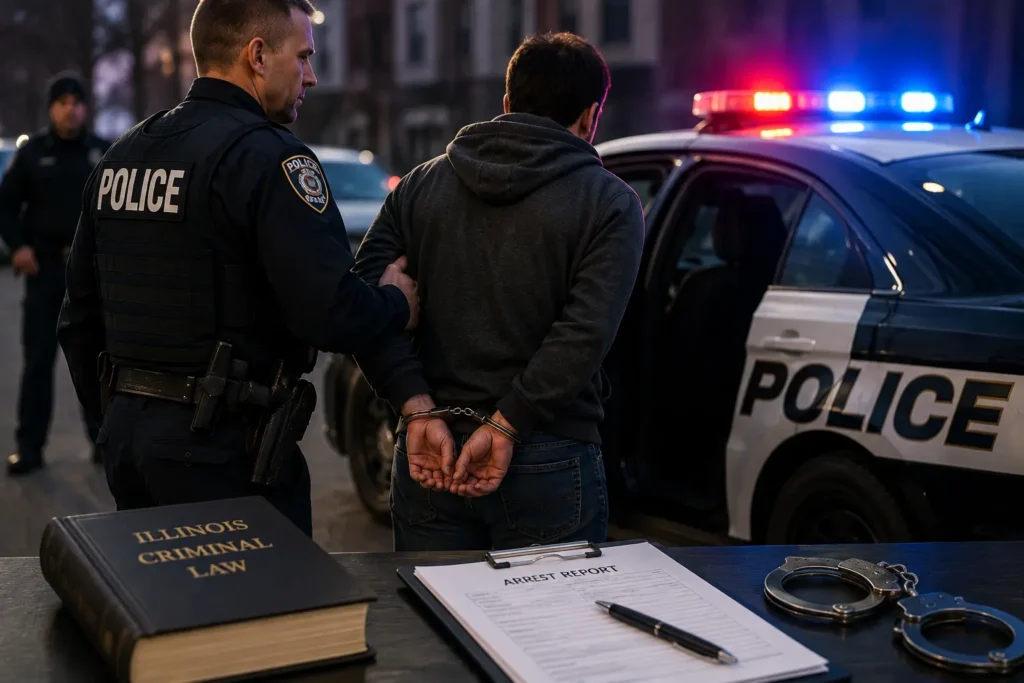
The Immediate Post-Arrest Process usually begins at the scene. Police may handcuff the person, search them, place them in a squad car, and transport them for booking.
After arrest, the process may include:
- Search of the person
- Collection of personal property
- Transport to the police station or jail
- Fingerprinting
- Mugshot
- Police reports
- Review for warrants
- Charging decision
- Release decision or court appearance
This stage can feel chaotic, but it is important not to make the situation worse. Do not argue about the facts, insult officers, explain the case, or talk about what happened without legal advice. Statements made during or after arrest can be used later.
Can You Be Released After a Resisting Arrest in Illinois?
Illinois now uses pre-trial release instead of the old cash bail system. That means the court reviews whether a person should be released, released with conditions, or detained while the case is pending.
In a resisting or obstructing case, the court may look at:
- The facts of the arrest
- Whether anyone was injured
- Prior criminal history
- Prior failures to appear
- Other pending charges
- Whether the person was already on probation or release
- Community ties
- Employment
- Public safety concerns
Many people charged with a standard misdemeanor may be released with conditions, but the facts matter. If the case involves injury, a felony charge, DUI, theft, drug possession, weapons, or a probation violation, the court may take a closer look.
What Happens at a Pretrial Release or Detention Hearing in Illinois?
People still often call the first release hearing “bond court” or a bond hearing, but Illinois no longer uses cash bail the old way. The hearing now focuses on release, conditions of release, or detention.
At the hearing, the judge may decide whether to:
- Release the person
- Set conditions of release
- Order no contact with certain people
- Require court reminders or supervision
- Restrict travel
- Prohibit weapons
- Require testing or treatment
- Detain the person if legally justified
The State may argue that the conduct created safety concerns. The defense may argue that release is appropriate and that conditions can manage any concerns.
What Is the Court Process for Resisting or Obstructing in Illinois?
The court process depends on whether the charge is filed as a misdemeanor or felony and whether other charges are involved.
The process may include:
- First appearance
- Arraignment
- Discovery
- Pretrial conferences
- Motion hearings
- Plea negotiations
- Trial
- Sentencing if convicted
What Happens at an Illinois Resisting or Obstructing Arraignment?
Arraignment is an early court date where the charge is formally addressed. The defendant may be advised of the charge and asked to enter a plea.
At arraignment, the court may also address:
- Attorney representation
- Future court dates
- Release conditions
- Discovery deadlines
- Related charges
- Interpreter or scheduling issues
Most defendants should not plead guilty at the first court date without understanding the consequences. A resisting or obstructing conviction can affect background checks, employment, probation status, immigration concerns for non-citizens, and future criminal cases.
What Happens During Pretrial Conferences in a Resisting Case?
Pre-Trial Conferences are court dates where the defense and prosecutor discuss the case before trial.
During these conferences, attorneys may address:
- Police reports
- Body camera footage
- Dash camera footage
- Witness statements
- Injury reports
- Related DUI, theft, or drug possession allegations
- Possible plea offers
- Diversion or supervision eligibility
- Trial readiness
- Motions to dismiss or suppress evidence
Body camera footage can be especially important in resisting or obstructing cases. Police reports may describe the encounter one way, while video may show more context.
How Body Camera Footage Can Affect a Resisting Arrest Case
Body camera footage can be one of the most important pieces of evidence in a resisting or obstructing case.
Video may show:
- Whether commands were clear
- Whether force was used
- Whether the person attempted to comply
- Whether the police report matches the encounter
- Whether the alleged resistance was intentional
Body-camera footage can be especially important because resisting and obstructing cases often depend on what happened during a short, rapidly developing encounter. Video may provide context about the officer’s commands, the person’s movements, the timing of physical contact, whether compliance was attempted, and whether the written police report accurately reflects the encounter.
What Happens if a Resisting or Obstructing Charge Goes to Trial?
If the case is not dismissed or resolved by agreement, it may proceed to trial. A resisting or obstructing case may be heard by a judge or jury depending on the charge and legal strategy.
At trial, the State may present:
- Officer testimony
- Body camera footage
- Dash camera footage
- Witness testimony
- Injury evidence
- Dispatch records
- Police reports
- Photos or medical records
The defense may challenge the officer’s version of events, cross-examine witnesses, present video evidence, and argue that the State has not proven the charge beyond a reasonable doubt.
What Are the Penalties for Resisting or Obstructing in Illinois?
Potential Penalties and Sentencing depend on whether the charge is a standard misdemeanor or a felony.
The court may consider:
- The exact conduct alleged
- Whether anyone was injured
- Whether force was used
- Whether the defendant has prior convictions
- Whether the case involved DUI, theft, drug possession, or another offense
- Whether the person was on probation or pre-trial release
- Whether the person complied with court conditions
- Mitigating facts
- Prior record
- Video evidence
Even when jail is not imposed, a conviction can still create a permanent criminal record.
Class A Misdemeanor Resisting or Obstructing Penalties in Illinois
A standard resisting or obstructing charge is usually a Class A misdemeanor. Illinois law also imposes a specific minimum sentence after conviction. The court must order either at least 48 consecutive hours of imprisonment or at least 100 hours of community service. The statute provides that probation cannot be used to reduce this required imprisonment or community-service component.
Possible Class A misdemeanor penalties may include:
- Up to 364 days in jail
- Fines and court costs
- Probation
- Conditional discharge
- Court supervision if available
- Community service
- No-contact or stay-away conditions
- Criminal record if convicted
A misdemeanor may sound minor compared with a felony, but employers and licensing boards may still take it seriously. A resisting conviction can look like a failure to cooperate with law enforcement, which can create background check problems.
When Is Resisting or Obstructing a Felony in Illinois?
Resisting or obstructing becomes a Class 4 felony when the violation is the proximate cause of injury to a peace officer, firefighter, or correctional institution employee.
Other criminal allegations such as DUI, drug possession, weapons charges, or probation violations may create separate charges or increase the overall seriousness of the case, but they do not by themselves transform a standard resisting or obstructing charge under Section 31-1 into a felony.
Whether the injury was actually caused by the alleged resisting or obstructing conduct can therefore become an important issue in the defense.
Long-Term Consequences of a Resisting or Obstructing Conviction in Illinois
A resisting or obstructing charge can affect life outside court.
Possible collateral consequences include:
- Job application problems
- Professional licensing issues
- Housing application concerns
- Probation violation
- Immigration concerns for non-citizens
- School discipline
- Security clearance problems
- Damage to future plea negotiations
- Increased scrutiny in later police encounters
If the charge is connected to DUI, theft, drug possession, or another criminal case, the consequences can compound. The resisting charge may make the entire case look worse to prosecutors and judges.
What Are Common Defenses to Resisting or Obstructing in Illinois?
A criminal defense attorney may review several issues in a resisting or obstructing case.
If the charge followed another allegation such as DUI, theft, or drug possession, a criminal defense attorney in Springfield can review how the related charges may affect your overall defense strategy.
Possible defense questions include:
- Was the officer performing an authorized act?
- Did the officer have a lawful basis for the stop or arrest?
- Did the person knowingly resist or obstruct?
- Was the conduct accidental or misunderstood?
- Did the person merely ask questions?
- Did the person lawfully refuse consent to a search?
- Does body camera footage support the police report?
- Were the officer’s commands clear?
- Was the accused physically capable of complying?
- Was excessive force involved?
- Was the charge added after a disputed arrest?
- Are witnesses available?
- Were statements taken properly?
The defense may be granular because small moments matter. A few seconds of video can change how the entire encounter looks.
Can a Resisting or Obstructing Charge Be Dismissed in Illinois?
A resisting or obstructing charge does not automatically result in a conviction. The outcome depends on the evidence, officer conduct, video footage, witness statements, and whether the State can prove every required element of the offense.
Possible outcomes may include:
| Possible Outcome | What It Means |
|---|---|
| Dismissal | The charge may be dropped if evidence problems or legal issues exist. |
| Reduced charge | The case may resolve with a less serious offense. |
| Negotiated resolution | The defense may work toward an outcome based on the circumstances. |
| Trial | The State must prove guilt beyond a reasonable doubt. |
A defense strategy often focuses on whether the conduct actually met the legal definition of resisting or obstructing.
What Should You Do After a Resisting or Obstructing Arrest in Illinois?
If you were arrested for resisting or obstructing a police officer in Illinois, take these steps seriously.
You should:
- Save all paperwork
- Write down what happened privately
- Identify witnesses
- Preserve texts, photos, or videos
- Avoid posting about the arrest
- Do not contact officers or witnesses on your own
- Follow release conditions
- Attend every court date
- Avoid new charges
- Speak with a criminal defense attorney
Do not try to explain the situation to police after the arrest. If there is video or other evidence that helps you, your attorney can use it properly.
How a Criminal Defense Attorney Can Fight a Resisting or Obstructing Charge
Seeking Legal Assistance early can make a major difference in a resisting or obstructing case. These charges often depend on officer testimony, police reports, video footage, and how the encounter unfolded.
If you are facing this charge in Sangamon County, a criminal defense attorney in Springfield, Illinois can review the officer’s actions, police reports, body-camera footage, witness statements, and whether the State can prove each element of the offense.
A Springfield criminal defense attorney may help by:
- Reviewing the arrest report
- Requesting body camera footage
- Reviewing dash camera footage
- Checking witness statements
- Challenging the lawfulness of the stop or arrest
- Challenging whether the conduct was truly resistance or obstruction
- Negotiating with the prosecutor
- Seeking dismissal or reduction
- Preparing for trial
- Protecting your record
The goal is to keep one bad encounter from becoming a long-term criminal record.
Charged With Resisting or Obstructing a Police Officer?
A resisting or obstructing charge can depend on a few seconds of interaction between you and law enforcement. Police reports, body-camera footage, witness statements, and the circumstances of the arrest may all affect your defense.
A criminal defense attorney can review whether the officer acted within legal authority, whether the evidence supports the charge, and what options may be available.
Schedule a Confidential ConsultationFrequently Asked Questions
Is resisting or obstructing a police officer a felony in Illinois?
Resisting or obstructing is generally a Class A misdemeanor in Illinois. It becomes a Class 4 felony when the violation is the proximate cause of injury to a peace officer, firefighter, or correctional institution employee.
What is the penalty for resisting or obstructing a police officer in Illinois?
A conviction for the standard offense is a Class A misdemeanor. Illinois law also requires either at least 48 consecutive hours of imprisonment or at least 100 hours of community service, in addition to other penalties the court may impose.
Does resisting arrest in Illinois require physical force?
Not every resisting or obstructing allegation looks the same. Resisting commonly involves physical conduct during an arrest, while obstruction may involve knowingly interfering with an officer performing an authorized official act. The specific conduct and circumstances matter.
Can resisting or obstructing charges be dismissed in Illinois?
Yes, dismissal may be possible when there are legal or evidentiary problems, but it is not automatic. Issues may include whether the officer was performing an authorized act, whether the accused knowingly resisted or obstructed, conflicting witness accounts, or video evidence that does not support the allegation.
Can body-camera footage help fight a resisting arrest charge?
Yes. Body-camera footage may show what commands were given, whether the person attempted to comply, how physical contact occurred, and whether the officer’s written account matches the recorded encounter.
Can you be charged with resisting even if the original charge is dismissed?
Potentially. A resisting or obstructing charge is a separate criminal allegation, so the outcome of the original charge does not automatically determine the outcome of the resisting case. The facts and legal requirements of each charge must be evaluated separately.
What should you do after being arrested for resisting or obstructing in Illinois?
Keep your court and arrest paperwork, preserve any photos or videos, identify potential witnesses, avoid posting about the incident online, comply with release conditions, attend every court date, and obtain legal advice before discussing the facts of the case.
Can a resisting or obstructing conviction affect your criminal record?
Yes. A conviction can appear on a criminal record and may affect employment, licensing, housing, or other background checks. The consequences depend on the charge, disposition, prior record, and individual circumstances.
Can police charge me with resisting if I did not hurt anyone?
A resisting or obstructing charge does not always involve injury. The charge depends on whether the State can prove the person knowingly resisted arrest or interfered with an officer performing an authorized act.
Does body camera footage help prove a resisting arrest defense?
Yes. Body-camera footage may show whether commands were clear, whether the person attempted to comply, and whether the police report accurately describes the encounter.