
- Quick Answer
- Why Can a Knife Change an Illinois Traffic Stop?
- What Happens When Police Find a Knife During a Traffic Stop?
- What If a Knife Is in Plain View During an Illinois Traffic Stop?
- Can Police Search Your Vehicle After Finding a Knife?
- Why Online Advice About Illinois Knife Laws Can Be Misleading
- Are Pocket Knives Legal to Carry in Illinois?
- What Types of Knives May Be Restricted in Illinois?
- How Do Location and Intent Affect Illinois Knife Charges?
- When Can Knife Possession Lead to a Misdemeanor in Illinois?
- What Are the Penalties for an Illinois Knife Charge?
- When Can a Knife Charge Become a Felony in Illinois?
- What Should You Do If Police Find a Knife During a Traffic Stop?
- What Are Common Defenses to an Illinois Knife Charge?
- What Should You Do After Being Charged With a Knife Offense in Illinois?
- Speak With a Springfield Criminal Defense Attorney
- Key Takeaways About Knives During Illinois Traffic Stops
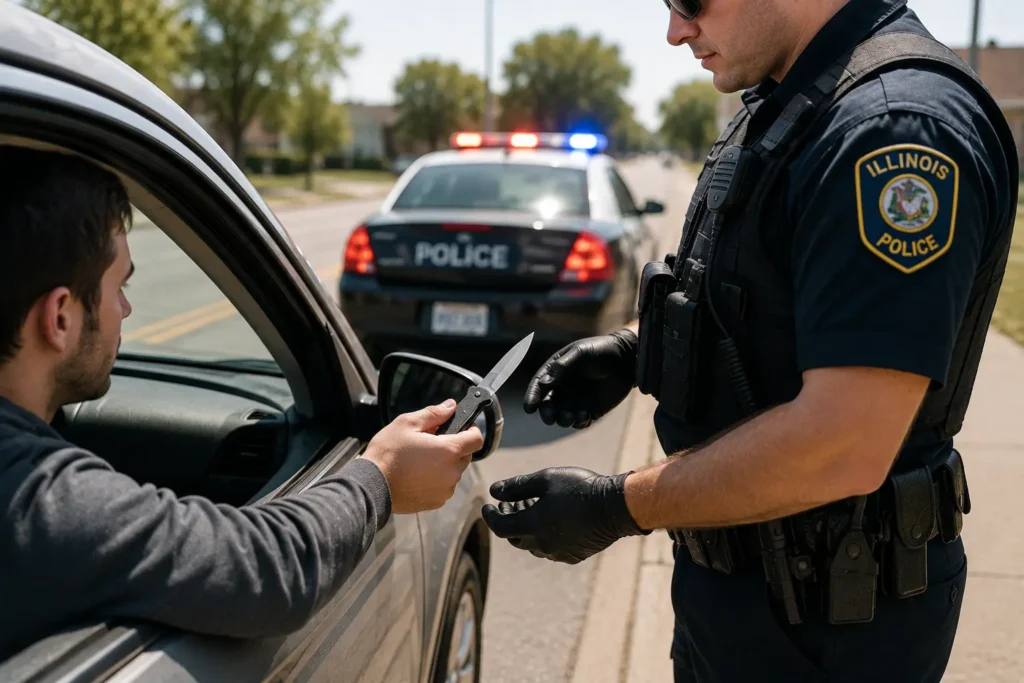
A traffic stop in Illinois can become more serious if police find a knife in your vehicle, pocket, backpack, glove box, center console, work bag, or under a seat. Many people carry knives for work, utility tasks, fishing, camping, moving boxes, or everyday use. But during a traffic stop, police may treat a knife as a safety concern and investigate whether it violates Illinois law.
Not every knife is illegal in Illinois. Ordinary pocket knives and common utility knives are often lawful when carried for legitimate purposes. However, the situation can change if the knife is a restricted type, carried with unlawful intent, found in a restricted location, or discovered during another investigation involving DUI, theft, drug possession, weapons allegations, or an outstanding warrant.
If police found a knife during a traffic stop in Springfield, Sangamon County, or anywhere in Illinois, the most important questions are what type of knife it was, where it was found, why police searched, and whether the State can prove unlawful intent or illegal possession.
Quick Answer
If police find a knife during an Illinois traffic stop, they may secure or confiscate it, investigate whether it is legal, and decide whether the stop should escalate into a search or criminal charge. Ordinary pocket knives and common utility knives may be legal when carried for lawful purposes, but restricted types, unlawful intent, restricted zones, or aggravating facts can lead to misdemeanor charges, jail time, fines, or felony upgrades. You should keep your hands visible, stay polite, and avoid making statements about intent until you speak with a criminal defense attorney.
Why Can a Knife Change an Illinois Traffic Stop?
A knife can change the tone of a traffic stop quickly. Even when the knife is legal, police may secure it for officer safety while the stop continues.
A knife may raise concern if it is:
- Visible on your person
- Clipped to a pocket
- Inside a backpack or bag
- In the center console
- In the glove box
- Under a seat
- Near drugs, alcohol, or stolen property
- Found during a DUI, theft, or drug possession investigation
- Found in a restricted location
- A type that may be restricted under Illinois law
The knife itself is only one part of the issue. The bigger legal question is whether the knife was possessed lawfully, whether the police search was legal, and whether the circumstances suggest unlawful intent.
What Happens When Police Find a Knife During a Traffic Stop?
Immediate Confiscation or Search Escalation may happen when an officer sees or discovers a knife during a stop. Confiscation does not always mean you will be charged. Sometimes police secure the knife temporarily for safety. Other times, they may treat it as evidence.
Police may:
- Ask where the knife is located
- Tell you not to reach for it
- Remove it from your pocket, bag, or vehicle area
- Ask you and passengers to step out
- Separate occupants
- Check whether the knife is prohibited
- Ask why you have it
- Expand the investigation
- Search other areas if they claim a legal basis
- Issue charges or make an arrest
Do not grab the knife to show it to the officer. That is how a manageable stop turns into instant chaos.
What If a Knife Is in Plain View During an Illinois Traffic Stop?
Plain view means police can see something without searching for it. If a knife is visible on the seat, floorboard, console, dashboard, or your person, police may notice it during the stop.
Plain view may allow police to secure the item if there is a safety concern. It may also give police a reason to ask more questions.
However, plain view does not always allow police to search the entire vehicle. Seeing an ordinary pocket knife does not automatically mean officers can open every bag, console, and container. Police still need a lawful basis for a broader search.
The defense may review:
- Whether the knife was actually visible
- Whether body camera footage confirms plain view
- Whether the knife appeared illegal
- Whether police exceeded the proper scope
- Whether the stop was extended without legal reason
Can Police Search Your Vehicle After Finding a Knife?
Expanded search means police search beyond the immediate area where the knife was seen or found.
Police may try to justify an expanded search based on:
- Consent
- Probable cause
- Officer safety
- Search incident to arrest
- Inventory search
- Plain view
- DUI investigation
- Drug possession investigation
- Theft or stolen property concerns
- Weapons suspicion
Illinois Legal Aid explains that police generally need a legal reason to search your vehicle or belongings, and you can refuse consent to a search.
If police searched after finding a knife, a criminal defense attorney may challenge whether the search went too far. If the search was illegal, evidence found after the search may be suppressed.
Why Online Advice About Illinois Knife Laws Can Be Misleading
Forum Consensus is not law, but it often reflects the practical confusion people have about knife cases. Many online discussions say things like “pocket knives are fine” or “it depends on the officer.” There is some truth in the idea that ordinary knives are often treated differently from prohibited weapons, but online advice can miss the important legal details.
The real answer depends on:
- The type of knife
- Blade mechanism
- Location
- Intent
- Whether it was concealed
- Whether it was used or displayed
- Whether it was found during another offense
- Whether local ordinances apply
- Whether the police search was lawful
A pocket knife in a toolbox is not the same as a restricted knife hidden under a seat during a drug possession stop. Same object category, very different courtroom energy.
Are Pocket Knives Legal to Carry in Illinois?
Ordinary pocket knives are commonly carried for work, utility tasks, fishing, camping, or everyday use. Illinois does not treat every pocket knife as illegal.
A pocket knife is more likely to be viewed as lawful when:
- It is used as a work or utility tool
- It is not a prohibited type
- It is not carried with unlawful intent
- It is not used or displayed threateningly
- It is not carried in a restricted location
- It is stored with tools or outdoor gear
- It is not connected to another criminal allegation
Examples may include:
- Folding pocket knives
- Multi-tools
- Box cutters
- Work knives
- Fishing knives
- Camping knives
- Utility blades
Still, facts matter. If police ask why you have the knife, be careful. Saying “I carry it in case I need to use it on someone” can create intent problems. That one sentence can turn a tool into evidence.
What Types of Knives May Be Restricted in Illinois?
Restricted Types can lead to charges even when the person says the knife was for self-defense or utility use.
Illinois unlawful weapons law references certain switchblade knives and ballistic knives. A ballistic knife is described as a device that propels a knife-like blade as a projectile by spring, elastic material, or compressed gas. The statute also includes language about switchblade knives and an exception involving people with a valid FOID card.
Restricted-type issues may involve:
- Automatic-opening mechanisms
- Ballistic blade projection
- Modified knives
- Disguised weapons
- Knives combined with other prohibited weapon features
- Local ordinance restrictions
Because knife classifications can be technical, the defense may review the actual item, how it opens, whether it fits the statutory definition, and whether any exception applies.
How Do Location and Intent Affect Illinois Knife Charges?
Location and Intent are often the most important parts of a knife case. A knife that is legal in one setting may create problems somewhere else.
High-risk locations may include:
- Schools
- Colleges
- Child care facilities
- Courthouses
- Government buildings
- Correctional facilities
- Public transportation areas
- Public events
- Private property with weapon restrictions
- Parks or public spaces depending on local rules
Intent matters too. Police and prosecutors may look at whether the knife was carried as a tool or as a weapon.
Facts that may suggest unlawful intent include:
- Threatening statements
- Brandishing the knife
- Hiding the knife in an unusual place
- Carrying it during an alleged theft
- Carrying it during a drug possession investigation
- Carrying it during a DUI stop with aggressive behavior
- Witness claims about threats
- Messages or social media posts
- Attempts to conceal or discard the knife
The State may need more than possession alone in some knife cases. A recent Illinois appellate decision noted that, under the statute involved there, prosecutors needed to prove either that the knife was a prohibited switchblade or that the defendant possessed a dangerous knife with intent to use it unlawfully.
When Can Knife Possession Lead to a Misdemeanor in Illinois?
Misdemeanor charges may apply depending on the type of knife, how it was carried, and the facts of the traffic stop.
A misdemeanor knife-related charge may involve:
- Unlawful possession of a weapon
- Carrying a prohibited knife
- Carrying a dangerous knife with unlawful intent
- Possessing a knife in certain restricted places
- Disorderly conduct or assault-related allegations if threats were made
- Local ordinance violations
A misdemeanor is still serious. It can lead to court appearances, fines, probation, conditional discharge, community service, and a criminal record if convicted.
What Are the Penalties for an Illinois Knife Charge?
Jail time and fines may be possible if the knife charge is filed as a criminal offense. The exact penalty depends on the charge level, location, prior record, and whether the case involves aggravating facts.
Possible consequences may include:
- Jail exposure
- Court fines and costs
- Probation
- Conditional discharge
- Community service
- Weapon forfeiture
- Criminal record
- Employment issues
- Housing problems
- Immigration concerns for non-citizens
- Probation or pretrial release violations
If the traffic stop also led to DUI, theft, drug possession, or weapons charges, the court may treat the case more seriously.
When Can a Knife Charge Become a Felony in Illinois?
Felony upgrades may happen when aggravating facts are present. A knife-related case can become more serious depending on the type of weapon, the person’s criminal history, location, and alleged conduct.
Felony risk may increase if:
- The knife is a prohibited weapon
- The person has a felony record
- The knife was possessed in a restricted location
- The knife was used or displayed during another offense
- The case involves threats or injury
- The person was on probation or pretrial release
- The knife was connected to theft, drug possession, DUI, or another criminal allegation
- The person was legally prohibited from possessing weapons
Felony charges can bring prison exposure, longer probation, higher fines, and long-term record consequences.
What Should You Do If Police Find a Knife During a Traffic Stop?
If police find or ask about a knife during a traffic stop, your goal is to stay safe and avoid creating evidence against yourself.
You should:
- Keep your hands visible
- Avoid sudden movements
- Do not reach toward the knife
- Follow lawful instructions
- Be polite
- Do not argue on the roadside
- Clearly refuse consent if police ask to search and you do not want to consent
- Remain silent about why you had the knife
- Ask for a lawyer if questioning continues
A safe statement is:
“I want to remain silent and speak with a lawyer.”
Do not lie. Do not explain under pressure. Do not say the knife is for protection, intimidation, or use against someone. Intent language can haunt the case.
What Are Common Defenses to an Illinois Knife Charge?
A Springfield criminal defense attorney may review several possible defense issues, including:
- The knife was an ordinary pocket knife
- The knife was a lawful utility tool
- The knife was properly transported
- The knife was not a restricted type
- No unlawful intent existed
- The stop was illegal
- The search was illegal
- The knife was not in plain view
- Police expanded the search without legal basis
- The knife belonged to someone else
- The accused lacked knowledge or control
- The location was not legally restricted
- Body camera footage contradicts the report
- Statements were taken improperly
A knife charge is not automatic proof of guilt. The State must prove the elements of the offense.
What Should You Do After Being Charged With a Knife Offense in Illinois?
If you were charged after police found a knife during an Illinois traffic stop, take action quickly.
You should:
- Save all tickets and paperwork
- Write down what happened privately
- Note where the knife was found
- Note whether it was visible or hidden
- Save proof of work, camping, fishing, moving, or utility use
- Identify passengers or witnesses
- Preserve photos, receipts, or tool records if helpful
- Avoid posting about the case online
- Do not contact police to explain
- Speak with a criminal defense attorney
Do not assume the charge will disappear because the knife was ordinary. The context still matters.
Speak With a Springfield Criminal Defense Attorney
If police found a knife during a traffic stop in Springfield, Sangamon County, or Central Illinois, speak with a criminal defense attorney before making statements or entering a plea.
A Springfield criminal defense attorney can review whether the knife was legal, whether it was in plain view, whether police had a lawful basis for an expanded search, whether intent can be proven, and whether the case should be reduced or dismissed.
This is especially important if the stop also involved DUI, theft, drug possession, weapons allegations, or a restricted location.
Key Takeaways About Knives During Illinois Traffic Stops
If police find a knife during an Illinois traffic stop, they may secure or confiscate it, investigate its legality, and decide whether the stop should escalate. An ordinary pocket knife or utility tool may be legal, but restricted types, unlawful intent, restricted locations, and aggravating facts can lead to misdemeanor charges, jail time, fines, or felony upgrades.
A plain view does not always justify an expanded search. Police still need a lawful reason to search beyond what they can see. The legality of the knife and the legality of the search may both become major defense issues.
If you were charged after police found a knife during a traffic stop in Springfield or Sangamon County, speak with a criminal defense attorney as soon as possible. Early defense work can help challenge the search, explain the context, and protect your record.