
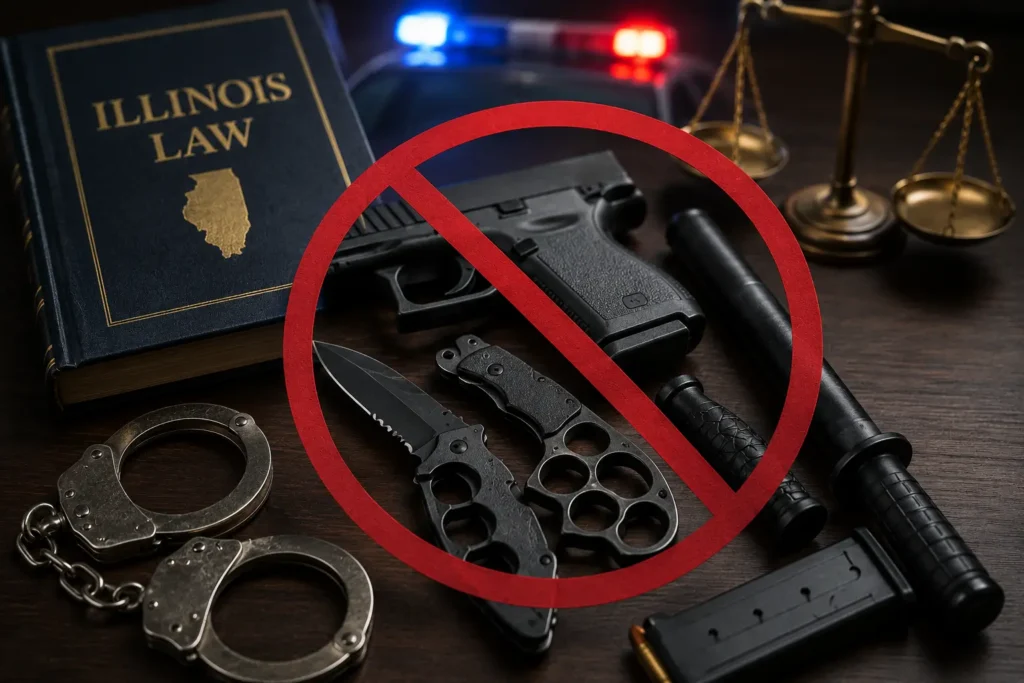
- Quick Answer: What Weapons Can Lead to Charges in Illinois?
- Why Illinois Weapons Charges Can Become Serious Even Without Using the Weapon
- Weapons and Accessories Restricted Under Illinois Law
- Illinois Weapons Charges and Defense Risks at a Glance
- Illinois Large Capacity Magazine Restrictions Explained
- Which Knives Can Lead to Weapons Charges in Illinois?
- When Certain Ammunition and Projectiles Become Illegal in Illinois
- Illinois Ghost Gun Laws and Unserialized Firearm Charges
- Why Machine Guns and Silencers Carry Serious Felony Risk
- Who Is Legally Prohibited From Possessing Firearms in Illinois?
- Firearm Possession Restrictions for Convicted Felons
- Illinois Firearm Restrictions for Minors
- How Drug-Related Disqualifications Can Affect Firearm Possession
- When Mental Health History Can Affect Illinois Firearm Eligibility
- How Orders of Protection Can Restrict Firearm Possession
- Places You Cannot Carry a Firearm Even With a FOID or CCL
- Firearm Restrictions at Schools, Colleges, and Child Care Facilities
- Weapons Restrictions in Courthouses and Government Facilities
- Firearm Restrictions in Parks, Playgrounds, and Public Housing Areas
- Firearm Restrictions at Hospitals and Mental Health Facilities
- When Carrying a Firearm in an Alcohol-Serving Business Becomes Illegal
- Can You Carry a Firearm on Public Transportation in Illinois?
- Weapons Restrictions at Festivals, Concerts, and Public Events
- When Private Property Owners Can Prohibit Firearms
- Criminal Penalties for Unlawful Weapon Possession in Illinois
- What Happens After a First Weapons Offense in Illinois?
- What Aggravated Unlawful Use of a Weapon Means in Illinois
- How Prior Convictions and Restricted Locations Increase Weapons PenaltiesRepeat Offenses and Prohibited Areas
- Penalties for Firearm Possession by a Felon in Illinois
- How Illinois Weapons Charges Usually Begin
- What Happens When Police Find a Weapon During a Traffic Stop or Arrest
- Common Defense Issues in Illinois Weapons Cases
- Charged With a Weapons Offense in Illinois?
- What To Do Immediately After an Illinois Weapons Arrest
- Why Early Legal Help Matters After a Weapons Charge in Springfield
- Speak With a Springfield Weapons Defense Attorney
- Related Guides for Illinois Weapons and Criminal Defense Cases
- Bottom Line: Illinois Weapons Cases Depend on Possession, Location, and Police Conduct
- Common Questions About Illinois Weapons Charges
- Can police charge you for a weapon found during a search?
- Does having a FOID card protect you from weapons charges?
- Can a weapons charge affect your FOID card?
- Can you be charged for having a weapon in your car in Illinois?
- Can you carry a firearm anywhere in Illinois with a concealed carry license?
- What is constructive possession in an Illinois weapons case?
- Can a weapons charge be dismissed in Illinois?
- Should you talk to police after a weapons arrest?
- Can I be charged for a weapon found in a shared vehicle?
- What should I do if police find a weapon during a traffic stop?
Illinois weapons laws are strict, detailed, and easy to misunderstand. A person may have a FOID card, a concealed carry license, or no criminal history and still face a weapons charge if they carry the wrong item, possess a firearm in the wrong place, or fall into a prohibited category.
Weapons charges in Illinois can involve firearms, ammunition, knives, firearm accessories, large capacity magazines, ghost guns, machine guns, silencers, restricted locations, and possession by people who are legally barred from having weapons. Some cases start after a traffic stop. Others begin during a DUI investigation, theft arrest, drug possession case, domestic call, probation search, or police response to a public disturbance.
The problem is that many people do not realize they crossed a legal line until they are already arrested. A weapon in a car, bag, pocket, console, or glove compartment can quickly become the centerpiece of a criminal case.
Quick Answer: What Weapons Can Lead to Charges in Illinois?
Illinois weapons charges may involve firearms, knives, large capacity magazines, ghost guns, silencers, prohibited accessories, or weapons carried in restricted locations. Whether someone faces charges depends on the weapon type, location, possession status, FOID or concealed carry status, prior record, and how police discovered the item.
If the weapons charge started during another case, related defense issues may also matter. Learn more about criminal defense in Springfield, IL, DUI defense, drug possession defense, and theft and burglary charges.
Why Illinois Weapons Charges Can Become Serious Even Without Using the Weapon
A weapons charge is not always about someone using a weapon. In many cases, the charge is based only on possession, transportation, location, or legal status.
That means a person may be charged even if:
- The firearm was never fired
- The weapon was inside a vehicle
- The person had no intent to harm anyone
- The weapon belonged to someone else
- The person had a FOID card
- The person thought the item was legal
- The person was also being investigated for DUI, theft, drug possession, or another offense
Illinois weapons cases often turn on small details. Where was the item found? Was it loaded? Was it immediately accessible? Did the person have a valid FOID card or CCL? Was the location prohibited? Was the person legally barred from firearm possession? Did police have a lawful reason to stop, search, or arrest?
Those details can determine whether a case is dismissed, reduced, negotiated, or treated as a felony.
Weapons and Accessories Restricted Under Illinois Law
Illinois law restricts many weapons and weapon-related items. Some are illegal because of what they are. Others become illegal because of how they are carried, where they are carried, or who possesses them.
Prohibited weapons and accessories may include:
- Certain firearms
- Large capacity magazines
- Specific knives
- Certain projectiles
- Ghost guns
- Machine guns
- Silencers
- Certain firearm accessories
- Weapons carried in restricted locations
- Firearms possessed by legally prohibited people
This area of law is technical, so do not assume an item is legal just because it can be bought online, inherited, stored at home, or carried in another state.
Illinois Weapons Charges and Defense Risks at a Glance
| Issue | Why It Can Lead to Charges | Common Defense Question |
|---|---|---|
| Large capacity magazines | Possession, sale, transfer, or transport may violate Illinois restrictions. | Does the item meet the legal definition? |
| Specific knives | Some knives become illegal based on type, intent, concealment, or location. | Was it a tool, weapon, or unlawfully carried item? |
| Ghost guns | Unserialized firearms or certain parts may trigger serious charges. | Can the State prove unlawful possession or assembly? |
| Machine guns and silencers | These items are heavily restricted and may trigger felony-level charges. | Does the item meet the legal definition under Illinois law? |
| Restricted locations | A lawful firearm may still be illegal in schools, courthouses, public transportation, and other areas. | Was the location legally restricted? |
Illinois Large Capacity Magazine Restrictions Explained
Illinois restricts certain large capacity ammunition feeding devices. These laws can affect magazines, drums, belts, and similar devices depending on capacity and firearm type.
A person may face legal problems if they possess, purchase, sell, deliver, or transport a restricted magazine or feeding device without falling under a legal exception.
Large capacity magazine cases may involve:
- Vehicle searches
- Home searches
- Firearm investigations
- Traffic stops
- Range-related possession
- Online purchase records
- Prior ownership questions
- FOID or CCL issues
A defense attorney may review whether the item meets the legal definition, whether an exception applies, whether the person knowingly possessed it, and whether police lawfully discovered it.
Which Knives Can Lead to Weapons Charges in Illinois?
Not every knife is illegal in Illinois, but certain knives and blade-related items can create weapons charges depending on the type, length, use, location, and how the item is carried.
Specific knives may become an issue when they are:
- Carried concealed
- Carried with unlawful intent
- Possessed in a restricted location
- Connected to another offense
- Found during a traffic stop or arrest
- Classified under a prohibited weapon category
Knife cases can be fact-sensitive. A tool used for work may look very different from a weapon carried for unlawful purposes. Context matters.
When Certain Ammunition and Projectiles Become Illegal in Illinois
Illinois weapons laws can also apply to certain projectiles and devices that launch or discharge harmful substances or objects.
These cases may involve items such as explosive-type projectiles, specialized ammunition, or devices that prosecutors argue fall within prohibited weapon definitions.
A projectile-related charge may become more serious if it is connected to:
- A vehicle stop
- A school or public park
- A government building
- A domestic incident
- A theft or burglary investigation
- A drug possession case
- A prior felony record
The defense may focus on the item’s legal classification, intent, possession, and whether the State can prove the required elements.
Illinois Ghost Gun Laws and Unserialized Firearm Charges
Ghost guns are firearms without proper serial numbers or firearms assembled from parts in a way that may avoid normal identification and transfer rules.
Illinois has taken a strict approach to unserialized firearms. A person may face serious charges if police find an unserialized firearm, unfinished frame, receiver, or privately assembled firearm that violates state law.
Ghost gun cases often involve:
- Search warrants
- Traffic stops
- Online purchase evidence
- Home searches
- Firearm parts kits
- Drug possession investigations
- Allegations of unlawful transfer or manufacture
These cases can become complex because prosecutors may rely on technical definitions and forensic firearm analysis.
Why Machine Guns and Silencers Carry Serious Felony Risk
Machine guns and silencers are heavily restricted in Illinois. Possession of these items can trigger felony-level charges and serious sentencing exposure.
Police and prosecutors may treat these cases aggressively because the items are considered highly dangerous or unlawful under state law.
A machine gun or silencer allegation may involve:
- Firearm conversion devices
- Modified firearms
- Suppressor-style devices
- Imported or inherited items
- Online purchase records
- Federal and state law overlap
- Search and seizure issues
If you are accused of possessing a machine gun, silencer, or conversion device, avoid explaining the item to police without legal advice. Statements made early in the case may be used by prosecutors and may affect possible defense options.
Who Is Legally Prohibited From Possessing Firearms in Illinois?
Illinois law does not only regulate weapons. It also regulates who is allowed to possess them.
Some people cannot legally possess firearms or ammunition, even if the firearm is otherwise legal.
Firearm Possession Restrictions for Convicted Felons
A convicted felon generally cannot possess a firearm in Illinois. Possession by a felon is one of the most serious weapons charges because it combines firearm possession with prior felony status.
The firearm does not need to be used. The charge may be based on possession alone.
Possession by a felon cases may involve:
- Firearms in a vehicle
- Firearms in a home
- Shared residences
- Constructive possession
- Ammunition possession
- Firearms found during a DUI, theft, or drug possession investigation
- Police claims that the person had access or control
A key defense issue may be whether the person actually or constructively possessed the firearm.
Illinois Firearm Restrictions for Minors
Minors face strict restrictions involving firearms and other weapons. Adults may also face charges if they unlawfully provide, store, transfer, or allow access to weapons by minors.
Minor-related weapons cases may involve:
- School incidents
- Vehicles
- Social media videos
- Family-owned firearms
- Shared bedrooms
- Public parks or playgrounds
- Juvenile court issues
These cases can affect school discipline, juvenile records, family court concerns, and future firearm eligibility.
How Drug-Related Disqualifications Can Affect Firearm Possession
Illinois law can restrict firearm possession by people who are addicted to narcotics or otherwise disqualified under firearm eligibility rules.
This issue may come up in drug possession cases, probation matters, treatment-related court files, or background checks. A person facing a drug possession charge and a firearm allegation may be at greater risk because prosecutors may argue the combination creates a public safety concern.
When Mental Health History Can Affect Illinois Firearm Eligibility
Certain mental health histories can affect firearm eligibility in Illinois. This may include recent mental health facility admission, involuntary commitment, adjudication, or other disqualifying mental health findings depending on the facts and legal standard.
Mental health-related firearm cases require careful handling. The issue is not just the criminal charge. It may also involve FOID status, records, treatment history, restoration rights, and whether the State has accurate information.
How Orders of Protection Can Restrict Firearm Possession
A person subject to certain protective orders may be barred from possessing firearms. This can include orders of protection in domestic violence or family-related cases.
If a protective order requires surrender of firearms or affects FOID eligibility, ignoring that order can lead to criminal charges.
Protective order firearm issues may arise during:
- Domestic battery cases
- Divorce or custody disputes
- Stalking or harassment allegations
- Emergency order hearings
- Police calls to a home
- Probation or pretrial release supervision
If a court order mentions firearms, read it carefully and speak with an attorney before taking any action.
Places You Cannot Carry a Firearm Even With a FOID or CCL
A FOID card does not allow someone to carry a concealed firearm in public. A concealed carry license does not allow someone to carry everywhere.
Illinois has many restricted locations where firearms are prohibited even if the person has a FOID or CCL.
Restricted locations can create criminal charges because the problem is not only who had the firearm. The problem is where the firearm was carried.
Firearm Restrictions at Schools, Colleges, and Child Care Facilities
Firearms are heavily restricted in schools, colleges, universities, school transportation areas, and child care facilities.
This includes many areas connected to:
- Public and private schools
- Colleges and universities
- Child care centers
- School buses
- School activities
- School-owned or controlled property
A firearm found near or inside a school-related area can make a case much more serious.
Weapons Restrictions in Courthouses and Government Facilities
Government buildings, courthouses, and correctional facilities are restricted areas. Carrying a weapon into these locations can lead to serious charges, even if the person normally has lawful possession rights.
These locations often have security screening. A person may be arrested after forgetting a firearm, ammunition, knife, or other weapon is in a bag, pocket, or vehicle.
Forgetting is not the defense strategy you want to rely on. It might explain what happened, but it may not stop the charge by itself.
Firearm Restrictions in Parks, Playgrounds, and Public Housing Areas
Illinois law also restricts firearms in certain public parks, playgrounds, and public housing areas.
These cases may arise when a person is stopped while walking, sitting in a parked vehicle, attending a gathering, or passing through an area with a firearm.
The defense may review whether the location legally qualifies as a restricted area and whether the person knowingly carried or possessed the weapon there.
Firearm Restrictions at Hospitals and Mental Health Facilities
Hospitals and mental health facilities are also restricted locations for firearms. Carrying into these places can lead to legal trouble because of patient safety concerns and facility rules.
These cases may happen when someone forgets a firearm in a bag, carries while visiting a patient, or has a weapon in a vehicle near facility property.
When Carrying a Firearm in an Alcohol-Serving Business Becomes Illegal
Illinois concealed carry law restricts firearms in certain establishments that serve alcohol, especially where alcohol sales meet the statutory threshold.
These cases can become fact-specific because the legal question may depend on the business type, revenue from alcohol, signage, and whether the person knowingly carried in a prohibited place.
A DUI-related stop after leaving an alcohol-serving establishment can become more serious if police also find a firearm.
Can You Carry a Firearm on Public Transportation in Illinois?
Public transportation is a restricted area under Illinois concealed carry rules. This can include buses, trains, and public transportation facilities.
A firearm allegation connected to public transportation may lead to criminal charges, even if the person has a concealed carry license.
Weapons Restrictions at Festivals, Concerts, and Public Events
Special events may create restricted areas depending on the event, location, permits, security rules, and government involvement.
Examples may include:
- Street festivals
- Parades
- Public gatherings
- Concerts
- Sporting events
- Community events
- Government-permitted events
Weapons at special events can lead to heightened police attention because of crowd safety concerns.
When Private Property Owners Can Prohibit Firearms
Private property owners may prohibit firearms on their property, often through posted signage or policies.
This can include:
- Stores
- Offices
- Restaurants
- Apartment communities
- Entertainment venues
- Employers
- Private campuses
- Event spaces
If a property owner prohibits firearms, carrying there can create legal and trespass-related problems. Employees may also face job loss or workplace discipline.
Criminal Penalties for Unlawful Weapon Possession in Illinois
Penalties for unlawful possession depend on the weapon, location, person’s status, prior record, and whether aggravating facts apply.
A weapons charge may be a misdemeanor or felony. Some cases carry mandatory prison exposure. Others may be eligible for diversion, probation, or negotiated reductions depending on the facts.
What Happens After a First Weapons Offense in Illinois?
A first offense weapons charge may still be serious. Even without a prior record, a person may face:
- Arrest
- Booking
- Court appearances
- Fines and court costs
- Probation or conditional discharge
- Jail exposure
- Firearm forfeiture
- FOID or CCL consequences
- Employment problems
- Permanent criminal record if convicted
Some first-time defendants may be eligible for alternative outcomes, but eligibility depends on the charge and criminal history.
What Aggravated Unlawful Use of a Weapon Means in Illinois
Illinois weapons cases are often discussed using terms like unlawful use of weapons, unlawful possession, and aggravated unlawful use of weapons. Some people may also hear older or informal language such as Aggravated UUW.
Aggravated weapons allegations may involve factors such as:
- No valid FOID card
- No valid concealed carry license
- Loaded firearm
- Immediate accessibility
- Possession in a vehicle
- Possession in a prohibited location
- Prior criminal history
- Firearm connected to another alleged offense
Aggravated charges can raise the case from a lower-level weapons issue into a felony with serious sentencing exposure.
How Prior Convictions and Restricted Locations Increase Weapons PenaltiesRepeat Offenses and Prohibited Areas
Repeat offenses and possession in prohibited areas can increase the seriousness of a weapons case.
A person may face harsher treatment if the case involves:
- Prior weapons convictions
- Prior felony convictions
- School zones
- Public parks
- Public transportation
- Courthouses
- Government buildings
- Public housing areas
- Protective order violations
- Weapons found during DUI, theft, or drug possession arrests
Prosecutors may view repeat or location-based weapons charges as higher risk. That can affect plea negotiations and sentencing.
Penalties for Firearm Possession by a Felon in Illinois
Possession by a felon is one of the most serious Illinois firearm charges. A person with a felony conviction may be prohibited from possessing firearms or ammunition.
The State may try to prove possession through:
- A firearm found on the person
- A firearm found in a vehicle
- A firearm found in a shared home
- Ammunition found near personal belongings
- Statements made during police questioning
- Fingerprints or DNA
- Photos, videos, or social media posts
- Witness testimony
The defense may challenge whether the person knew about the firearm, had control over it, or was legally connected to the place where it was found.
How Illinois Weapons Charges Usually Begin
Many Illinois weapons charges begin during a separate police encounter. The case may start as a traffic stop, DUI investigation, theft arrest, drug possession case, domestic call, probation search, warrant arrest, or police response to a public disturbance.
Common situations include:
- A firearm found in a vehicle console, glove box, trunk, or backpack
- A knife found during a search after an arrest
- A weapon discovered during a DUI or drug possession investigation
- A firearm located in a shared home or bedroom
- A weapon found after police search a bag, purse, or storage area
- A restricted weapon discovered near a school, courthouse, public park, or public transportation area
These cases often depend on whether the search was legal, whether the person knew about the weapon, and whether prosecutors can prove actual or constructive possession.
What Happens When Police Find a Weapon During a Traffic Stop or Arrest
Many Illinois weapons charges begin during another police encounter. A traffic stop, DUI investigation, drug possession arrest, theft accusation, domestic call, probation search, or warrant arrest may lead police to search a vehicle, bag, pocket, home, or shared space.
When a weapon is found during a stop or arrest, the defense may focus on whether the stop was legal, whether police had a lawful basis to search, whether the person knowingly possessed the item, and whether the State can prove control over the weapon.
Understanding your rights during police encounters is also important when dealing with Illinois traffic stop searches and possible weapons evidence.
| Police Encounter | Common Weapon Issue | Defense Focus |
|---|---|---|
| Traffic stop | Weapon found in console, glove box, trunk, pocket, or bag. | Was the stop and search lawful? |
| DUI investigation | Firearm or knife found during vehicle search or arrest. | Was the weapon legally possessed and properly transported? |
| Drug possession case | Weapon found near alleged drugs or in a shared space. | Can the State prove knowing possession and control? |
| Domestic call | Firearm issue connected to an order of protection or safety allegation. | Did a court order restrict firearm possession? |
Common Defense Issues in Illinois Weapons Cases
Every weapons case depends on the facts. A Springfield criminal defense attorney may review several possible defense issues.
Defense questions may include:
- Did police have a lawful reason for the stop?
- Was the search legal?
- Did the person actually possess the weapon?
- Was it constructive possession or mere proximity?
- Was the item legally classified as a prohibited weapon?
- Did the person have a valid FOID card?
- Did the person have a valid CCL?
- Was the location actually restricted?
- Was the weapon loaded or unloaded?
- Was the firearm immediately accessible?
- Was the person legally prohibited from possession?
- Did officers violate the person’s rights?
- Can evidence be suppressed?
In some cases, the strongest defense is not arguing about the weapon itself. It may be challenging the traffic stop, search, seizure, or statements made after arrest.
Charged With a Weapons Offense in Illinois?
Illinois weapons cases often depend on details such as where the weapon was found, whether police had authority to search, and whether prosecutors can prove knowing possession. A Springfield criminal defense attorney can review your case and explain your available options.
Schedule a Confidential ConsultationWhat To Do Immediately After an Illinois Weapons Arrest
If you are charged with a weapons offense in Springfield or anywhere in Illinois, take action quickly.
You should:
- Stay silent about the facts of the case
- Do not explain ownership to police
- Do not claim the weapon without legal advice
- Save all paperwork
- Write down what happened privately
- Identify witnesses
- Preserve FOID or CCL documents
- Avoid new charges
- Follow all court orders
- Speak with a criminal defense attorney
Do not assume the charge is minor because nobody was hurt. Illinois can punish possession-based weapons cases harshly.
Why Early Legal Help Matters After a Weapons Charge in Springfield
Illinois weapons laws are complex, especially when a case involves DUI, theft, drug possession, a traffic stop, restricted locations, large capacity magazines, ghost guns, machine guns, silencers, or possession by a felon.
A Springfield criminal defense attorney can review the charge, examine the search, challenge weak evidence, negotiate with prosecutors, and fight to protect your record and freedom.
If you were arrested or charged in Springfield, Sangamon County, or Central Illinois, get legal help before making statements, entering a plea, or assuming the case cannot be defended.
Speak With a Springfield Weapons Defense Attorney
Illinois weapons cases often depend on important details, including where the weapon was found, whether police conducted a lawful search, whether the item was legally restricted, and whether prosecutors can prove knowing possession. A legal review can help identify possible defenses and protect your rights.
If you are facing an Illinois weapons charge, speak with Andrew Affrunti about your case and available defense options.
Contact the OfficeRelated Guides for Illinois Weapons and Criminal Defense Cases
- Mistakes to Avoid After Being Arrested in Illinois
- First Arrest in Illinois? What Happens Next
- Illinois Weapons Charges: What Is Illegal to Carry?
- What Happens If You Have a Warrant in Illinois and Don’t Know It
Bottom Line: Illinois Weapons Cases Depend on Possession, Location, and Police Conduct
Illinois weapons charges can involve much more than carrying a firearm. A person may face charges for prohibited weapons and accessories, large capacity magazines, specific knives, certain projectiles, ghost guns, machine guns, silencers, restricted locations, or possession by someone legally barred from having firearms.
Even with a FOID card or CCL, you cannot carry everywhere. Schools, colleges, child care facilities, government buildings, courthouses, correctional facilities, public parks, public housing projects, hospitals, mental health facilities, alcohol-serving establishments, public transportation, special events, and private property restrictions can all create legal risk.
If you are accused of unlawful possession, aggravated unlawful possession, possession by a felon, or a weapons charge connected to DUI, theft, drug possession, or another criminal case, speak with a Springfield criminal defense attorney as soon as possible. Early defense work can help protect your rights, your record, and your future.
Common Questions About Illinois Weapons Charges
Can police charge you for a weapon found during a search?
Police may file charges if they believe they discovered an unlawfully possessed weapon. However, whether evidence can be used may depend on whether the search and seizure were legally conducted.
Does having a FOID card protect you from weapons charges?
No. A FOID card allows firearm possession in certain situations but does not permit possession everywhere or possession of every weapon. Location restrictions and firearm laws still apply
Can a weapons charge affect your FOID card?
Yes. Certain weapons charges or convictions may affect firearm eligibility, FOID status, and future ability to legally possess firearms.
Can you be charged for having a weapon in your car in Illinois?
Yes. A person may face a weapons charge if police find a firearm, knife, magazine, or other restricted weapon in a vehicle. The case may depend on whether the item was lawful, whether it was properly transported, whether the person had the required FOID card or concealed carry license, and whether police can prove possession.
Can you carry a firearm anywhere in Illinois with a concealed carry license?
No. A concealed carry license does not allow someone to carry a firearm everywhere. Illinois restricts firearms in schools, courthouses, government buildings, public transportation, hospitals, certain alcohol-serving establishments, and other prohibited locations.
What is constructive possession in an Illinois weapons case?
Constructive possession means prosecutors may argue that a person had knowledge of and control over a weapon, even if it was not found directly on their body. These cases often involve weapons found in vehicles, shared homes, bags, bedrooms, or storage areas.
Can a weapons charge be dismissed in Illinois?
A weapons charge may be challenged if police violated search and seizure rules, if the State cannot prove possession, if the item does not meet the legal definition of a prohibited weapon, or if the person had a valid legal defense. Dismissal depends on the facts, evidence, and charge.
Should you talk to police after a weapons arrest?
No. A person charged with a weapons offense should avoid explaining ownership, possession, or intent to police without legal advice. Statements made early in the case may be used as evidence.
Can I be charged for a weapon found in a shared vehicle?
Yes. A weapon found in a shared vehicle can lead to charges if prosecutors believe you knew it was there and had control over it. These cases often depend on where the weapon was found, who owned the vehicle, who had access, what was said to police, and whether the search was lawful.
What should I do if police find a weapon during a traffic stop?
Stay calm, do not physically resist, and do not explain ownership, intent, or self-defense without legal advice. A defense attorney can review the stop, search, license status, weapon location, and whether the State can prove knowing possession.