
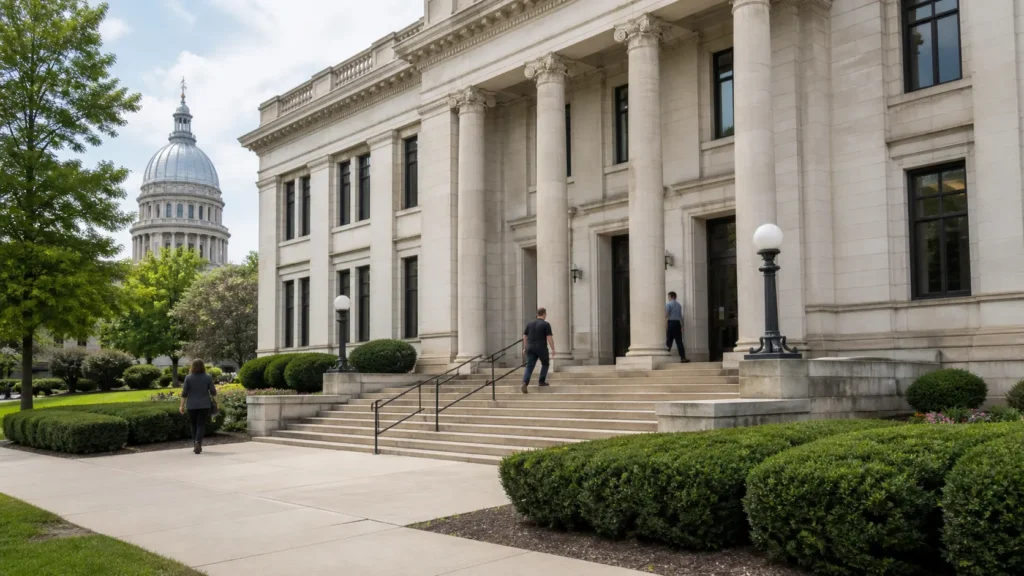
- If You Are Charged in Springfield or Sangamon County
- 1. Arrest, Citation, or Criminal Complaint
- 2. Pretrial Release or Detention
- 3. First Appearance and Arraignment Procedures
- 4. Preliminary Hearing or Indictment
- 5. Discovery and Evidence Review
- 6. Pretrial Motions
- 7. Plea Negotiations
- 8. Trial
- 9. Sentencing
- 10. Why Local Springfield Court Experience Matters
- Sangamon County Criminal Case Timeline
- How Long Does a Criminal Case Take in Sangamon County?
- Facing a Criminal Case in Sangamon County?
- Related Sangamon County Criminal Defense Resources
- Frequently Asked Questions
Quick Answer
A Sangamon County criminal case may begin with an arrest, citation, complaint, warrant, or formal charge. Depending on the case, the next stages may include a first appearance, pretrial release proceedings, arraignment, felony charging procedures, discovery, motions, plea negotiations, trial, and sentencing. The exact sequence depends on the charge, custody status, and how the case is filed.
If You Are Charged in Springfield or Sangamon County
Criminal cases arising in Springfield are generally handled through the Circuit Court of Sangamon County, which is part of Illinois’ Seventh Judicial Circuit.
The court process depends on how the case begins, whether the accused is detained or released, whether the allegation is a misdemeanor or felony, and whether prosecutors proceed by complaint, information, or indictment.
This guide explains the major stages of a Sangamon County criminal case and what defendants should review before each stage.
1. Arrest, Citation, or Criminal Complaint
A Sangamon County criminal case may begin through an arrest, citation, summons, criminal complaint, warrant, or an investigation that later results in formal charges.
The documents provided at this stage may identify:
- The alleged offense
- The court case or citation number
- The next court date
- Release conditions
- Restrictions on contact, travel, weapons, alcohol, or other conduct
Keep every document provided by police or the court. Avoid discussing the facts of the allegation with investigators before understanding how those statements may affect the case. If your case began with an arrest, review what happens after an arrest in Sangamon County.
2. Pretrial Release or Detention
Illinois does not use a monetary cash-bail system for new criminal cases. A defendant may be released, released with conditions, or, in qualifying cases, ordered detained after the procedures required by Illinois pretrial-release law.
Pretrial detention is not available simply because prosecutors request it. The charge must fall within the categories for which detention is authorized, and the court must conduct the required hearing.
Release conditions may address matters such as:
- Contact with particular people
- Travel
- Reporting requirements
- Electronic monitoring
- Firearm possession
- Alcohol or drug use
- Other restrictions related to the case
Read the written release order carefully. Violations can create additional hearings and may affect whether the existing conditions remain in place. For a deeper explanation of release and detention hearings, review Illinois pretrial release law.
3. First Appearance and Arraignment Procedures
Early court appearances may address representation, release conditions, scheduling, and other preliminary issues.
Arraignment has a more specific function. Under Illinois law, the defendant is called into open court, informed of the charge, and asked to enter a plea.
A not guilty plea allows the case to continue while the defense reviews discovery, investigates the allegations, and evaluates possible motions or negotiations.
The precise order and timing of these events can vary depending on how the case was filed and whether it is a misdemeanor or felony.
What To Bring to Your First Court Date in Sangamon County
Before your first court date in Sangamon County, gather any paperwork from the arrest, citation, jail release, notice to appear, bond or release conditions, police contact, and court notice. You should also bring identification and any documents your attorney requested.
Do not bring weapons, illegal items, or anything that could create new problems at the courthouse. Arrive early, check the courtroom assignment, and speak with your attorney before making decisions or statements in court.
What Happens at Your First Sangamon County Criminal Court Date?
Your first criminal court date may involve confirming the charge, reviewing release conditions, entering an initial plea, setting future dates, or confirming whether you have an attorney. The exact hearing depends on the charge and whether you were released, detained, cited, or arrested.
Do not treat the first court date as routine. What happens early can affect release conditions, discovery deadlines, plea discussions, and the defense strategy.
What Happens After Being Charged in Sangamon County?
| Stage | What Happens |
|---|---|
| Arrest or Citation | The case begins through police action, citation, complaint, or warrant. |
| Pretrial Release | The court decides whether you are released, released with conditions, or detained. |
| Arraignment | You are informed of charges and enter an initial plea. |
| Discovery | The defense reviews evidence and identifies possible issues. |
| Resolution | The case may end through dismissal, plea agreement, trial, or sentencing. |
Missing a court date can create additional problems. Learn what happens if you miss a court date in Illinois and how to respond.
4. Preliminary Hearing or Indictment
Felony cases may proceed through a preliminary hearing, grand jury indictment, or another legally authorized charging procedure.
At a preliminary hearing, the judge considers whether probable cause exists to believe an offense was committed and that the accused committed it.
A grand jury proceeding follows a different process and may result in an indictment.
These stages are not a full criminal trial. They address whether the felony prosecution may continue, not whether the State has proved guilt beyond a reasonable doubt.
5. Discovery and Evidence Review
Discovery is the process through which the defense obtains and reviews evidence related to the prosecution.
Depending on the case, discovery may include:
- Police reports
- Body-camera footage
- Dashboard-camera footage
- Surveillance video
- Witness statements
- Photographs
- Laboratory reports
- Breath, blood, or urine testing
- Search-warrant materials
- Phone or digital evidence
- Statements attributed to the accused
Discovery review can reveal factual conflicts, missing evidence, identification issues, testing problems, or potential constitutional challenges.
A plea decision should generally not be based only on the charge listed in the complaint. The available evidence and possible legal challenges also matter.
6. Pretrial Motions
Pretrial motions ask the judge to decide legal issues before trial.
Depending on the facts, motions may address:
- An unlawful traffic stop
- Search-and-seizure issues
- Statements made during police questioning
- Identification procedures
- Discovery disputes
- Admissibility of particular evidence
- Other procedural or constitutional questions
A successful motion may limit or exclude evidence, but it does not automatically dismiss every criminal charge. The effect depends on what evidence remains after the ruling. Searches, statements, witness evidence, and other issues are evaluated together when building a criminal defense strategy.
Mistakes To Avoid in Sangamon County Criminal Court
Small mistakes can create bigger problems in a criminal case. Missing court, violating release conditions, contacting witnesses, discussing the case online, or speaking with police without legal advice can hurt the defense.
- Do not miss court dates.
- Do not violate no-contact orders or release conditions.
- Do not discuss the case on social media.
- Do not contact witnesses or alleged victims unless your attorney says it is allowed.
- Do not accept a plea before reviewing the evidence with a defense attorney.
7. Plea Negotiations
Many criminal cases are resolved without trial, but the available resolution depends on the charge, evidence, criminal history, sentencing rules, and negotiations between the parties.
Possible outcomes may include:
- Dismissal of a charge
- Amendment to another charge
- A negotiated guilty plea
- Court supervision where legally available
- Probation or conditional discharge where legally permitted
- Other agreed sentencing terms
Before accepting a plea, review the sentencing consequences and any effects on employment, professional licensing, driving privileges, immigration, firearm rights, and the criminal record.
A faster resolution is not necessarily a better resolution if important evidence or legal issues have not been reviewed. Before accepting an offer, learn how plea bargains work in Illinois criminal cases.
Questions to Ask a Criminal Defense Attorney Before Court
Before appearing in court or accepting any plea offer, it helps to ask direct questions about your case, evidence, risks, and options. A defense attorney can explain what matters most at each stage of the court process.
- What charge am I facing and what are the possible penalties?
- Can the evidence be challenged?
- Are there release conditions I need to follow?
- Could this case affect my job, license, housing, or record?
- What should I avoid saying or doing before the next court date?
Understanding plea negotiations is important before accepting any agreement. Learn more about how plea bargains work in Illinois criminal cases .
8. Trial
If the case does not resolve through dismissal or negotiation, it may proceed to a bench trial or jury trial when a jury trial is legally available and properly requested.
At trial, the prosecution has the burden of proving the charged offense beyond a reasonable doubt.
The defense may:
- Cross-examine prosecution witnesses
- Challenge physical or digital evidence
- Present defense evidence when appropriate
- Call witnesses
- Raise reasonable doubt
- Make legal objections
The judge or jury determines whether the prosecution has met its burden.
9. Sentencing
If a defendant is convicted or enters a guilty plea, the court determines an authorized sentence based on the offense and applicable Illinois sentencing rules.
Possible sentencing consequences may include:
- Probation where permitted
- Conditional discharge where permitted
- Jail
- Prison
- Fines and court costs
- Restitution
- Treatment or other conditions
- Driver’s license consequences
- Other offense-specific requirements
The court may consider the offense, criminal history, statutory aggravating and mitigating factors, victim-impact information where applicable, and other legally relevant circumstances.
Not every sentencing option is available for every misdemeanor or felony.
10. Why Local Springfield Court Experience Matters
Sangamon County criminal cases are handled through the Seventh Judicial Circuit. The Sangamon County Circuit Clerk is located at the county court complex at 200 South Ninth Street in Springfield.
Local court familiarity may help with practical issues such as:
- Confirming where a case is assigned
- Understanding filing and scheduling procedures
- Tracking pretrial and status dates
- Reviewing local court orders
- Preparing for hearings
- Identifying which documents should be obtained before the next appearance
Courtroom assignments, judges, schedules, and procedures can change. Always confirm the courtroom and appearance information shown on the most recent court notice or through the Circuit Clerk.
Local knowledge does not change the Illinois statutes or burden of proof. It helps an attorney navigate the procedures through which those laws are applied in a particular courthouse.
Sangamon County Criminal Case Timeline
Every criminal case is different, but many cases in Sangamon County follow a similar court process. The exact timeline depends on the charge, whether the person is detained or released, how much evidence must be reviewed, and whether the case resolves before trial.
| Court Stage | What Usually Happens | Why It Matters |
|---|---|---|
| Arrest, citation, or complaint | The case begins after police contact, an investigation, a citation, a criminal complaint, or a warrant. | Early statements, paperwork, and release terms can shape the case. |
| Pretrial release or detention | The court decides whether the person is released, released with conditions, or detained. | This can affect freedom, work, family, and defense preparation. |
| Arraignment | The defendant is informed of the charge and asked to enter a plea. | A not guilty plea often gives the defense time to review the case. |
| Discovery and motions | The defense reviews evidence and may challenge searches, stops, statements, or probable cause. | Evidence review can change the direction of the case. |
| Plea, trial, or sentencing | The case may resolve by agreement, proceed to trial, or move to sentencing after a finding of guilt. | The final outcome can affect record, license, employment, housing, and freedom. |
How Long Does a Criminal Case Take in Sangamon County?
A simple misdemeanor case may resolve in a few months, while a contested misdemeanor or felony case can take longer. The timeline depends on the charge, evidence, court schedule, motions, negotiations, and whether the case goes to trial.
Cases involving body camera footage, lab results, witness issues, search challenges, or serious felony allegations often take more time because the defense needs to review the evidence carefully before making decisions.
Facing a Criminal Case in Sangamon County?
A criminal case may involve release conditions, discovery, motions, plea decisions, trial preparation, and sentencing issues. Andrew Affrunti can review where your case stands and explain what may happen before your next Sangamon County court date.
Schedule a Confidential ConsultationCall 217-528-2183
Related Sangamon County Criminal Defense Resources
- Criminal Defense Attorney in Springfield, IL
- First Arrest? What a Criminal Defense Lawyer Wants You to Know
- What Happens If You Miss a Court Date in Illinois?
- How Plea Bargains Work in Illinois Criminal Cases
Frequently Asked Questions
Where is Sangamon County criminal court located?
Sangamon County court operations are based at the county court complex at 200 South Ninth Street in Springfield. Confirm the specific courtroom listed on your current court notice before appearing.
What judicial circuit handles Springfield criminal cases?
Sangamon County is part of Illinois’ Seventh Judicial Circuit, along with Greene, Jersey, Macoupin, Morgan, and Scott counties.
What happens first after a criminal charge in Sangamon County?
The first steps depend on how the case begins and whether the person is in custody. They may include an arrest or citation, release proceedings, a first court appearance, arraignment, and future scheduling.
Does Illinois still use cash bail?
Illinois no longer uses monetary cash bail for new criminal cases. A defendant may be released, released with conditions, or detained in qualifying cases under the state’s pretrial-release laws.
What happens at an Illinois arraignment?
At arraignment, the accused is informed of the charge and called upon to enter a plea. The court also records that the arraignment occurred.
Do all Sangamon County felony cases have a preliminary hearing?
Not necessarily. Felony cases may proceed through a preliminary hearing, grand jury indictment, or another legally authorized charging process.
Do all Sangamon County criminal cases go to trial?
No. Cases may resolve through dismissal, an amended charge, a negotiated plea, or another legally available disposition. Cases that do not resolve may proceed to bench or jury trial.
How can I check my Sangamon County criminal case?
The Sangamon County Circuit Clerk provides case and records information. Use the case number and your most recent court paperwork to verify scheduled appearances, and contact the Circuit Clerk when the information is unclear.