
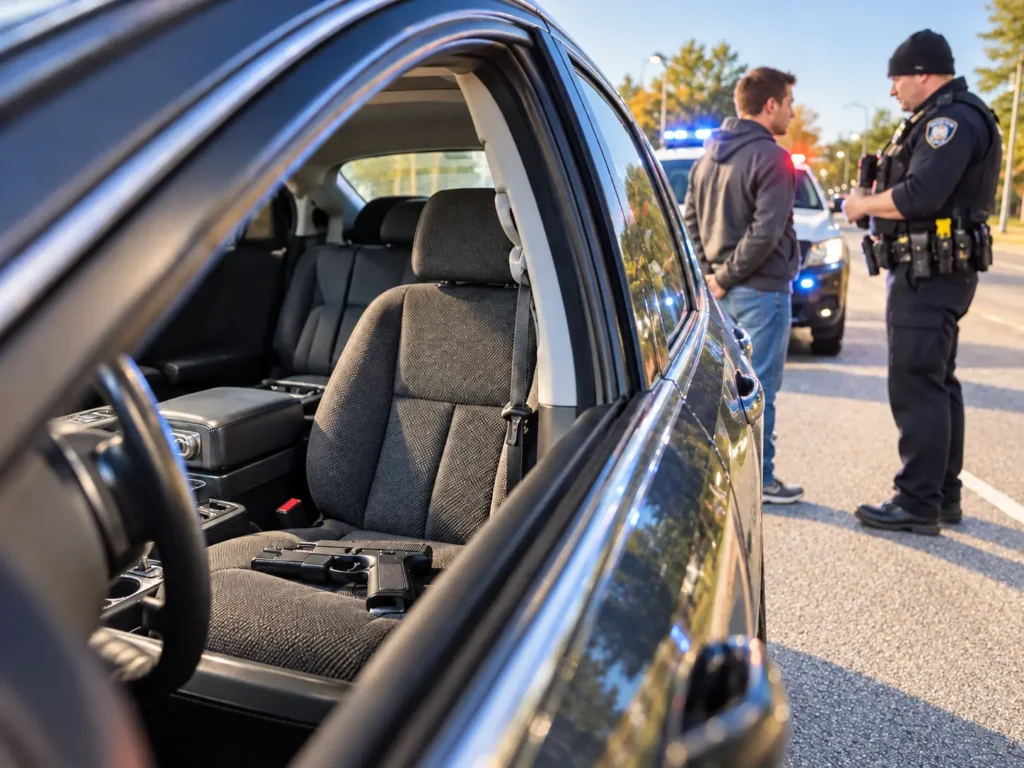
A DUI traffic stop in Illinois can become more complicated when police discover a firearm or another weapon inside the vehicle. Even if the weapon is legally owned, its presence may lead to additional questions about firearm possession, concealed carry, transportation requirements, and possible criminal charges.
Illinois law distinguishes between possessing a firearm legally and carrying one while under the influence of alcohol or drugs. A driver with a valid Firearm Owner’s Identification (FOID) card or Concealed Carry License (CCL) may still face legal consequences depending on how the firearm was stored and whether the person was intoxicated.
If the weapon was loaded, uncased, or immediately accessible, police may investigate whether a separate weapons violation occurred.
For drivers arrested in Springfield, Sangamon County, or Central Illinois, understanding the difference between a DUI charge and a firearms offense is essential to protecting their rights.
Quick Answer
If police find a weapon during a DUI stop in Illinois, the outcome depends on whether the firearm was legally possessed, loaded or unloaded, properly cased, and immediately accessible. A valid FOID card may allow lawful transportation, while a CCL generally permits concealed handgun carry. However, carrying a concealed firearm while under the influence is a separate offense, even for a valid CCL holder. Improper firearm possession or transportation may result in additional misdemeanor or felony charges, including aggravated unlawful possession of a weapon.
Why Police Investigate Weapons During DUI Stops
During a DUI investigation, officers may look for evidence of impaired driving, including alcohol consumption, drug use, unsafe driving, and other circumstances surrounding the stop.
If officers discover a firearm, they may also investigate whether it is legally possessed and transported.
Police may consider:
- Whether the firearm is loaded
- Whether it is inside a case or container
- Whether it is immediately accessible
- Whether the driver has a valid FOID card
- Whether the driver has a valid CCL
- Whether passengers have access to the firearm
- Whether the firearm is lawfully owned
- Whether any occupant is prohibited from possessing weapons
- Whether another offense occurred
A firearm’s presence does not automatically establish a criminal violation. The circumstances must satisfy the requirements of a specific weapons law.
1. If You Are Legally Allowed to Possess the Firearm
A driver may legally own and possess a firearm but still face separate questions about how it was carried or transported during a DUI stop.
For example, a person with a valid FOID card may lawfully transport an unloaded firearm in an enclosed case when the relevant statutory conditions are satisfied.
A person with a valid CCL generally has additional authority to carry a concealed handgun in a vehicle.
However, these credentials do not provide unlimited firearm privileges.
A police officer may investigate whether:
- The driver was carrying the firearm while intoxicated
- The firearm was properly transported
- The driver’s credentials were valid
- The firearm was in a prohibited location
- Other firearm restrictions applied
The distinction between lawful possession and unlawful carrying is especially important when the driver is suspected of DUI.
Return of the Weapon
If the firearm was legally possessed and no weapons violation occurred, its return may be possible.
However, police do not necessarily return a firearm immediately following a DUI arrest.
Officers may temporarily secure the weapon for safety or retain it as evidence when legally justified.
The process for recovering a firearm may depend on:
- Whether the weapon was seized as evidence
- Whether criminal weapons charges were filed
- Whether a court ordered forfeiture
- Whether the owner remains legally eligible to possess firearms
- Whether the person’s FOID card or CCL was suspended or revoked
- Applicable police department property-release procedures
A firearm owner may need to contact the appropriate law enforcement agency or seek assistance from an attorney to determine whether the firearm can be returned.
A DUI charge alone does not necessarily mean permanent forfeiture of a lawfully possessed firearm.
DUI Arrest
A DUI arrest and a weapons charge are separate legal matters.
Illinois DUI law, under 625 ILCS 5/11-501, prohibits driving or being in actual physical control of a vehicle under specified impairment or alcohol-concentration circumstances.
Following a DUI arrest, the driver may face:
- Criminal DUI proceedings
- Statutory summary suspension of driving privileges
- Chemical testing issues
- Vehicle towing or impoundment
- Court appearances
- Alcohol or drug evaluation requirements
- Additional charges if a weapons violation occurred
A driver may be arrested for DUI even when the firearm is lawfully stored.
Likewise, an officer may investigate firearm possession even if the DUI charge is later dismissed.
The two allegations have different legal elements and may require separate defense strategies.
2. If the Weapon Is Unlawful or Improperly Transported
A weapon found during a DUI stop may create additional criminal exposure if the driver or another occupant violated Illinois firearm possession or transportation requirements.
The legal analysis often depends on whether the firearm was loaded or cased.
Was the Firearm Loaded or Cased?
Illinois law recognizes several firearm transportation exceptions under 720 ILCS 5/24-1.6.
These include firearms that are:
- Broken down into a nonfunctioning state
- Not immediately accessible
- Unloaded and enclosed in a qualifying case or container by a person with a valid FOID card
For example, a FOID holder transporting an unloaded firearm inside an appropriate enclosed container may qualify for a statutory exception.
However, a loaded, uncased, immediately accessible handgun may create serious legal problems for someone without a valid CCL.
Even an unloaded firearm can raise legal concerns if it is uncased, the ammunition is immediately accessible, and an applicable exception does not protect the conduct.
The firearm’s condition and location therefore matter substantially.
How a FOID Card or CCL Affects the Charge
A FOID card and CCL serve different legal purposes.
| Credential | General Legal Function | DUI Stop Concern |
| Valid FOID card | Permits eligible firearm possession and qualifying transportation | Does not generally authorize loaded concealed handgun carry |
| Valid CCL | Authorizes qualifying concealed handgun carry | Carrying while under the influence is prohibited |
| Neither credential | May indicate unlawful possession, subject to exemptions | Greater risk of separate firearm charges |
A valid FOID card does not automatically authorize carrying a loaded handgun inside a vehicle.
A valid CCL also does not protect someone who carries a concealed firearm while intoxicated.
Certain nonresident and other statutory exemptions may apply, so the absence of an Illinois-issued credential does not automatically prove guilt.
Aggravated Unlawful Use of a Weapon (AUUW)
Aggravated Unlawful Use of a Weapon, commonly known as AUUW, is the former name for the offense now titled aggravated unlawful possession of a weapon under 720 ILCS 5/24-1.6.
The statute addresses certain forms of unlawful firearm or weapon possession.
A driver may face charges when the State can prove the required elements, such as knowingly possessing a firearm in a vehicle along with a qualifying aggravating factor.
Potential factors include:
- A loaded, uncased, immediately accessible handgun without a valid CCL
- An unloaded, uncased handgun with immediately accessible ammunition without a valid CCL
- Lack of a valid FOID card when required
- Certain prior criminal adjudications
- Certain drug-related offenses committed during firearm possession
- Specified prior protective orders
- Certain misdemeanor offenses involving violence
Not every DUI arrest involving a firearm satisfies these conditions.
The State must establish the specific elements of the charged weapons offense.
Carrying a Concealed Firearm While Intoxicated
An important distinction in DUI-related firearm cases is the prohibition against carrying a concealed firearm while under the influence.
Under the Illinois Firearm Concealed Carry Act, a license holder may not carry a concealed firearm while under the influence of alcohol, drugs, or intoxicating substances under the DUI standards specified by Illinois law.
Violations carry the following classifications:
| Violation | Criminal Classification |
| First violation | Class A misdemeanor |
| Second violation | Class A misdemeanor |
| Third violation | Class 4 felony |
A second violation may also result in a CCL suspension of up to six months. A third violation requires permanent revocation.
This means someone may have valid firearm credentials and still face a weapons-related criminal charge following a DUI investigation.
However, an allegation of impairment does not automatically prove every element of this offense.
A defense attorney may review the chemical test results, driving evidence, officer observations, firearm location, and whether the accused was legally carrying the firearm.
Felony Penalties
Felony penalties depend on the specific offense, prior criminal history, and additional aggravating circumstances.
Aggravated unlawful possession of a weapon is generally a Class 4 felony, but enhanced classifications apply in certain circumstances.
Class 4 Felony
A standard Class 4 felony in Illinois generally carries:
- 1 to 3 years in prison
- Possible probation when legally available
- Criminal fines and court costs
- Firearm-related restrictions
- A felony record if convicted
Specific firearm offenses may have additional sentencing requirements.
Class 2 Felony
A second or subsequent aggravated unlawful possession of a weapon offense may be classified as a Class 2 felony.
A Class 2 felony generally carries:
- 3 to 7 years in prison
- Fines and court costs
- Additional firearm restrictions
- Significant long-term consequences
Certain prior felony convictions can also result in Class 2 treatment under the statute.
Class X Felony
In a narrower set of circumstances, aggravated unlawful possession of a weapon may be classified as a Class X felony, including a qualifying offense involving body armor and the absence of a valid FOID card.
A standard Class X felony generally carries 6 to 30 years in prison, subject to applicable sentencing laws.
A Class X charge is not a routine consequence of finding a firearm during a DUI stop. It requires specific statutory circumstances.
Additional Complications
Finding a weapon during a DUI investigation may create consequences beyond the initial arrest.
Firearm License Consequences
Certain criminal convictions or disqualifying events may affect FOID or CCL eligibility.
Depending on the offense, consequences may include suspension, revocation, or restrictions on future firearm possession.
Multiple Criminal Charges
A defendant may face separate DUI and weapons counts arising from the same incident.
For example, a driver may be accused of DUI while also facing allegations involving improper handgun carry or unlawful firearm possession.
Driver’s License Consequences
DUI proceedings may create an administrative driver’s license suspension independently of the criminal prosecution.
A conviction can also trigger separate driver’s license revocation consequences.
Employment and Professional Licensing
Weapons convictions may affect employment opportunities, professional credentials, background checks, and positions requiring firearm eligibility.
The extent depends on the conviction and relevant employment or licensing requirements.
Can Police Search a Vehicle for Weapons During a DUI Stop?
Police generally need a lawful basis to search a vehicle.
Possible grounds include:
- A valid warrant
- Voluntary consent
- Probable cause under the automobile exception
- A lawful search incident to arrest within applicable limits
- A valid inventory search
- Other recognized exceptions
A DUI arrest does not automatically authorize an unlimited search of every compartment.
For example, an inventory search following lawful vehicle impoundment must comply with applicable constitutional requirements and established procedures.
A criminal defense attorney may review whether the weapon was discovered during a lawful search.
If police exceeded their authority, the defense may seek suppression of unlawfully obtained evidence.
Can a Passenger Be Charged for the Weapon?
Yes, but being a passenger does not automatically make someone criminally responsible for a firearm found in a vehicle.
Illinois courts recognize the concept of constructive possession.
This means a person may be legally considered to possess a firearm even when it is not physically carried.
Constructive possession generally requires evidence of knowledge and control.
Questions may include:
- Who owned the firearm?
- Who knew it was present?
- Who placed it in the vehicle?
- Who controlled the compartment?
- Who could access the firearm?
- Did anyone admit possessing it?
- Was the firearm connected to another occupant?
The fact that someone sat near a firearm is not necessarily enough to establish criminal possession.
Common Defense Options
A DUI-related weapons case may involve several possible defenses.
Lawful Firearm Transportation
The firearm may have been unloaded, properly enclosed, or otherwise transported within a recognized statutory exception.
Valid FOID or CCL
The accused may have possessed valid firearm credentials and complied with applicable legal requirements.
Lack of Knowledge
A driver or passenger may not have known that another person placed a firearm inside the vehicle.
Lack of Constructive Possession
The prosecution may lack sufficient evidence that the accused exercised the required control over the firearm.
No Proven Intoxication
If the weapons charge depends on carrying while under the influence, the defense may challenge whether the evidence establishes impairment under the applicable legal standard.
Unlawful Search
If officers discovered the firearm during a search that violated constitutional protections, a motion to suppress may be appropriate.
Incorrect Weapon Classification
Different weapons are regulated differently. A case may involve questions about whether the item falls within the specific statute charged.
What Happens After an Arrest?
If police arrest someone for DUI and file a separate weapons charge, the criminal process may involve:
- Booking and processing
- Review of charges
- Pretrial release or detention proceedings
- Court appearances
- Discovery of police reports and recordings
- Review of chemical testing and firearm evidence
- Pretrial motions
- Negotiations or trial
- Sentencing if convicted
The firearm may remain in evidence while the weapons investigation or prosecution continues.
A defendant should preserve all documentation relating to the DUI stop and firearm possession.
What You Should Do If Police Find a Weapon During a DUI Stop
During a traffic stop, safety and compliance with lawful instructions are important.
You should:
- Keep your hands visible
- Avoid reaching toward the weapon
- Follow lawful instructions
- Provide legally required documentation
- Do not make false statements
- Do not resist the officer
- Clearly decline consent if asked for permission to search and you do not wish to consent
- Request an attorney before answering detailed investigative questions
After an arrest, preserve relevant FOID or CCL documentation, firearm purchase records, and information concerning the weapon’s condition and storage.
Avoid discussing the case publicly or posting about it online.
How a Springfield Criminal Defense Attorney Can Help
A Springfield criminal defense attorney can review both the DUI allegations and any related weapons charges.
Legal representation may involve:
- Reviewing the traffic stop
- Challenging the DUI evidence
- Reviewing chemical testing procedures
- Examining firearm storage and transportation
- Verifying FOID or CCL status
- Reviewing the legality of a vehicle search
- Challenging constructive possession
- Examining body camera and dash camera recordings
- Challenging unsupported firearm enhancements
- Filing motions to suppress evidence
- Negotiating with prosecutors
- Preparing for trial
When DUI and weapons allegations arise from the same traffic stop, both cases should be evaluated together.
Speak With a Springfield DUI and Weapons Defense Attorney
If police found a firearm during a DUI stop in Springfield, Sangamon County, or Central Illinois, do not assume that the presence of the weapon automatically makes the case a felony.
The outcome depends on the weapon’s condition, whether it was loaded or cased, the driver’s FOID or CCL credentials, and whether the State can establish unlawful possession or carrying while intoxicated.
A Springfield criminal defense attorney can examine the circumstances, challenge improper charges, and help protect your driving privileges, firearm rights, and criminal record.
Frequently Asked Questions
Can you have a gun in your car during a DUI stop in Illinois?
Possessing a firearm in a vehicle is not automatically illegal. However, the firearm must be carried or transported lawfully, and concealed carry while under the influence is prohibited.
What if the firearm was unloaded and in a case?
An unloaded firearm enclosed in a qualifying case may fall within a lawful transportation exception when other statutory requirements are satisfied.
Can police arrest someone with a valid CCL for carrying a firearm while intoxicated?
Yes. Illinois prohibits carrying a concealed firearm while under the influence, even when the person possesses a valid CCL.
Does a DUI automatically revoke your FOID card?
Not necessarily. A DUI arrest alone does not automatically establish a FOID-disqualifying event. Separate offenses, convictions, or other statutory factors may affect eligibility.
Can a DUI stop lead to felony weapons charges?
Yes. A DUI stop can lead to felony weapons charges when prosecutors have evidence satisfying a separate felony firearms statute. A DUI arrest by itself is not enough.
Final Thoughts
If police find a weapon during a DUI stop in Illinois, the legal outcome depends on whether the firearm was lawfully possessed, loaded or unloaded, properly cased, and immediately accessible.
A valid FOID card or CCL may protect certain forms of firearm possession and transportation. However, a CCL does not authorize carrying a concealed firearm while under the influence.
An improperly transported or unlawfully possessed firearm may lead to additional charges, including aggravated unlawful possession of a weapon. Felony penalties may apply depending on the circumstances and criminal history.
If you were arrested for DUI and weapons-related allegations in Springfield or Sangamon County, speak with a local criminal defense attorney promptly. Reviewing the traffic stop, firearm evidence, and license requirements can help identify available defense options.