
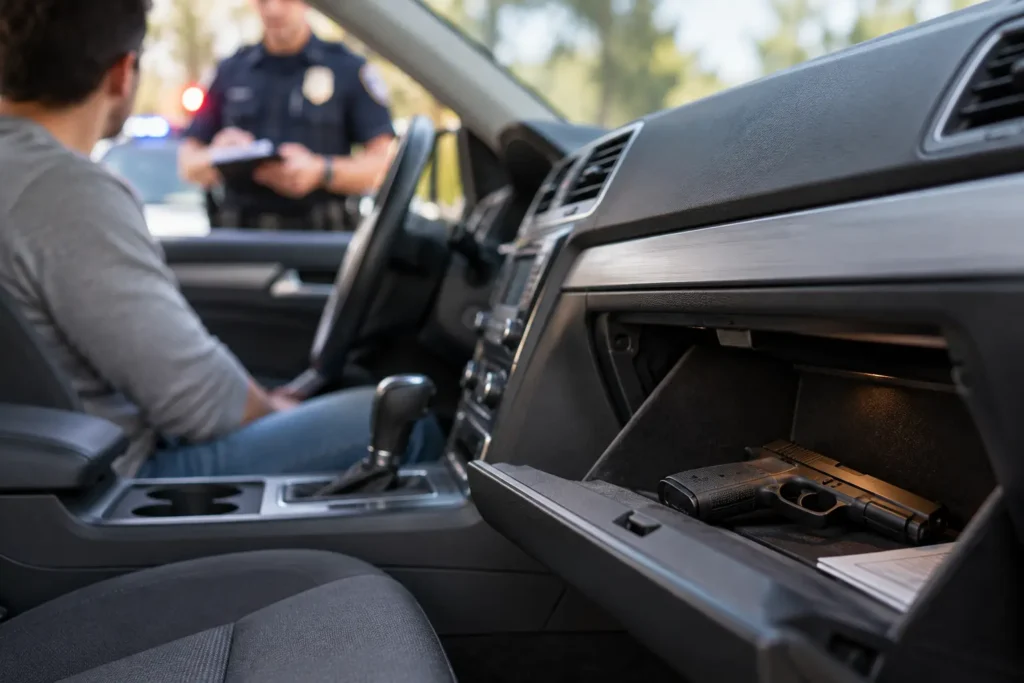
A routine traffic stop in Illinois can become a criminal investigation when police discover a weapon inside a vehicle’s glove box. Even when the weapon is not being carried directly by the driver or passenger, its location, accessibility, and ownership may raise questions about unlawful possession.
Many drivers assume that keeping a firearm inside a closed glove compartment automatically makes transportation legal. Others believe that having a Firearm Owner’s Identification (FOID) card is enough to carry a loaded handgun in a vehicle. However, Illinois law distinguishes between lawful firearm transportation and concealed carry.
A weapon discovered during a traffic stop may lead to charges depending on whether it is loaded, whether the person has a valid Concealed Carry License (CCL), and whether the State can prove that someone knowingly possessed it.
If police found a weapon in your glove box in Springfield, Sangamon County, or Central Illinois, understanding these distinctions is essential to protecting your rights.
Quick Answer
Yes, you can be charged for a weapon found in your glove box in Illinois, but criminal liability is not automatic. A valid Concealed Carry License (CCL) generally permits lawful handgun carry in a vehicle, while a FOID card alone typically permits transportation only under specific conditions. Without valid credentials or another legal exemption, firearm possession may result in aggravated unlawful possession of a weapon charges. Prosecutors must also establish knowledge and possession, including constructive possession when the weapon is not physically carried by the accused.
How Illinois Law Treats Weapons Found in a Vehicle
Illinois regulates firearm possession and transportation through several laws, including the Firearm Owners Identification Card Act, the Firearm Concealed Carry Act, and the Criminal Code.
A weapon found inside a vehicle may raise questions about:
- Whether the weapon is a handgun, rifle, shotgun, stun gun, or another regulated weapon
- Whether it was loaded or unloaded
- Whether it was enclosed in a case or container
- Whether ammunition was immediately accessible
- Whether the driver or passenger had a valid FOID card
- Whether someone possessed a valid CCL
- Whether anyone in the vehicle knew the weapon was present
- Whether the weapon belonged to the driver, passenger, or someone else
- Whether the person was legally prohibited from possessing firearms
The discovery of a firearm does not automatically establish criminal guilt. Police and prosecutors must determine whether the circumstances satisfy a specific criminal offense.
How Charges Depend on Credentials
One of the most important factors in an Illinois glove box firearm case is the person’s legal authorization to possess or carry the weapon.
A FOID card and a CCL serve different purposes.
A FOID card generally authorizes eligible Illinois residents to possess firearms and ammunition. A CCL generally authorizes eligible license holders to carry a concealed handgun in accordance with Illinois law.
The difference becomes important when a loaded firearm is discovered inside a glove compartment.
With a Valid Concealed Carry License (CCL)
A valid Illinois Concealed Carry License generally permits an eligible person to carry a loaded or unloaded concealed handgun on or about their person within a vehicle.
A CCL holder may also lawfully store a firearm in certain vehicle compartments when applicable requirements are satisfied.
However, having a CCL does not eliminate every firearms restriction.
Legal questions may arise when:
- The CCL is expired, suspended, or revoked
- The firearm is prohibited by another law
- The person is subject to a disqualifying court order
- The vehicle is located in a restricted area
- The handgun is stored in violation of applicable requirements
- The firearm is connected to another alleged criminal offense
Illinois law also includes special rules for firearm storage in vehicles parked at certain prohibited locations.
Therefore, a CCL can provide important legal protection, but it does not guarantee that every weapon found in a glove compartment is lawfully possessed.
With Only a Firearm Owner’s Identification (FOID) Card
A valid FOID card does not provide the same concealed carry privileges as a CCL.
For a person who has only a FOID card, firearm transportation must comply with applicable Illinois requirements.
Under Illinois weapon possession laws, transportation exceptions include firearms that are:
- Broken down into a nonfunctioning state
- Not immediately accessible
- Unloaded and enclosed in a case, firearm carrying box, shipping box, or another qualifying container by a person with a valid FOID card
For example, a driver with a valid FOID card may be able to transport an unloaded firearm inside a fully enclosed glove compartment when the transportation exception applies.
However, a loaded handgun that is immediately accessible may create legal problems when the person does not possess a valid CCL.
The important distinction is that a FOID card generally permits qualifying firearm transportation, not unrestricted loaded handgun carry.
The exact storage arrangement, firearm condition, and any applicable exemptions should be reviewed before determining whether a violation occurred.
Without a Valid FOID Card or CCL
A person who lacks a valid FOID card or CCL may face more serious legal risks when police discover a firearm inside a vehicle.
Potential charges depend on the person’s residency, eligibility, firearm status, and whether another statutory exemption applies.
Possible concerns include:
- Possessing a firearm without required authorization
- Carrying a loaded handgun without a valid CCL
- Possessing ammunition unlawfully
- Having a firearm while prohibited from possession
- Transporting a firearm outside a lawful exception
- Possessing a firearm during another criminal offense
Certain nonresidents may qualify for exemptions under Illinois law. Therefore, not possessing an Illinois FOID card does not automatically establish a violation in every case.
A criminal defense attorney should examine the person’s legal status and applicable exemptions before evaluating the charge.
Aggravated Unlawful Use of a Weapon (AUUW)
Aggravated Unlawful Use of a Weapon, commonly abbreviated AUUW, is terminology frequently used for Illinois weapons charges.
The relevant statute, 720 ILCS 5/24-1.6, now uses the heading Aggravated Unlawful Possession of a Weapon.
A person may be charged under this statute when they knowingly carry or possess a qualifying weapon in a vehicle or another covered location and an additional statutory factor is present.
These factors may include:
- An uncased, loaded, immediately accessible handgun without a valid CCL
- An uncased, unloaded firearm with immediately accessible ammunition under circumstances covered by the statute
- Lack of a valid FOID card when required
- Certain prior juvenile felony adjudications
- Certain drug-related offenses occurring during possession
- Certain protective order histories
- Possession during specified violent misdemeanor conduct
Not every firearm discovered in a glove box meets these requirements.
The State must prove the required elements, and a lawful transportation exception may prevent the conduct from qualifying as the offense.
Potential Penalties
Weapons charges in Illinois can carry misdemeanor or felony penalties depending on the exact statute and circumstances.
A criminal case may result in:
- Jail or prison exposure
- Criminal fines and court costs
- Probation when legally available
- Firearm seizure or forfeiture
- FOID card consequences
- CCL suspension or revocation
- Employment difficulties
- Professional licensing consequences
- Restrictions on future firearm possession
- A permanent criminal record if convicted
The seriousness of the penalty depends on the charge and any statutory sentencing enhancements.
Class 4 Felony
Aggravated unlawful possession of a weapon is generally a Class 4 felony for a first offense.
A standard Class 4 felony in Illinois generally carries:
- 1 to 3 years in prison
- Possible probation when legally available
- Fines and court costs
- Firearm-related restrictions
- A felony criminal record if convicted
Certain first-offense firearm cases carry specific sentencing provisions, and probation eligibility depends on the charge.
A second or subsequent aggravated unlawful possession conviction can be charged as a Class 2 felony.
A prior felony conviction may also increase sentencing exposure. In particularly serious circumstances, such as qualifying possession involving body armor, the offense may be classified as a Class X felony.
For that reason, the exact criminal charge and statutory subsection matter more than the general description of a weapon found in a vehicle.
Constructive Possession
Constructive possession is one of the most important legal issues when police find a firearm in a glove box.
Actual possession generally means the weapon is physically held or carried by the accused.
Constructive possession means the person may be legally considered to possess the firearm even though it was not physically on their body.
In Illinois firearm cases, constructive possession generally requires evidence of:
- Knowledge that the firearm was present
- Control over the firearm or the area where it was discovered
For example, police may find a handgun inside the glove compartment of a car driven by someone who does not own the firearm.
The driver might be charged if prosecutors believe the driver knew the gun was there and exercised the required control over it.
However, simply driving a car containing a firearm does not automatically prove constructive possession.
Important evidence may include:
- Vehicle ownership
- Access to the glove compartment
- Statements made during the stop
- Fingerprints or DNA
- Surveillance footage
- Whether the firearm was visible
- Whether the accused previously handled the weapon
- Whether another occupant claimed ownership
- Whether the accused knew the weapon was inside the compartment
The Illinois Supreme Court has recognized that proximity to a firearm alone may be insufficient to establish constructive possession.
Did Anyone in the Vehicle Know About the Weapon?
Whether anyone in the vehicle knew about the weapon is a critical question.
A passenger may know that a handgun is stored in the glove box, while the driver may have no knowledge of it.
Alternatively, a driver may know about the firearm while passengers remain unaware.
The presence of several occupants does not automatically make everyone criminally responsible.
Prosecutors may examine:
- Who owns the firearm
- Who owns the vehicle
- Who placed the firearm inside the glove box
- Who could access the compartment
- Whether anyone admitted knowing about the weapon
- Whether the weapon was visible before the compartment was opened
- Whether passengers had access to the compartment
- Whether the occupants made statements connecting themselves to the firearm
Knowledge is important, but knowledge alone is not necessarily sufficient. The State must also establish the possession elements required by the charge.
Can a Passenger Be Charged for a Gun in the Glove Box?
Yes, a passenger may face weapons charges if evidence establishes unlawful possession.
For example, a passenger may be charged if the firearm belongs to them, they placed it in the glove compartment, or other evidence establishes knowledge and control.
However, merely sitting in the front passenger seat does not automatically make someone responsible for a firearm inside the vehicle.
A defense attorney may examine whether the passenger:
- Knew about the weapon
- Had access to the glove compartment
- Exercised control over the weapon
- Owned the firearm
- Made statements about possession
- Was connected to the firearm through other evidence
Passenger cases often require careful examination of constructive possession.
What Type of Weapon Was Found?
The type of weapon can significantly affect whether charges are appropriate.
Illinois laws treat different weapons differently.
Handguns
Handguns are particularly relevant to FOID and CCL requirements.
A loaded handgun found in an accessible glove compartment may raise different legal issues depending on whether the person has a valid CCL.
Rifles and Shotguns
Long guns have transportation requirements and restrictions that differ from concealed handgun carry.
The firearm’s accessibility, loaded status, and manner of transportation may determine whether an exception applies.
Stun Guns and Tasers
Illinois weapons statutes also address stun guns and tasers.
Whether their possession or transportation is lawful depends on the applicable statutory requirements and exemptions.
Knives and Other Weapons
A knife found in a glove box does not automatically create the same legal issues as a handgun.
Knife-related charges may depend on the knife’s classification, the person’s intent, and other circumstances.
Certain prohibited weapons are regulated separately under Illinois law.
Can Police Search the Glove Box During a Traffic Stop?
Police generally need a lawful basis to search a vehicle’s glove compartment.
Possible legal grounds include:
- A valid search warrant
- Consent
- Probable cause under the automobile exception
- A lawful search incident to arrest within constitutional limits
- A valid inventory search
- Other recognized legal exceptions
A routine traffic violation does not automatically authorize officers to search every compartment.
If police discover a firearm during an unlawful search, a defense attorney may challenge the evidence through a motion to suppress.
The legality of the search can be just as important as the firearm itself.
Common Defense Options
A weapons charge involving a glove compartment may be challenged using several legal defenses.
Lack of Knowledge
The accused may not have known the firearm was inside the vehicle.
For example, someone borrowing a car may not know that its owner left a firearm in the glove box.
Lack of Constructive Possession
The State may be unable to prove that the accused exercised the required control over the firearm or the area where it was found.
This defense may be especially important when multiple people occupied the vehicle.
Lawful Firearm Transportation
A valid FOID holder may have transported an unloaded and properly enclosed firearm under an applicable statutory exception.
Valid Concealed Carry License
A person may have lawfully possessed or carried the handgun under Illinois concealed carry law.
Illegal Search or Seizure
Police may have searched the glove compartment without sufficient legal justification.
If constitutional rights were violated, the defense may seek suppression of unlawfully obtained evidence.
Mistaken Identity or Ownership
The firearm may belong to another person, although ownership alone does not determine whether someone constructively possessed it.
The defense may use records, statements, and other evidence to identify who exercised control over the firearm.
What Happens After Police Find a Weapon?
The process depends on whether police believe a violation occurred.
Possible steps include:
- Officers secure the firearm and investigate the circumstances.
- Police verify relevant FOID or CCL information.
- Officers question vehicle occupants.
- Police may arrest someone or refer the matter for charging.
- The firearm may be retained as evidence.
- The accused may appear before a judge for pretrial release proceedings.
- The case proceeds through discovery, motions, negotiations, and potentially trial.
Not every firearm discovery results in criminal charges.
If charges are filed, the State must prove the elements of the alleged offense beyond a reasonable doubt.
What Should You Do If Police Find a Gun in Your Glove Box?
During a traffic stop, it is important to avoid sudden movements or actions that could create safety concerns.
You should:
- Keep your hands visible
- Follow lawful officer instructions
- Do not reach toward the glove compartment or firearm
- Provide legally required identification and firearm credentials
- Do not make false statements
- Clearly decline consent to a search if you do not wish to consent
- Avoid making unnecessary statements about firearm ownership or possession
- Request an attorney before answering investigative questions
If you are charged, preserve relevant documentation, including firearm purchase records, FOID or CCL information, vehicle records, and any evidence concerning who had access to the glove compartment.
How a Springfield Criminal Defense Attorney Can Help
A Springfield criminal defense attorney can evaluate the circumstances surrounding the firearm’s discovery and determine whether the prosecution can prove unlawful possession.
An attorney may:
- Review the traffic stop
- Examine the legality of the glove compartment search
- Verify FOID and CCL status
- Identify applicable transportation exemptions
- Challenge constructive possession allegations
- Review body camera and dash camera footage
- Investigate ownership and access
- Examine statements from passengers
- Review fingerprint or DNA evidence
- Challenge improper felony enhancements
- File motions to suppress unlawfully obtained evidence
- Negotiate with prosecutors or prepare for trial
A local criminal defense attorney familiar with Sangamon County court procedures can also explain the criminal process and available options based on the specific allegations.
Speak With a Springfield Weapons Charge Defense Attorney
If police found a firearm or another weapon inside your glove compartment in Springfield, Sangamon County, or Central Illinois, do not assume that being the driver or passenger automatically makes you guilty.
The outcome may depend on the type of weapon, whether it was loaded, the presence of valid FOID or CCL credentials, constructive possession, and the legality of the vehicle search.
A Springfield criminal defense attorney can review the evidence, explain the charges, challenge unsupported possession allegations, and help protect your rights and future.
Frequently Asked Questions
Is it illegal to keep a gun in your glove box in Illinois?
Not automatically. Whether it is lawful depends on the firearm, how it is stored, whether it is loaded, the person’s credentials, and applicable transportation or carry rules.
Can you keep a loaded gun in your glove compartment with a FOID card?
A FOID card alone generally does not authorize unrestricted loaded handgun carry inside a vehicle. A valid CCL or another applicable legal exception may be necessary.
Can a passenger be charged for a gun in the glove box?
Yes, but the State must prove the required elements of possession. Simply being a passenger is not automatic proof of guilt.
What if the gun belongs to someone else?
Ownership and possession are different legal concepts. Someone may be accused of possessing a firearm they do not own, but prosecutors must establish the required knowledge and control.
Is aggravated unlawful possession of a weapon a felony in Illinois?
Yes. It is generally a Class 4 felony for a first offense, with higher classifications possible for certain prior convictions or aggravating circumstances.
Final Thoughts
A weapon found in a glove box during an Illinois traffic stop can lead to criminal charges, but the presence of the weapon does not automatically establish guilt.
The outcome depends on the type of weapon, whether it was loaded or unloaded, the person’s FOID or CCL credentials, and whether prosecutors can prove actual or constructive possession.
If someone else placed the firearm in the vehicle, knowledge and control become particularly important. The legality of the police search may also provide a potential defense.
If you were charged with aggravated unlawful possession of a weapon or another firearm offense in Springfield or Sangamon County, speak with a local criminal defense attorney as soon as possible.