
- Quick Answer
- What Counts as a Probation Violation in Illinois?
- What Happens at a Probation Violation Hearing?
- What Actions Can Trigger a Probation Violation in Illinois?
- Technical Violation vs. New Criminal Conduct
- What Happens If You Are Arrested While on Probation?
- What Happens After a Probation Violation Petition Is Filed?
- Probation Violation Process Timeline
- What Illinois Judges Can Do After a Probation Violation
- When Judges Continue Probation With Stricter Conditions
- When a Probation Violation Leads to Prison Time
- How Probation Violations Can Be Challenged in Illinois
- How Mitigation Can Reduce Penalties After a Probation Violation
- Intermediate Sanctions for Some Illinois Probation Violations
- How to Defend Against a Probation Violation in Illinois
- Probation Violation Hearings in Springfield and Sangamon County
- Need Help Before a Probation Violation Hearing?
- Common Questions About Illinois Probation Violations
- What proof does the State need for a probation violation in Illinois?
- Can a new arrest violate probation even if I am not convicted?
- Can a probation violation send you to prison in Illinois?
- Can a judge continue probation after a violation?
- Can probation be revoked because I could not afford to pay?
- Do I have the right to an attorney at an Illinois probation violation hearing?
- Does time already spent on probation reduce a prison sentence after revocation?
- Can missing one probation appointment cause a violation?
- Can a failed drug test lead to probation revocation in Illinois?
- Can probation conditions be made stricter instead of revoked?
Probation is not the end of a criminal case. It is a second chance with conditions attached, and when those conditions are broken, the court moves fast. A probation violation petition can be filed the same day you are arrested for a new offense, the same day a drug test comes back positive, or the same day your probation officer decides you have not been compliant. Once that petition is filed, the judge has wide authority over what happens next.
If you or someone you know is facing a violation hearing in Sangamon County or anywhere in the 7th Judicial Circuit, here is exactly what you are up against and why the time to act is now.
Quick Answer
After an alleged probation violation in Illinois, the court may issue notice, a summons, or a warrant when legally authorized. At the violation hearing, the State must prove the alleged violation by a preponderance of the evidence. If the judge finds a violation, the court may continue probation, modify or add conditions, or revoke probation and impose another sentence that was legally available for the original offense.
What Counts as a Probation Violation in Illinois?
A probation violation occurs when a person fails to comply with a condition imposed by the sentencing court.
Probation conditions may require a person to:
- Obey criminal laws
- Report as directed
- Complete treatment
- Perform community service
- Comply with drug or alcohol testing
- Follow no-contact or location restrictions
- Pay restitution or other financial obligations when legally required
- Complete other conditions specifically ordered by the court
An allegation alone does not establish a probation violation. Unless the matter is otherwise resolved, the State must prove the alleged violation at a hearing under the applicable evidentiary standard.
What Happens at a Probation Violation Hearing?
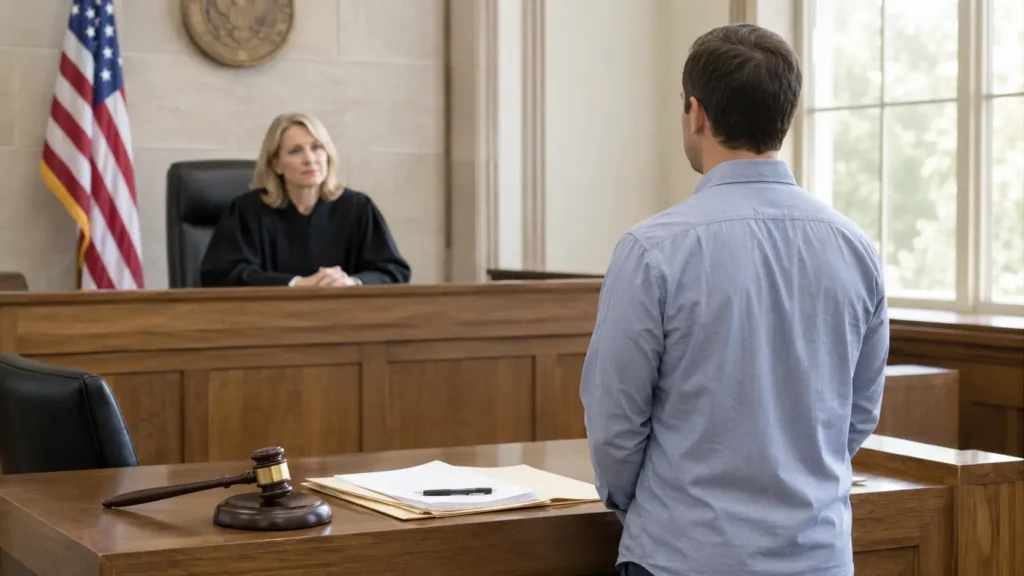
At a probation violation hearing, the judge determines whether the State proved that a probation condition was violated.
Under Section 5-6-4:
- The State has the burden of going forward with the evidence.
- The violation must be proved by a preponderance of the evidence.
- The person has the right to representation by counsel.
- Evidence is presented in open court.
- The person has rights of confrontation and cross-examination.
This is different from a criminal trial because the State does not have to prove the probation violation beyond a reasonable doubt.
The defense may challenge the allegation, cross-examine witnesses, present records or other evidence, and argue mitigation if the court finds that a violation occurred.
What Actions Can Trigger a Probation Violation in Illinois?
Probation violations generally fall into two broad categories.
Technical Violations
These involve alleged failures to comply with probation conditions without necessarily committing a new crime.
Examples can include:
- Missing a probation appointment
- Failing to complete treatment
- Missing required testing
- Violating travel restrictions
- Failing to complete community service
- Violating a no-contact condition
Alleged New Criminal Conduct
A new arrest or criminal charge can lead to a probation-violation allegation because complying with criminal laws may be a condition of probation. However, an arrest or charge is not itself the same as a judicial finding that a probation violation occurred. The State still must prove the alleged violation under the probation-hearing standard.
Technical Violation vs. New Criminal Conduct
| Type | Examples | Main Issue |
|---|---|---|
| Technical Violation | Missed reporting, treatment, testing, community service, or no-contact requirements | Whether a probation condition was actually violated |
| New Criminal Conduct | A new arrest or allegation of another offense | Whether the State can prove the alleged conduct under the probation-hearing standard |
What Happens If You Are Arrested While on Probation?
A new arrest or criminal charge can lead to a probation-violation allegation, but the State still must prove the alleged violation under the probation-hearing standard.
The probation proceeding and the new criminal case are separate.
This distinction matters because:
- The new criminal charge must be proved under the rules governing that criminal case.
- The probation violation is decided by the judge under the preponderance-of-the-evidence standard.
- The probation hearing does not necessarily have to wait for a conviction in the new criminal case.
The evidence supporting the new allegation should therefore be evaluated independently in both proceedings.
What Happens After a Probation Violation Petition Is Filed?
After a qualifying probation-violation petition is filed, the court may:
- Issue notice requiring the person to appear
- Issue a summons
- Issue an arrest warrant when the statutory requirements are met
Section 5-6-4 allows a warrant where there is danger of flight, danger of serious harm, or failure to respond to a summons or notice.
Illinois law generally provides for pretrial release while a probation-violation hearing is pending. If the alleged violation is itself a new criminal offense, pretrial release is handled under the Illinois Code of Criminal Procedure. If a person remains incarcerated solely because of the alleged probation violation, Section 5-6-4 generally requires a hearing within 14 days, subject to the statute’s exception for alleged new offenses.
If a person remains incarcerated only because of the alleged probation violation, Section 5-6-4 generally requires the hearing within 14 days of the start of that incarceration, subject to the statute’s rules for alleged new offenses. If the alleged violation also involves a new criminal charge, review how Illinois pretrial release and detention rules work.
Probation Violation Process Timeline
| Stage | What Happens |
|---|---|
| Violation reported | Probation officer or prosecutor alleges noncompliance |
| Petition filed | Court receives request to revoke or modify probation |
| Hearing scheduled | Judge reviews evidence and arguments |
| Court decision | Judge may continue probation, modify or add conditions, or revoke probation and impose another legally available sentence |
What Illinois Judges Can Do After a Probation Violation
A finding that probation was violated does not automatically require revocation. The court may continue probation, modify or add conditions, revoke probation, or impose another sentence that was legally available at the time of the original sentencing.
The outcome may depend on the original offense, sentencing range, seriousness of the violation, prior compliance, mitigating information, and any statutory sentencing limits.
When Judges Continue Probation With Stricter Conditions
A finding of a probation violation does not automatically require revocation. Illinois law allows the court to continue the existing probation sentence while modifying or adding conditions.
Depending on the case, modified conditions may involve additional reporting, treatment, testing, electronic monitoring, community service, or other requirements authorized by law.
Whether probation is continued or revoked depends on the original sentence, the proven violation, prior compliance, the available sentencing options, and the information presented to the court.
When a Probation Violation Leads to Prison Time
If probation is revoked, the judge may impose another sentence that was legally available for the original offense, including imprisonment when imprisonment was an authorized sentencing option.
The risk depends on the original offense, sentencing range, seriousness of the proven violation, prior compliance, applicable enhancements or restrictions, and any credit legally available for prior custody.
Time previously spent on probation is not automatically credited against a later prison sentence unless the court orders otherwise.
How Probation Violations Can Be Challenged in Illinois
A probation-violation allegation can be challenged when the State’s evidence does not establish that the claimed violation occurred or does not establish an element necessary for the alleged violation.
Relevant issues may include:
- Whether the condition was actually imposed
- Whether the condition was sufficiently clear
- Whether the alleged conduct occurred
- Accuracy of probation records or testing
- Mistaken reporting or identity
- Documented reasons for missed appointments or treatment
- Whether alleged new criminal conduct can be proved
- Whether nonpayment resulted from inability to pay rather than willful refusal
The defense may use records, witnesses, treatment documentation, employment information, medical evidence, testing records, communications, or other relevant evidence.
Even when a violation is proved, the defense may separately present mitigating information relevant to whether probation should be continued, modified, or revoked.
Probation may not be revoked solely because a person failed to satisfy a financial condition unless the failure resulted from a willful refusal to pay.
How Mitigation Can Reduce Penalties After a Probation Violation
Even when a violation is proved, mitigation may affect what the judge decides to do next.
Relevant information can include:
- Overall probation compliance
- Employment or school
- Treatment progress
- Testing history
- Family responsibilities
- Medical circumstances
- Transportation issues
- Corrective action
- Completion of missed requirements
Mitigating information does not erase a proven violation, but it may be relevant when the judge decides whether to continue probation, modify its conditions, or impose another authorized sentence.
Intermediate Sanctions for Some Illinois Probation Violations
Illinois law allows a supervising agency, with supervisory approval, to use a Notice of Intermediate Sanctions instead of immediately filing a violation petition in some qualifying cases.
The notice identifies the technical violation and proposed sanction.
If the person accepts and successfully completes the intermediate sanction, the court may not later revoke probation or impose additional sanctions for that same violation.
Intermediate sanctions are not available for every situation, including violations that could support an additional separate felony charge.
How to Defend Against a Probation Violation in Illinois
A probation violation does not automatically mean you will go to jail. A defense attorney can challenge the allegation, explain the circumstances, and argue for alternatives to revocation.
Possible defenses may include:
- The violation did not actually occur
- The probation officer misunderstood the situation
- The violation was caused by circumstances outside your control
- You completed other probation requirements successfully
- Revocation is not appropriate under the circumstances
Because probation violations can lead to serious penalties, having a criminal defense attorney review your case can help identify defenses and possible alternatives to revocation.
Probation Violation Hearings in Springfield and Sangamon County
If a probation violation case is being handled in Springfield or Sangamon County, review the original probation order, the alleged violation, court notices, probation records, testing or treatment documentation, and any new criminal allegations before the hearing. Early preparation can help identify factual disputes, legal issues, mitigation, and possible alternatives to revocation.
Need Help Before a Probation Violation Hearing?
A probation violation hearing may involve reporting records, testing, treatment compliance, financial obligations, alleged new criminal conduct, and your overall probation history. Reviewing the alleged violation, original probation conditions, available defenses, and mitigation before the hearing can help clarify the risks and possible outcomes.
Schedule a Confidential ConsultationCommon Questions About Illinois Probation Violations
What proof does the State need for a probation violation in Illinois?
The State must prove the alleged probation violation by a preponderance of the evidence. This is a lower standard than proof beyond a reasonable doubt used for a criminal conviction.
Can a new arrest violate probation even if I am not convicted?
A new arrest or criminal charge can lead to a probation-violation allegation, but the arrest itself does not automatically prove the violation. The State still must prove the alleged violation under the probation-hearing standard.
Can a probation violation send you to prison in Illinois?
Potentially. If probation is revoked, the court may impose another sentence that was legally available for the original offense, including imprisonment when that sentence was legally authorized.
Can a judge continue probation after a violation?
Yes. Illinois law allows the judge to continue the existing probation sentence, with or without modifying or adding conditions, rather than automatically revoking probation.
Can probation be revoked because I could not afford to pay?
Probation cannot be revoked for failure to satisfy a financial condition unless the failure resulted from a willful refusal to pay. The reason for nonpayment therefore matters.
Do I have the right to an attorney at an Illinois probation violation hearing?
Yes. Illinois law provides for representation by counsel at a probation-violation hearing, along with confrontation and cross-examination rights.
Does time already spent on probation reduce a prison sentence after revocation?
Not automatically. Illinois law provides that time spent on probation generally is not credited against a later sentence of imprisonment unless the court orders otherwise.
Can missing one probation appointment cause a violation?
It can lead to a violation allegation if reporting as directed was a condition of probation. Whether the court finds a violation may depend on the circumstances, the evidence, and any documented reason for the missed appointment.
Can a failed drug test lead to probation revocation in Illinois?
A failed drug or alcohol test may support a violation allegation when testing or substance-related conditions were part of probation. Revocation is not automatic, and the court may consider the evidence, prior compliance, treatment history, and mitigation.
Can probation conditions be made stricter instead of revoked?
Yes. Illinois law allows a judge to continue probation while modifying or adding conditions when the court determines that revocation is not required.